
What Does HL Mean in Geometry? (Hypotenuse-Leg Explained)
Quick Answer
HL stands for Hypotenuse-Leg, a theorem that proves two right triangles are congruent if their hypotenuses are congruent AND one pair of corresponding legs are congruent. It’s the only congruence shortcut that works with just two sides — but it only applies to right triangles.
The HL theorem is one of five ways to prove triangle congruence in geometry. But what makes HL special? And why does it only work for right triangles? This guide breaks it all down with diagrams, examples, and comparisons to other congruence theorems.
📑 Table of Contents
What Is the HL Theorem?
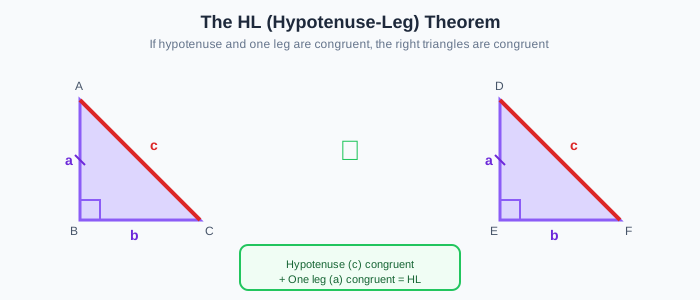
The HL Theorem (Hypotenuse-Leg) is a rule that allows us to prove two right triangles are congruent using just two pieces of information:
- Their hypotenuses are congruent
- One corresponding leg is congruent
If both conditions are true, then the triangles are congruent. This is one of the few congruence shortcuts that works with only two pairs of parts — but the key is that it only applies to right triangles.
Want to see all five congruence theorems? Check out our Triangle Congruence Theorems guide.
Key Terms: Hypotenuse, Leg, and Right Triangle
| Term | Definition |
|---|---|
| Hypotenuse | The longest side of a right triangle, opposite the right angle |
| Leg | One of the two sides that form the right angle |
| Right Triangle | A triangle that contains exactly one 90-degree angle |
When proving triangles congruent using HL, you’re specifically matching the hypotenuse and one leg. You don’t need to match the right angle — it’s already guaranteed to be 90° in both triangles.
HL vs Other Triangle Congruence Theorems
Here’s how HL compares to the other major triangle congruence rules:

| Theorem | What It Requires | Right Triangles Only? |
|---|---|---|
| SSS | All 3 sides congruent | No |
| SAS | 2 sides + included angle | No |
| ASA | 2 angles + included side | No |
| AAS | 2 angles + non-included side | No |
| HL | Hypotenuse + one leg | YES — Right triangles only |
For more on all congruence methods, visit our Core Geometry Concepts Guide.
Step-by-Step HL Proof Example
Here’s a sample geometry proof using the HL Theorem:
Given:
△ABC and △DEF are right triangles
AB ≅ DE (hypotenuse)
AC ≅ DF (leg)
Prove: △ABC ≅ △DEF
Proof:
1. AB ≅ DE (Given)
2. AC ≅ DF (Given)
3. ∠C and ∠F are right angles (Given)
4. △ABC and △DEF are right triangles (Definition of right triangle)
5. △ABC ≅ △DEF by HL ✓
Need help writing your own proofs? Check out our Geometry homework help service.
Why HL Only Works for Right Triangles
Right triangles give you a “free” angle — the 90° angle — which makes it easier to prove congruence. This is why HL is sometimes described as a special case of SAS:
- You already know one angle is 90° in both triangles
- The hypotenuse and one leg determine the third side (via the Pythagorean theorem)
- So matching just two sides is enough to guarantee congruence
For non-right triangles, two sides alone don’t guarantee congruence — that’s why SSA (Side-Side-Angle) fails in general.
HL vs SSA: What’s the Difference?
Students often confuse HL with SSA (Side-Side-Angle), but they’re not the same:
| HL (Valid) | SSA (Not Valid) |
|---|---|
| Only for right triangles | For any triangle (but unreliable) |
| Always guarantees congruence | Can produce 0, 1, or 2 triangles (ambiguous) |
| The 90° angle is already known | The angle could be in different positions |
Remember: SSA is often called the “Ambiguous Case” because it doesn’t reliably prove congruence. HL works because the right angle removes the ambiguity.
Common Student Mistakes with HL
| Mistake | Why It’s Wrong |
|---|---|
| Using HL on non-right triangles | HL requires a 90° angle — no right angle, no hypotenuse |
| Confusing leg with hypotenuse | Hypotenuse is always opposite the right angle; legs form the right angle |
| Using HL when no right angle is given | Must explicitly know or prove a 90° angle exists first |
| Assuming SSA is the same as HL | SSA is ambiguous; HL only works because the angle is fixed at 90° |
Many students lose points by assuming HL works like SSS or SAS. Always verify it’s a right triangle before using HL.
Frequently Asked Questions
What does HL stand for in Geometry?
HL stands for Hypotenuse-Leg. It’s a congruence theorem used for right triangles, where if two triangles share a congruent hypotenuse and one matching leg, the triangles are congruent.
Can I use HL on an obtuse triangle?
No. HL only works on right triangles. Without a 90-degree angle, the hypotenuse doesn’t exist — the hypotenuse is specifically defined as the side opposite the right angle.
Is HL the same as SSA?
No. SSA (Side-Side-Angle) is ambiguous and doesn’t always guarantee triangle congruence — it can produce 0, 1, or 2 valid triangles. HL is reliable but only works for right triangles because the 90° angle eliminates the ambiguity.
Where does HL appear in school?
HL is taught in most U.S. high school Geometry classes (typically 9th-10th grade) and shows up on standardized tests, geometry worksheets, homework packets, and state exams.
Can I get someone to do my HL proofs for me?
Yes! Visit Do My Geometry Homework and our experts will handle your HL proofs, triangle congruence problems, or any geometry assignment. We guarantee A/B grades on all work.
Need Help with Geometry?
HL proofs, triangle congruence, and more — we handle it all.