

Quick Answer: What Comes After Calculus I?
After Calculus I, most students take Calculus II (Integral Calculus). However, your specific next course depends on your major:
- Engineering/Physics: Calculus II → Calculus III → Differential Equations → Linear Algebra
- Computer Science: Calculus II → Discrete Mathematics → Linear Algebra
- Mathematics: Calculus II → Calculus III → Linear Algebra → Real Analysis → Abstract Algebra
- Economics/Business: Calculus II → Statistics → Econometrics
Need help with advanced calculus? Get expert support for Calculus II and III or Differential Equations.
What Math Class Comes After Calculus? Complete Course Pathway Guide
Understanding your post-calculus math options for different majors, career paths, and academic goals.
You’ve completed Calculus I. Your next course depends entirely on your major, career goals, and institution’s requirements. Mathematics branches in multiple directions after single-variable calculus, and choosing the right path requires understanding how different courses connect to your academic and professional objectives.
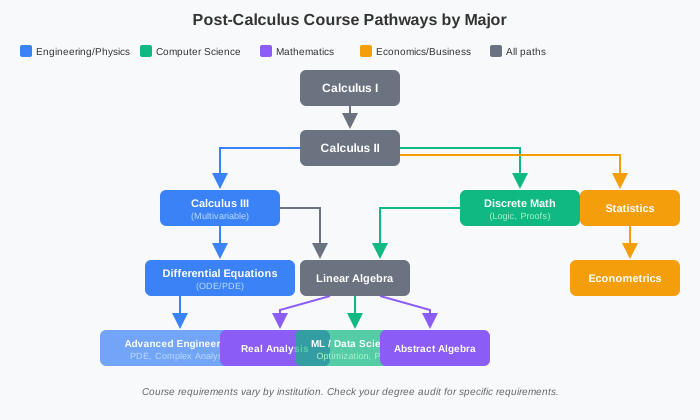
Post-Calculus Pathways by Major
Your major determines your mathematics sequence more than any other factor. Here are the typical pathways:
🔧 Engineering (All Disciplines)
Calc I → Calc II → Calc III → Diff Eq → Linear Algebra
Some specializations add: Complex Variables, PDE, Numerical Methods
💻 Computer Science
Calc I → Calc II → Discrete Math → Linear Algebra
ML/Data Science tracks add: Calc III, Probability, Optimization
🔢 Mathematics Major
Calc I → Calc II → Calc III → Linear Alg → Real Analysis → Abstract Algebra
Longest sequence with transition to proof-based courses
📊 Economics / Business
Calc I → Calc II (or Business Calc) → Statistics → Econometrics
PhD track adds: Calc III, Linear Algebra, Real Analysis
⚛️ Physics
Calc I → Calc II → Calc III → Diff Eq → Linear Alg → Math Methods
Upper-division physics heavily uses multivariable calc and DEs
🧪 Chemistry (BS)
Calc I → Calc II → Sometimes Calc III for Physical Chemistry
Biochemistry tracks often have lighter math requirements
Core Post-Calculus Courses Explained
Understanding what each course covers helps you plan your sequence and prepare for what’s ahead.
| Course | Key Topics | Who Needs It |
|---|---|---|
| Calculus II | Integration techniques, sequences, series, Taylor series | Nearly all STEM majors, economics |
| Calculus III | Vectors, partial derivatives, multiple integrals, vector calculus | Engineering, physics, math majors |
| Differential Equations | First/second-order DEs, systems, Laplace transforms | All engineering, physics, some CS |
| Linear Algebra | Matrices, vector spaces, eigenvalues, linear transformations | Math, CS, engineering, data science |
| Discrete Mathematics | Logic, proofs, combinatorics, graph theory | Computer science, math majors |
| Real Analysis | Rigorous limits, continuity, epsilon-delta proofs | Math majors (required) |
Course Resources
If you need additional help understanding these courses, these free resources are excellent:
- Khan Academy’s Integral Calculus — Video lessons for Calculus II
- MIT OpenCourseWare Multivariable Calculus — Complete Calc III course
- Paul’s Online Math Notes — Clear explanations for Differential Equations
Difficulty Levels and What to Expect
Understanding relative difficulty helps you plan course loads and timing for success.
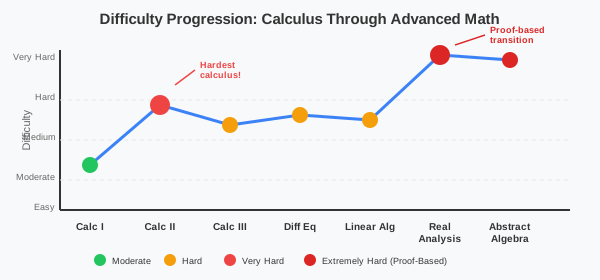
Why Calculus II Feels So Hard
Calculus II consistently ranks as the hardest calculus course for several reasons:
10+ integration methods requiring pattern recognition
Convergence tests involve subtle logic and multiple conditions
Wrong technique early = completely wrong answer
Infinite series and convergence are conceptually difficult
The Proof-Based Transition
Real Analysis, Abstract Algebra, and abstract Linear Algebra represent a fundamental shift from computational to proof-based mathematics. Students encounter:
- Proof-writing requirements: Correct answers aren’t enough—rigorous logical arguments required
- Abstract thinking: Working with general structures rather than specific numbers
- Minimal computation: Calculations become rare; conceptual understanding dominates
Course Load Warning: Don’t underestimate advanced mathematics when planning semester loads. Calculus II or Differential Equations paired with multiple other demanding courses often produces overwhelming workloads. Consider reducing total courses when tackling particularly challenging mathematics.
Course Sequencing Strategies
When you take courses matters as much as which courses you take.
Standard Progression
- Freshman year: Calculus I (fall), Calculus II (spring)
- Sophomore year: Calculus III (fall), Differential Equations (spring)
- Sophomore/Junior: Linear Algebra (timing varies by program)
When to Take Linear Algebra
Take it early if you’re in computer science, data science, or need it for graphics/ML courses. Take it later if you’re following a traditional mathematics major sequence. Check your program’s recommended order.
Summer Course Considerations
Advantages: Sole focus, faster completion, may free up academic year. Disadvantages: Compressed timeline (6-8 weeks) makes difficult courses even harder, limited support resources.
Summer Calc II is risky. It’s already the hardest calculus course—compressing it into 6 weeks with 20-30 hours weekly makes it brutal. Only attempt if you aced Calculus I and can make it your sole summer focus.
Career Connections
Understanding how post-calculus mathematics connects to careers helps motivate the coursework.
Engineering: Differential equations model mechanical systems, circuits, heat transfer, and fluid dynamics. Linear algebra powers structural analysis and optimization.
Data Science/Machine Learning: Linear algebra is absolutely fundamental—neural networks, PCA, and most ML algorithms rely on matrix operations. Multivariable calculus enables understanding of gradient descent.
Computer Graphics: Linear algebra handles transforms, rotations, projections. Multivariable calculus powers physics engines and lighting models.
Economics/Finance: Multivariable calculus optimizes utility and cost functions. Differential equations model option pricing (Black-Scholes) and dynamic economic systems.
For comprehensive career information, see the American Mathematical Society’s Career Resources and Bureau of Labor Statistics Occupational Outlook.
When You’re Struggling with Advanced Math
Advanced mathematics courses present significant challenges even for strong students. Recognizing when you need help determines whether difficulties become temporary setbacks or permanent roadblocks.
Use Campus Resources First
- Professor office hours: Attend regularly with specific questions
- Math tutoring centers: Free support often available daily
- Supplemental Instruction: Study sessions led by successful former students
- Study groups: Collaborative learning with serious classmates
When to Consider Withdrawing
Consider withdrawal if: you’re failing after midterm despite maximum effort, life circumstances prevent adequate study time, prerequisite gaps are too severe to overcome mid-semester, or course failure would endanger financial aid.
Professional Assistance
If you’ve exhausted institutional resources and genuine life circumstances prevent independent success, professional assistance becomes a practical consideration. At Finish My Math Class, we work with students facing real barriers: severe time constraints from work or family, major prerequisite gaps, previous course failures despite sincere effort, or circumstances preventing adequate study time.
We provide support for calculus coursework including Calculus II and III, and differential equations. If advanced mathematics is threatening your graduation timeline or GPA, discussing your situation might be worthwhile.
Frequently Asked Questions
What math class comes directly after Calculus I?
Is Calculus II harder than Calculus I?
Do I need Calculus III for engineering?
What is the difference between Calculus III and Differential Equations?
Can I take Linear Algebra before Calculus III?
What math do computer science majors need after Calculus?
Is Real Analysis required for a math major?
Should I take Calculus II in summer?
Planning Your Mathematics Pathway
Mathematics after Calculus I branches in numerous directions based on major requirements, career goals, and academic interests. Most STEM students continue through Calculus II, Calculus III, and Differential Equations, with Linear Algebra added at varying points. Mathematics majors face the longest sequences, adding proof-based courses like Real Analysis and Abstract Algebra. Computer science emphasizes discrete structures alongside traditional calculus.
Success requires not just understanding content but strategic planning: taking courses in appropriate sequence, managing course loads, using support resources effectively, and recognizing when difficulties signal need for additional help.
Need Help With Advanced Calculus?
If you’re struggling with Calculus II, III, Differential Equations, or Linear Algebra, we can help. Our experts provide support across all platforms and course formats.
- Complete course support for Calculus II, III, Differential Equations
- All platforms: MyMathLab, WebAssign, ALEKS, WileyPLUS
- A/B grade guarantee or full refund