
Home ›
Statistics Help ›
Standard Deviation
Standard Deviation Explained: Formula, Variance & How to Calculate
Quick Answer
Standard deviation measures how spread out data is from the mean. It tells you the “typical” distance of data points from the average. Small standard deviation = data clustered tightly around the mean. Large standard deviation = data scattered widely. The formula is σ = √[Σ(x − μ)² / N] for populations and s = √[Σ(x − x̄)² / (n−1)] for samples.
In This Guide
Standard deviation is one of the most important—and most misunderstood—concepts in statistics. Many students can calculate it mechanically without understanding what the number actually means. This guide fixes that.
What Standard Deviation Measures
Standard deviation answers one question: How far, on average, are data points from the mean?
Think of it as the “typical” distance from the center. If a class has a mean test score of 75 with a standard deviation of 10, most students scored within about 10 points of 75—somewhere between 65 and 85.

Standard deviation measures how spread out data is from the center
Key insight: Standard deviation is always in the same units as your data. If you’re measuring heights in inches, standard deviation is in inches. If you’re measuring test scores in points, standard deviation is in points.
Visualizing Different Spreads
The best way to understand standard deviation is to see how it affects distributions. Same mean, different spreads:
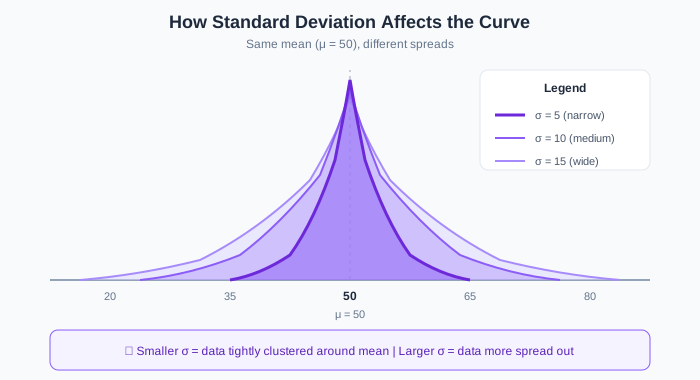
Smaller σ = taller, narrower curve. Larger σ = shorter, wider curve.
The Formulas
There are two versions—one for populations, one for samples:
Population Standard Deviation
σ = √[Σ(x − μ)² / N]
Divide by N (total population size)
Sample Standard Deviation
s = √[Σ(x − x̄)² / (n−1)]
Divide by (n−1) for samples
The logic of the formula:
- Find the mean — the center of your data
- Find each deviation — subtract mean from each value (x − μ)
- Square each deviation — to make them all positive
- Average the squared deviations — this gives you variance
- Take the square root — to get back to original units
Step-by-Step Calculation
Let’s calculate standard deviation for a small dataset:
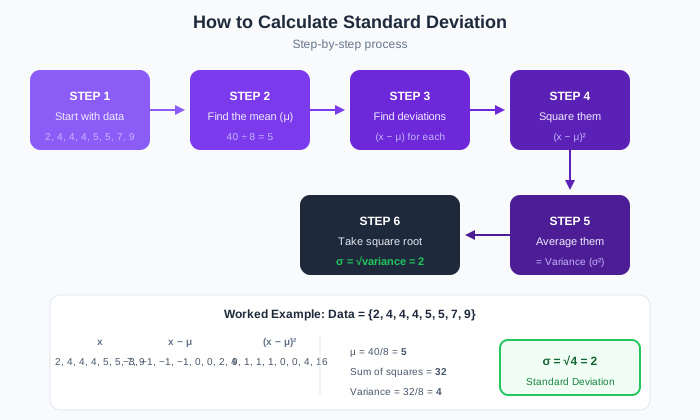
Each step builds on the previous one
📝 Complete Worked Example (Sample)
Data: 4, 8, 6, 5, 7 (n = 5)
Step 1: Find the mean (x̄)
x̄ = (4 + 8 + 6 + 5 + 7) / 5 = 30 / 5 = 6
Step 2: Find each deviation (x − x̄)
4 − 6 = −2, 8 − 6 = +2, 6 − 6 = 0, 5 − 6 = −1, 7 − 6 = +1
Step 3: Square each deviation
(−2)² = 4, (+2)² = 4, (0)² = 0, (−1)² = 1, (+1)² = 1
Step 4: Sum the squared deviations
4 + 4 + 0 + 1 + 1 = 10
Step 5: Divide by (n − 1) — this is variance
s² = 10 / (5 − 1) = 10 / 4 = 2.5
Step 6: Take the square root
s = √2.5 = 1.58
Interpretation: The data points are, on average, about 1.58 units away from the mean of 6.
Population vs. Sample Standard Deviation
This distinction trips up many students:
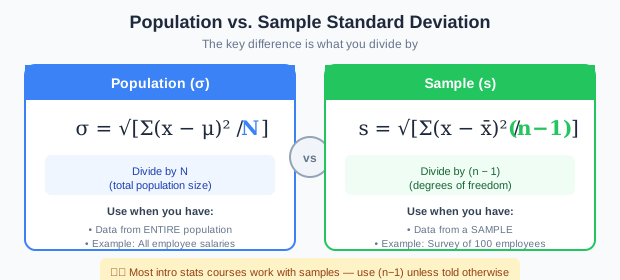
The denominator is the key difference
| Population (σ) | Sample (s) | |
|---|---|---|
| When to use | Data from entire population | Data from a sample |
| Symbol | σ (lowercase sigma) | s |
| Mean symbol | μ (mu) | x̄ (x-bar) |
| Divide by | N (population size) | n − 1 (degrees of freedom) |
| Example | All employees’ salaries | Survey of 100 employees |
Why Divide by (n − 1) for Samples?
This is called Bessel’s correction. When you calculate standard deviation from a sample, using n in the denominator tends to underestimate the true population standard deviation. Dividing by (n − 1) corrects this bias. In most intro stats courses, you’ll work with samples, so you’ll typically use (n − 1).
Variance vs. Standard Deviation
Variance and standard deviation measure the same thing—spread—but in different units:
| Variance (σ² or s²) | Standard Deviation (σ or s) | |
|---|---|---|
| What it is | Average of squared deviations | Square root of variance |
| Units | Squared units (points², inches²) | Original units (points, inches) |
| Interpretation | Hard to interpret directly | Easy—”typical distance from mean” |
| Relationship | σ² = variance | σ = √variance |
Example: If test scores have σ = 10 points, then variance = 100 points². The standard deviation (10 points) is easier to interpret—you can say “most students scored within about 10 points of the mean.”
💡 Why Do We Square the Deviations?
Two reasons: (1) To make all values positive—otherwise positive and negative deviations would cancel out to zero. (2) To give more weight to larger deviations—squaring ensures that points far from the mean have outsized impact on the result.
The 68-95-99.7 Rule
For normal distributions, standard deviation has a precise meaning:
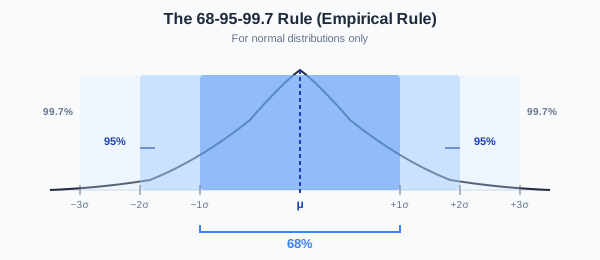
The empirical rule only applies to bell-shaped distributions
- 68% of data falls within 1 standard deviation of the mean
- 95% of data falls within 2 standard deviations of the mean
- 99.7% of data falls within 3 standard deviations of the mean
📝 Example: Applying the Rule
Adult heights are normally distributed with μ = 68 inches and σ = 3 inches.
- 68% of adults are between 65–71 inches (68 ± 3)
- 95% of adults are between 62–74 inches (68 ± 6)
- 99.7% of adults are between 59–77 inches (68 ± 9)
Important: This rule only applies to normal (bell-shaped) distributions. For skewed data, these percentages don’t hold. Learn more in our z-scores guide and normal distribution guide.
Interpreting Standard Deviation
A number by itself means nothing—context matters. Here are ways to interpret standard deviation:
Compare to the Mean (Coefficient of Variation)
To judge whether a standard deviation is “large” or “small,” compare it to the mean:
CV = (σ / μ) × 100%
Coefficient of Variation
- CV < 15% — Low variability (data is consistent)
- CV 15–30% — Moderate variability
- CV > 30% — High variability (data is scattered)
Context-Specific Standards
| Field | What “Good” σ Looks Like |
|---|---|
| Test scores | σ = 10–15 is typical |
| Manufacturing | Smaller is better (tighter tolerances) |
| Stock returns | Higher σ = more risk/volatility |
| Scientific measurements | Lower σ = more precise instrument |
Common Student Mistakes
❌ Mistake #1: Using N instead of (n−1) for samples
Most intro stats problems involve samples, which require dividing by (n−1). Using N gives a slightly smaller (biased) result. Always check whether your data is a population or sample.
❌ Mistake #2: Forgetting to take the square root
If you stop after averaging the squared deviations, you have variance—not standard deviation. Don’t forget the final step: σ = √variance.
❌ Mistake #3: Confusing σ (population) with s (sample)
These symbols aren’t interchangeable. σ uses N in the denominator; s uses (n−1). Using the wrong one affects your answer and can cost points on exams.
❌ Mistake #4: Calculator gives unexpected answer
Most calculators report both σ (labeled σx or σn) and s (labeled sx or σn-1). Make sure you’re reading the correct value. TI-84 labels them Sx (sample) and σx (population).
❌ Mistake #5: Thinking larger σ is always “bad”
Context matters. Stock portfolios with higher standard deviation aren’t necessarily worse—they just have more volatility. Some data is naturally more variable than others.
Platform-Specific Tips
ALEKS
ALEKS often asks for both variance and standard deviation separately. Watch rounding—typically wants 2–4 decimal places. ALEKS explicitly states “population” or “sample,” so read carefully.
MyStatLab (Pearson)
StatCrunch calculates automatically via Stat → Summary Stats → Columns. MyStatLab is strict about which version (σ vs s) you report. Double-check the question wording.
WebAssign
May require showing intermediate steps (variance before standard deviation). Match their decimal precision exactly—WebAssign is picky about rounding.
TI-83/84 Calculator
Enter data into a list (STAT → Edit), then:
- STAT → CALC → 1-Var Stats
- Sx = sample standard deviation (use this most often)
- σx = population standard deviation
Need help with these platforms? Our tutors work with ALEKS statistics, MyStatLab, and WebAssign daily.
Quick Reference Summary
📐 Formulas
Population:
σ = √[Σ(x − μ)² / N]
Sample:
s = √[Σ(x − x̄)² / (n−1)]
📊 68-95-99.7 Rule
- 68% within ±1σ
- 95% within ±2σ
- 99.7% within ±3σ
(Normal distributions only)
🖩 TI-84
STAT → CALC → 1-Var Stats | Sx = sample | σx = population
⚠️ Remember: Samples use (n−1) • σ = √variance • Same units as data • Can never be negative
Frequently Asked Questions
What does standard deviation tell you?
Standard deviation tells you how spread out data is from the mean. A small standard deviation means data points cluster tightly around the mean. A large standard deviation means data points are scattered far from the mean. It’s essentially the “typical” distance of data points from the average.
What is a “good” standard deviation?
There’s no universal “good” or “bad” standard deviation—it depends on context. For test scores, σ = 10–15 is typical. Compare standard deviation to the mean using the coefficient of variation (CV = σ/μ) to judge relative variability.
What’s the difference between σ and s?
σ (sigma) is the population standard deviation—used when you have data for an entire population. s is the sample standard deviation—used when you have data from a sample. The key difference: sample standard deviation divides by (n−1) instead of N to correct for bias when estimating population parameters.
What’s the difference between variance and standard deviation?
Variance is the average of squared deviations from the mean. Standard deviation is the square root of variance. They measure the same thing (spread), but standard deviation is in the original units of your data, making it easier to interpret. If σ = 10 points, then variance = 100 points².
Why do we square the deviations?
We square deviations for two reasons: (1) to make all values positive—otherwise positive and negative deviations would cancel out to zero, and (2) to give more weight to larger deviations. Squaring ensures that points far from the mean have outsized impact on the final result.
Can standard deviation be negative?
No, standard deviation can never be negative. Since we square all deviations before averaging, the variance is always positive or zero. The square root of a positive number is also positive. Standard deviation equals zero only when all data points are identical (no spread at all).
How is standard deviation related to the normal distribution?
For normal distributions, the 68-95-99.7 rule states that 68% of data falls within 1σ of the mean, 95% within 2σ, and 99.7% within 3σ. This relationship only holds for bell-shaped distributions.
Can you help with my standard deviation homework?
Absolutely. Standard deviation appears in nearly every statistics course—from descriptive stats to hypothesis testing. Our tutors help with calculations, interpretation, and platform-specific questions. Get a free quote to get started.
Related Resources
Statistics Foundations
- Descriptive Statistics Explained
- Normal Distribution Explained
- Z-Scores Explained
- Central Limit Theorem Explained
Statistics Help
Need Help With Standard Deviation?
Our tutors help you understand variance, standard deviation, and all descriptive statistics concepts.