

Is Business Statistics Hard? Why Students Struggle (and How to Pass)
Quick Answer
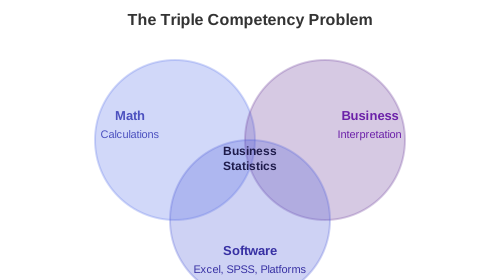
Yes, Business Statistics is hard for most students—but not because of the mathematics itself. The difficulty comes from combining calculations with business interpretation, writing polished explanations in professional language, mastering statistical software (Excel, SPSS), and navigating strict auto-graded platforms like ALEKS, MyStatLab, and WebAssign. Students who excelled in previous math courses often struggle because Business Statistics demands simultaneous competence in statistics, business reasoning, technical writing, and software proficiency—a combination that catches most learners off guard.
Table of Contents
If you’re searching “Is Business Statistics hard?” at 2 AM the night before an exam, you’re experiencing what thousands of business students face every semester. Business Statistics consistently ranks among the most feared required courses in undergraduate business programs, MBA curricula, and professional graduate degrees.
The course’s reputation for difficulty isn’t unfounded. Unlike traditional mathematics courses where mastering formulas leads to success, Business Statistics demands a unique combination of skills that catches most students off guard. This guide breaks down exactly why the course is challenging, who struggles most, and what actually works for passing.
What Is Business Statistics?
Business Statistics is an applied statistics course focused on using statistical methods to analyze business data, make data-driven decisions, and communicate findings in professional contexts. Unlike theoretical statistics in math departments, Business Statistics emphasizes practical application: you’re not just calculating a mean, you’re analyzing average customer spending and recommending pricing strategies.
According to the American Statistical Association, the course develops competencies in descriptive statistics, probability, hypothesis testing, confidence intervals, regression analysis, and data communication—all filtered through business applications. What makes it different from pure math courses is the expectation that correct calculations aren’t enough. You must explain findings in professional language suitable for business reports.
Why Business Statistics Is So Hard
The difficulty stems from multiple compounding factors rather than a single obstacle. Understanding these helps explain why even mathematically capable students struggle.
Triple Competency Requirement
Most courses require competence in one or two areas. Business Statistics demands mathematical proficiency, business reasoning, AND professional communication simultaneously—creating cognitive overload.
Interpretation Subjectivity
Unlike math where 2+2=4, statistics interpretations involve judgment. Is a correlation of 0.65 “strong” or “moderate”? You can solve problems correctly but lose points because your interpretation wasn’t “detailed enough.”
Platform Formatting Traps
Auto-graded platforms have zero tolerance. Type “0.05” instead of “0.050” when three decimals are required? Marked wrong. Use “<” instead of “≤”? Wrong. No partial credit for understanding the concept.
Compressed Timelines
Content that should fill a semester gets compressed into 8-week or 6-week terms, especially in MBA programs. No time for concepts to sink in before the next exam arrives.
Inadequate Prerequisites
Schools require only College Algebra, but the course assumes familiarity with functions, summation notation, and logical reasoning. Students who passed prerequisites years ago lack foundational skills.
High-Stakes Positioning
For many students, it’s a required course blocking graduation, a GPA threat taken late in programs, and a prerequisite for major courses. The pressure of “I MUST pass” impairs learning.
Who Struggles Most
Business Statistics challenges students across demographics, but certain groups face disproportionate difficulties due to how the course is structured.
MBA & Graduate Students
Compressed 6-8 week terms, juggling careers and family, often 5-10+ years since last math course. The time crunch—not ability—creates failure conditions.
Adult Learners
15-20 year gaps since math coursework, unfamiliar technology platforms, accumulated math anxiety. Doubt about capabilities becomes self-fulfilling.
Traditional Undergrads
Limited business experience makes interpretation requirements abstract. Questions like “should the company launch this product based on your regression?” feel impossible without professional context.
Non-Business Majors
Healthcare, nursing, public policy students required to take business-focused stats. Career goals don’t involve data analysis, making the course feel irrelevant.
Core Topics: What You’ll Actually Face
Five core topics consistently cause the most difficulty. Here’s what they look like in practice—notice how every problem requires both correct math AND business interpretation.
Hypothesis Testing Example
Problem: A business claims its average customer satisfaction score is 7.5/10. You survey 50 customers and find a mean of 7.1 with standard deviation 1.2. Test whether satisfaction has declined (α = 0.05).
Why students struggle: Getting steps 1-4 right isn’t enough. Professors demand step 5, and students lose points for explanations that don’t connect findings to business actions.
Confidence Interval Example
Problem: A company samples 36 transactions and finds mean purchase of $45 with standard deviation $12. Construct a 95% confidence interval.
Calculation: SE = 12/√36 = 2 | t-critical (df=35) ≈ 2.030 | ME = 2.030 × 2 = 4.06
Result: 95% CI = ($40.94, $49.06)
Correct interpretation: “We are 95% confident the true mean purchase amount falls between $40.94 and $49.06.”
The Platform Problem
Most Business Statistics courses deliver content through auto-graded platforms with strict formatting requirements. According to EDUCAUSE research, students report spending as much time fighting with software as learning statistics.
| Platform | Common Frustration | Survival Tip |
|---|---|---|
| ALEKS | Knowledge checks “un-master” topics you forgot | Review mastered topics weekly |
| MyStatLab | Typed 0.05 instead of .05? Marked wrong. | Use the equation editor, not keyboard |
| WebAssign | Excel graded on formatting, not just answers | Match example formatting exactly |
| MyOpenMath | Zero partial credit on any problem | Work on paper first, double-check entries |
How to Actually Pass
Generic study methods fail because they don’t address the simultaneous requirements for mathematical accuracy, business interpretation, and software proficiency. These strategies actually work:
Master Interpretation Templates
Create fill-in-the-blank templates for hypothesis tests, confidence intervals, and regression. Practice until they’re automatic—this prevents losing interpretation points.
Interpret Before Calculating
Read the entire problem first. Identify what’s being asked, predict what results would mean, THEN calculate. This prevents solving the wrong problem correctly.
Keep an Error Log
Don’t just review wrong answers—track the specific error type, why you made it, and how to avoid it. Review the log before exams to target your weaknesses.
Front-Load Office Hours
Don’t wait until you’re failing. Visit Weeks 1-2 to clarify expectations, after first assignment to understand what the professor values, and before exams with practice problems.
Frequently Asked Questions
Is Business Statistics harder than Calculus?
Business Statistics and Calculus are differently hard. Calculus involves more complex mathematics but is predictable—learn the rules, apply them consistently. Business Statistics combines moderate math with interpretation demands, business context requirements, and software proficiency. Many students who excelled in Calculus struggle with Business Statistics because success depends on communication skills and contextual reasoning, not just mathematical ability.
Do I need to know Excel for Business Statistics?
Almost certainly yes. Most courses require Excel proficiency for charts, descriptive statistics, regression, and hypothesis tests. The Data Analysis ToolPak is particularly important—enable it and practice before the course starts. Some courses also require SPSS, JASP, or StatCrunch. Basic spreadsheet skills aren’t enough; you need statistical analysis functions specifically.
Why do so many students fail Business Statistics?
High failure rates (30-40% DFW nationally) result from compounding factors: simultaneous demands for calculations plus interpretation, strict auto-graded platforms with no partial credit, students underestimating workload, compressed timelines in MBA programs, and vague rubrics. Students aren’t failing because they’re incapable—the course design creates conditions for struggle.
Can I pass if I’m bad at math?
Yes, with strategic effort. Business Statistics math is mostly algebra-level—means, standard deviations, formulas—not calculus. The difficulty comes from interpretation and application. Students who struggle with math but excel at writing and reasoning can succeed by using software to handle calculations, mastering interpretation templates, and seeking help early.
Why are p-values so confusing?
P-values are inherently counterintuitive. They answer “If the null hypothesis were true, how likely is data this extreme?”—conditional probability most people find unnatural. Students think p-values mean “probability the hypothesis is true,” but that’s wrong. The confusion stems from pressure to apply rules before understanding the logic.
How much time should I spend weekly?
Traditional 16-week semesters: 12-15 hours minimum. Accelerated 8-week terms: 20-25 hours. Compressed 6-week summer: 25-30 hours. This exceeds the standard “3 hours per credit” rule because assignments take longer due to software, interpretation writing, and multi-step problems. Underestimating time means falling behind by Week 3-4.
Should I take it in summer session?
Only if you have no other obligations, strong prerequisites, and can dedicate 25-30 hours weekly. Summer sessions fail catastrophically for students working full-time or taking other courses. One week behind in summer equals two weeks behind in a regular semester—recovery becomes nearly impossible.
What happens if I fail?
You’ll need to retake before progressing to dependent courses. Consequences include delayed graduation, GPA damage, additional tuition, and possible academic probation. Before failing, consider strategic withdrawal by drop deadline (W on transcript, no GPA impact) or intensive tutoring. Many students succeed on second attempt with better preparation.
Conclusion: Hard But Manageable
Is Business Statistics hard? Yes—for most students. The difficulty stems not from impossible mathematics but from the course’s unique demand for simultaneous competence in calculation, business interpretation, professional communication, and software proficiency.
The key insights: difficulty is structural (course design creates struggle conditions, not student inadequacy), the triple competency requirement creates overload, software and platforms amplify challenges, time investment is non-negotiable, and help-seeking timing is critical—students who get support in Weeks 1-3 succeed far more often than those who wait until failing.
For students who’ve exhausted traditional support options—office hours, tutoring, study groups—and still struggle due to circumstances beyond their control, professional academic assistance provides an option. Comprehensive statistics support offers help with homework, projects, and exams when you need guaranteed results rather than continued struggle.
Business Statistics represents one challenging semester in your academic journey. The course won’t feel relevant until you’re in professional contexts using regression to forecast sales or hypothesis tests to evaluate campaigns. But those applications eventually materialize, making the struggle worthwhile.