
Knewton Alta Statistics Answers– Help That Actually Works
Let our experts complete your modules, quizzes, or full course—accurately, privately, and with a guaranteed A or B
← Back to Knewton Alta Answers
Quick Answer
Knewton Alta Statistics is notoriously difficult because it tests conceptual understanding, not just calculations. Hypothesis testing interpretation, p-value formatting, and probability concepts all trigger Alta’s infinite loop when you show uncertainty. Because questions use randomized datasets, static answer keys don’t exist. Our experts handle the interpretation and formatting requirements that trip students up.
100% Mastery Guarantee | Human Experts | Same-Day Available

On This Page
Statistics on Knewton Alta presents unique challenges because unlike computation-heavy math courses, stats requires conceptual understanding and interpretation skills. You can calculate a p-value perfectly but still get marked wrong because you phrased the conclusion incorrectly.
Alta’s algorithm is particularly aggressive with statistics content. It detects surface-level understanding through varied question wording and scenario changes, then adds extensive remedial content when you show uncertainty. Our experts know exactly how Alta tests statistical reasoning and what interpretation language the platform accepts.
Statistics Topics We Cover
We handle the full Knewton Alta Statistics curriculum, aligned with courses like Introduction to Statistics, Business Statistics, and Elementary Statistical Methods:
| Topic Area | What’s Covered |
|---|---|
| Descriptive Statistics | Mean, median, mode, standard deviation, variance, percentiles, boxplots |
| Probability | Basic probability, conditional probability, Bayes’ theorem, independence |
| Distributions | Binomial, normal, t-distribution, chi-square, sampling distributions |
| Confidence Intervals | Z-intervals, t-intervals, proportion intervals, margin of error |
| Hypothesis Testing | Z-tests, t-tests, proportion tests, p-value interpretation, Type I/II errors |
| ANOVA | One-way ANOVA, F-statistic, sum of squares, post-hoc analysis |
| Regression | Linear regression, correlation, coefficient interpretation, residuals |
| Chi-Square Tests | Goodness of fit, test of independence, expected frequencies |
Why Knewton Alta Statistics Is Hard
Statistics on Alta is harder than other subjects because it tests interpretation, not just calculation:
Hypothesis Testing Interpretation
Stating “reject the null hypothesis” vs “fail to reject” in proper context triggers numerous follow-up questions if you phrase things imprecisely. Alta detects whether you truly understand what the conclusion means.
Probability Concept Traps
Alta tests whether you understand when to add vs multiply probabilities through varied scenario wording. Memorizing formulas isn’t enough—the system catches surface-level understanding.
Sampling Distribution Confusion
The conceptual leap between individual data points and sampling distributions confuses many students. Alta responds by adding extensive remedial content on standard error and the Central Limit Theorem.
Confidence Interval Misinterpretation
Many students memorize formulas but misinterpret what the interval actually means. Alta catches this through varied wording and adds questions until you demonstrate proper interpretation.
Stuck on Statistics?
Hypothesis testing and probability concepts trap students in Alta’s infinite loop constantly. Our experts know exactly how to demonstrate mastery and escape the remediation cycle.
Alta Statistics Formatting Requirements
These formatting requirements cause correct calculations to get marked wrong:
| Value Type | Alta Expects | Common Mistake |
|---|---|---|
| P-values | 0.0234 (4 decimals) |
Rounding to 2 decimals or using scientific notation |
| Test Statistics | 2.45 or 2.453 |
Inconsistent decimal places |
| Confidence Intervals | (12.34, 15.67) |
Using brackets instead of parentheses |
| Probabilities | 0.85 or 0.8500 |
Writing as percentage (85%) |
| Standard Deviation | s = 4.56 |
Using σ when sample SD is required |
| Hypothesis Conclusions | “Reject H₀” or “Fail to reject H₀” | Saying “Accept H₀” (statistically incorrect) |
Why AI Fails on Alta Statistics
AI tools struggle with statistics more than other subjects because stats requires interpretation, not just calculation:
| Capability | AI Tools | FMMC Experts |
|---|---|---|
| Interprets hypotheses correctly | Often uses wrong wording | Yes |
| Knows Alta’s decimal requirements | No | Yes |
| Reads randomized datasets accurately | Makes transcription errors | Yes |
| Chooses correct test type | Inconsistent | Yes |
| Understands context-specific conclusions | Generic responses | Yes |
| Guarantees your grade | No | 100% mastery or refund |
Results
Recent Knewton Alta Statistics assignments completed by our team:
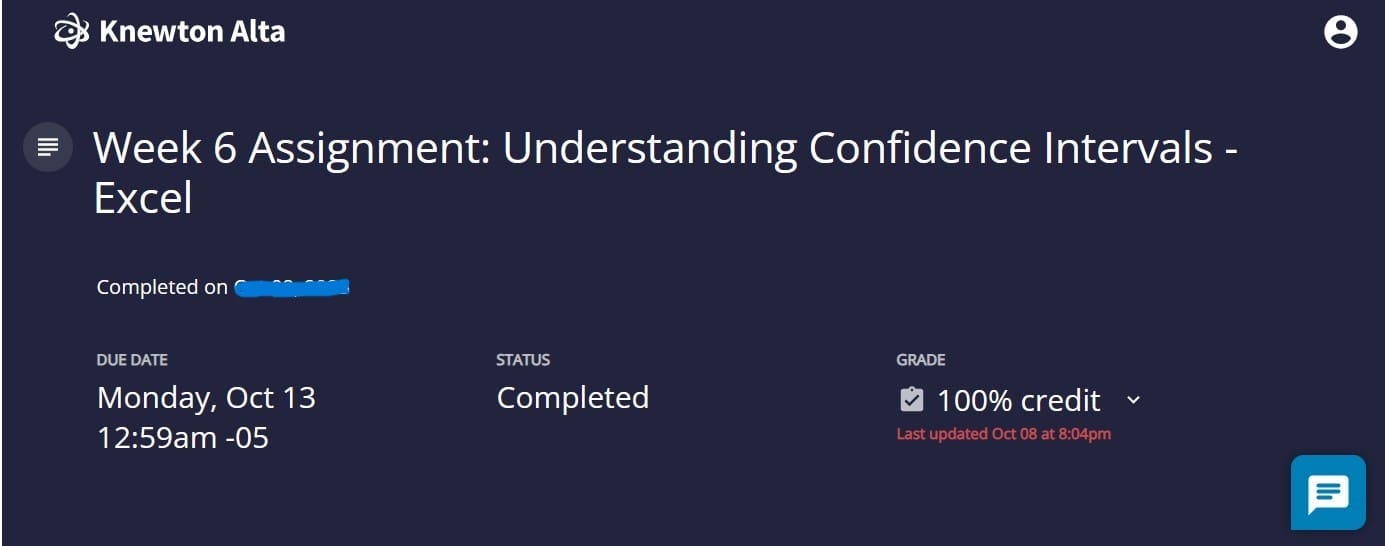
100% on Statistics Assignment

93% on Statistics Test
How It Works
Send Your Details
Contact us with your Alta Statistics course info, current mastery level, and deadlines. Screenshots help us quote accurately.
Get Your Quote
We respond within hours with transparent pricing. No hidden fees. Full-course discounts available.
We Deliver Results
Our Statistics expert completes your work with guaranteed 100% mastery. Check progress anytime.
Frequently Asked Questions
Can you help with hypothesis testing on Knewton Alta?
Yes. Hypothesis testing is one of the most common areas where Alta Statistics students get stuck. We handle all hypothesis tests—z-tests, t-tests, chi-square, ANOVA—with the exact interpretation language and p-value formatting Alta requires.
Why does Alta mark my statistics answers wrong when they’re correct?
Alta requires very specific formatting: p-values rounded to exactly 4 decimal places, test statistics to 2 or 3 decimals, and precise interpretation wording like “reject the null hypothesis” vs “fail to reject.” Even mathematically correct answers get marked wrong if the format doesn’t match.
How long does a Knewton Alta Statistics assignment take?
It varies dramatically. Alta’s adaptive system means a student who demonstrates mastery quickly might finish in 45 minutes, while a student who struggles could spend 4+ hours as Alta adds remedial questions. Our experts typically complete Statistics modules in 2-3 hours.
Do you guarantee grades on Alta Statistics?
We guarantee 100% mastery completion on all Alta Statistics assignments. Since Alta is mastery-based, assignments aren’t complete until you reach 100%. We work through your unique question set until the mastery bar is full, regardless of how many questions Alta adds.
Can you help with probability and distributions?
Yes. We cover all probability topics including conditional probability, Bayes’ theorem, binomial distributions, normal distributions, and sampling distributions. These conceptual topics often trigger Alta’s infinite loop when students show surface-level understanding.
Does Alta Statistics use statistical software?
Alta Statistics primarily uses its built-in calculator and tables rather than external software like SPSS or Excel. However, the platform expects you to know when to use z-tables vs t-tables and how to interpret calculator outputs correctly.
Can you complete Alta Statistics on short notice?
Yes. We regularly handle same-day and next-day Statistics requests. The more notice you give, the better—but we can prioritize urgent deadlines when needed.
Will my professor know I got help?
Alta tracks completion patterns but doesn’t distinguish between independent work and tutoring support. Our experts maintain natural pacing and avoid patterns that trigger instructor attention. All work is done by humans—no AI, no recycled answers.
Ready to Master Alta Statistics?
Stop losing points to interpretation errors and formatting requirements. Our experts deliver guaranteed 100% mastery.
See also: Knewton Alta Hub | Why Answer Keys Don’t Exist | Alta Chemistry | Alta Algebra | Alta Calculus
There are many reasons why students need help with their coursework. In any case, it is never too late to ask for help. So, what are you waiting for? Let’s connect!