
Home ›
Statistics Help ›
Linear Regression
Linear Regression Explained: Predicting Outcomes from Data
📊 Quick Answer
Linear regression finds the best-fitting straight line through your data points, allowing you to predict values of one variable (Y) based on another (X). The equation ŷ = a + bx gives you a formula where a is the y-intercept (starting point) and b is the slope (rate of change). Use it when you want to predict outcomes, understand relationships, or explain how much X influences Y.
📑 In This Guide
What Is Linear Regression?
Linear regression is a statistical method that finds the best-fitting straight line through a set of data points. This line, called the regression line or line of best fit, minimizes the distance between itself and all the data points.
The key idea: if two variables have a linear relationship, you can use one (the independent variable, X) to predict the other (the dependent variable, Y).
Examples of regression questions:
- How much will sales increase if we spend $1,000 more on advertising?
- What test score would we predict for a student who studies 5 hours?
- How does height relate to weight in this population?
Linear regression goes beyond correlation—it gives you a specific equation for making predictions and tells you exactly how much Y changes for each unit change in X.
The Regression Equation
The regression equation takes the form:
ŷ = a + bx
Also written as: ŷ = b₀ + b₁x
Where:
- ŷ (y-hat) = the predicted value of Y
- a (or b₀) = the y-intercept (value of Y when X = 0)
- b (or b₁) = the slope (change in Y for each 1-unit increase in X)
- x = the value of the independent variable
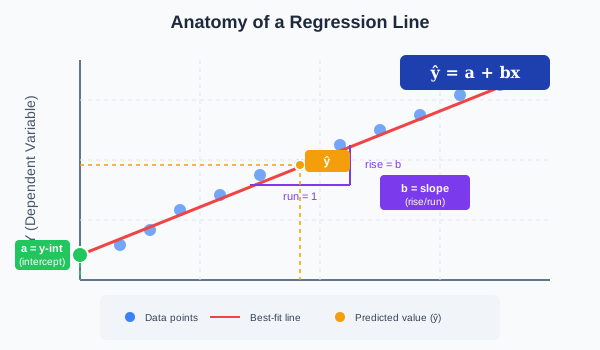
The regression line minimizes the distance to all data points
The regression line is found using the least squares method, which minimizes the sum of the squared residuals (the vertical distances between each point and the line).
Interpreting Slope and Intercept
The Slope (b)
The slope tells you how much Y changes for each 1-unit increase in X. This is the most important part of your regression output for interpretation.
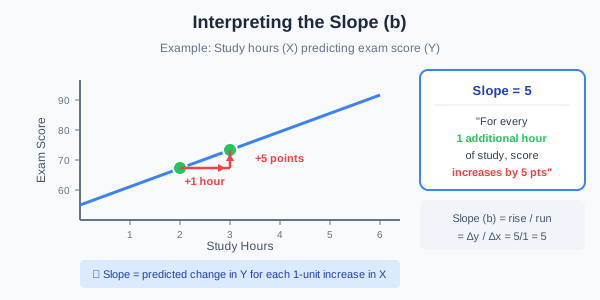
The slope shows the rate of change: “For every 1-unit increase in X, Y changes by b”
How to interpret: “For every 1-unit increase in [X], we predict [Y] will increase/decrease by [b] units.”
Example: If the regression equation for predicting exam score from study hours is ŷ = 50 + 5x, the slope of 5 means: “For every additional hour of studying, we predict the exam score will increase by 5 points.”
Sign matters:
- Positive slope: As X increases, Y increases (line goes up)
- Negative slope: As X increases, Y decreases (line goes down)
- Slope of zero: X has no linear relationship with Y (horizontal line)
The Y-Intercept (a)
The intercept is the predicted value of Y when X equals zero. It’s where the regression line crosses the y-axis.
Example: In ŷ = 50 + 5x, the intercept of 50 means: “A student who studies 0 hours would be predicted to score 50 points.”
⚠️ When the Intercept Doesn’t Make Sense
Sometimes X = 0 is impossible or meaningless. If predicting weight from height, height = 0 inches is meaningless—the intercept is just a mathematical anchor for the line, not a meaningful prediction. In these cases, focus your interpretation on the slope.
R² (Coefficient of Determination)
R² (R-squared) tells you what percentage of the variation in Y is explained by X. It measures how well your regression line fits the data.
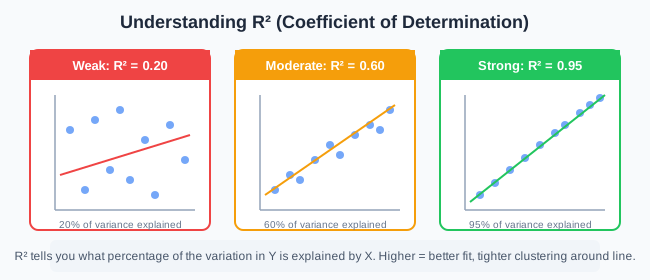
Higher R² means points cluster more tightly around the regression line
Interpretation guidelines:
| R² Value | Interpretation | Meaning |
|---|---|---|
| 0.00 – 0.25 | Weak | X explains little variation in Y |
| 0.25 – 0.50 | Moderate | X explains some variation |
| 0.50 – 0.75 | Good | X explains most variation |
| 0.75 – 1.00 | Strong | X explains nearly all variation |
Example: If R² = 0.72, you’d say: “Study hours explain 72% of the variation in exam scores.” The remaining 28% is due to other factors not in the model.
Key relationships:
- R² = r² (R-squared is the correlation coefficient squared)
- R² ranges from 0 to 1 (or 0% to 100%)
- R² cannot be negative (though adjusted R² in multiple regression can be)
Understanding Residuals
A residual is the difference between the actual observed value and the predicted value from your regression line:
Residual = Observed − Predicted = y − ŷ
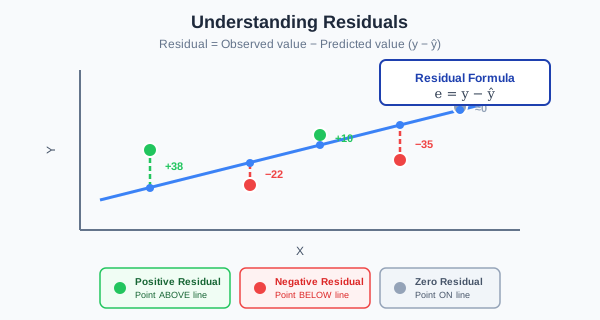
Residuals measure how far each point is from the predicted value
Interpreting residuals:
- Positive residual: Observed value is ABOVE the line (model underpredicted)
- Negative residual: Observed value is BELOW the line (model overpredicted)
- Zero residual: Point falls exactly on the line (perfect prediction)
Residuals are crucial because they help you check whether your regression assumptions are met. The sum of all residuals in a regression always equals zero (positive and negative cancel out).
Checking Assumptions
Linear regression has four key assumptions. Violating them can lead to unreliable results.
✅ The LINE Assumptions
- L — Linearity: The relationship between X and Y is linear (not curved)
- I — Independence: Observations are independent of each other
- N — Normality: Residuals are approximately normally distributed
- E — Equal Variance: Residuals have constant spread across all X values (homoscedasticity)
How to Check: Residual Plots
The most important diagnostic tool is the residual plot—a graph of residuals vs. predicted values (or vs. X). A good residual plot shows random scatter with no pattern.

A good residual plot shows random scatter; patterns indicate violated assumptions
What patterns mean:
- Random scatter: Assumptions are met ✓
- Funnel shape: Unequal variance (heteroscedasticity) — try transforming Y
- Curved pattern: Non-linear relationship — try a quadratic term or transformation
Making Predictions
Once you have your regression equation, making predictions is straightforward—just plug in the X value:
📝 Prediction Example
Equation: ŷ = 50 + 5x (predicting exam score from study hours)
Question: Predict the score for a student who studies 4 hours.
Solution: ŷ = 50 + 5(4) = 50 + 20 = 70 points
Interpretation: We predict a student who studies 4 hours will score 70 points.
The Danger of Extrapolation
Interpolation (predicting within your data range) is safe. Extrapolation (predicting beyond your data range) is risky because you don’t know if the linear relationship continues.

Only predict within the range of your data—extrapolation can give misleading results
⚠️ Extrapolation Example
If your data includes students who studied 1–8 hours, don’t use the equation to predict scores for 15 hours of studying. The relationship might not be linear beyond your data—maybe there’s a point of diminishing returns.
Correlation vs. Regression
Students often confuse correlation and regression. Here’s the difference:
| Correlation (r) | Regression |
|---|---|
| Measures strength & direction of relationship | Provides equation for prediction |
| Single value: −1 to +1 | Equation: ŷ = a + bx |
| Symmetric: r(X,Y) = r(Y,X) | Asymmetric: predicting Y from X ≠ X from Y |
| Answers: “How strongly are they related?” | Answers: “What value of Y do I predict?” |
| No independent/dependent distinction | X is independent, Y is dependent |
💡 Which Should I Use?
- “Is there a relationship between X and Y?” → Correlation
- “How strong is the relationship?” → Correlation
- “Predict Y given a value of X” → Regression
- “How much does Y change when X increases by 1?” → Regression
- “What equation fits this data?” → Regression
Key connection: r² = R². The correlation coefficient squared equals the coefficient of determination. If r = 0.85, then R² = 0.72.
Common Student Mistakes
❌ Mistake #1: Confusing r and R²
r is the correlation coefficient (−1 to +1). R² is the coefficient of determination (0 to 1). They’re related (R² = r²) but answer different questions. Don’t say “r² = 0.64 means a strong correlation”—that’s R², not r.
❌ Mistake #2: Saying regression proves causation
Regression shows association, NOT causation. Even with a strong regression, you cannot conclude X causes Y. There could be confounding variables, reverse causation, or coincidence. Only controlled experiments establish causation.
❌ Mistake #3: Extrapolating beyond the data
If your data covers ages 20–60, don’t predict outcomes for age 5 or age 90. The linear relationship may not hold outside your observed range. Always check if your X value falls within the original data range.
❌ Mistake #4: Interpreting the intercept when X=0 is meaningless
If predicting salary from years of experience, “0 years of experience” is meaningful. But if predicting weight from height, “0 inches tall” is nonsense. In such cases, the intercept is just mathematical—don’t interpret it literally.
❌ Mistake #5: Ignoring residual plots
A high R² doesn’t mean your regression is valid. If residual plots show patterns (curves, funnels), your assumptions are violated and your predictions may be wrong. Always check the residual plot before trusting your results.
❌ Mistake #6: Switching X and Y
The regression of Y on X is NOT the same as X on Y. If you’re predicting salary from education, education is X and salary is Y. Swapping them gives a different equation with different meaning. Always identify which variable you’re predicting.
❌ Mistake #7: Using ŷ as the actual value
ŷ (y-hat) is the PREDICTED value, not the observed value. When interpreting, say “we predict” or “the expected value is”—don’t state it as a fact about any individual. Predictions have error.
Platform-Specific Tips
ALEKS
ALEKS often gives you summary statistics (means, standard deviations, correlation) and asks you to calculate the regression equation. Use these formulas:
- Slope: b = r × (sy/sx)
- Intercept: a = ȳ − b(x̄)
ALEKS is strict about rounding—follow their instructions exactly, usually rounding the final answer, not intermediate steps.
MyStatLab (Pearson)
StatCrunch is integrated and handles regression well. Go to Stat → Regression → Simple Linear. The output gives you the equation, R², and residual plots. MyStatLab often asks for interpretations—use complete sentences with context (units, variable names).
WebAssign
WebAssign problems often provide the regression equation and ask for predictions or interpretations. Watch for questions that test extrapolation awareness—they may ask if a prediction is reliable, and the answer depends on whether X is within the data range.
Excel
Use Data Analysis → Regression, or use formulas:
- =SLOPE(y_range, x_range) for the slope
- =INTERCEPT(y_range, x_range) for the intercept
- =RSQ(y_range, x_range) for R²
TI-83/84 Calculator
Enter data into L1 (X) and L2 (Y), then: STAT → CALC → LinReg(ax+b). Make sure Diagnostics are ON (2nd → Catalog → DiagnosticOn) to see r and R².
Need help with these platforms? Our tutors work with ALEKS statistics, MyStatLab, and WebAssign every day.
📝 Step-by-Step: Finding the Regression Equation
- Calculate means: Find x̄ and ȳ
- Calculate standard deviations: Find sx and sy
- Calculate correlation: Find r
- Calculate slope: b = r × (sy/sx)
- Calculate intercept: a = ȳ − b(x̄)
- Write equation: ŷ = a + bx
- Calculate R²: R² = r²
- Check residual plot: Verify assumptions are met
📊 Complete Worked Example
Problem: A professor collects data on study hours (X) and exam scores (Y) for 5 students. Find the regression equation and predict the score for a student who studies 6 hours.
| Student | Hours (X) | Score (Y) |
|---|---|---|
| 1 | 2 | 65 |
| 2 | 3 | 70 |
| 3 | 4 | 72 |
| 4 | 5 | 80 |
| 5 | 6 | 83 |
Step 1: Calculate means
x̄ = (2+3+4+5+6)/5 = 20/5 = 4
ȳ = (65+70+72+80+83)/5 = 370/5 = 74
Step 2: Calculate standard deviations
sx = 1.58 (sample standard deviation of X)
sy = 7.18 (sample standard deviation of Y)
Step 3: Calculate correlation
r = 0.976
Step 4: Calculate slope
b = r × (sy/sx) = 0.976 × (7.18/1.58) = 0.976 × 4.54 = 4.43
Step 5: Calculate intercept
a = ȳ − b(x̄) = 74 − 4.43(4) = 74 − 17.72 = 56.28
Step 6: Write equation
ŷ = 56.28 + 4.43x
Step 7: Calculate R²
R² = (0.976)² = 0.953 (95.3% of variation in scores is explained by study hours)
Step 8: Make prediction
For x = 6 hours: ŷ = 56.28 + 4.43(6) = 56.28 + 26.58 = 82.86 points
Interpretation: For every additional hour of studying, we predict exam scores increase by about 4.4 points. A student who studies 6 hours is predicted to score about 83 points. Study hours explain 95.3% of the variation in exam scores—a very strong relationship.
Quick Reference Summary
📐 Key Formulas
| Equation: | ŷ = a + bx |
| Slope: | b = r(sy/sx) |
| Intercept: | a = ȳ − bx̄ |
| Residual: | e = y − ŷ |
| R²: | R² = r² |
📝 Interpretation Templates
Slope: “For every 1-unit increase in [X], [Y] increases/decreases by [b] units.”
Intercept: “When [X] = 0, the predicted [Y] is [a].”
R²: “[X] explains [R²×100]% of the variation in [Y].”
✅ LINE Assumptions Checklist
- Linearity — relationship is linear (check scatter plot)
- Independence — observations are independent
- Normality — residuals are normally distributed
- Equal variance — residuals have constant spread (check residual plot)
⚠️ Remember: Only predict within your data range (interpolation). Never extrapolate. Regression shows association, not causation.
Frequently Asked Questions
What’s the difference between simple and multiple regression?
Simple linear regression uses one predictor variable (X) to predict Y. Multiple regression uses two or more predictors (X₁, X₂, etc.). Intro statistics typically covers simple regression; multiple regression is in more advanced courses.
Can I use regression if the relationship isn’t perfectly linear?
Linear regression requires an approximately linear relationship. If the scatter plot shows a curve, linear regression isn’t appropriate. Options include transforming variables (log, square root), using polynomial regression, or trying a non-linear model. Always check the residual plot.
Why is my R² low even though the relationship is significant?
Statistical significance and R² measure different things. Significance tests whether the slope is different from zero; R² measures how much variation is explained. With large samples, even weak relationships can be significant. A low R² with a significant p-value means the relationship exists but is weak.
How do I know if my regression equation is “good enough”?
Check multiple things: R² (higher is better, but context matters), significance of the slope (p-value < 0.05), residual plot (should show random scatter), and practical significance (does the slope represent a meaningful effect?). There's no universal "good" threshold—it depends on your field.
What does it mean when the slope is not significant?
A non-significant slope (p-value ≥ 0.05) means you don’t have evidence that X predicts Y. The slope could be zero in the population. In this case, your regression line isn’t useful for prediction—X doesn’t explain Y in a meaningful way.
Can I use regression with categorical variables?
Simple linear regression requires a numerical Y variable. X can be categorical if coded as dummy variables (0/1), but this is typically covered in multiple regression. For comparing categories, t-tests or ANOVA are usually more appropriate in intro courses.
What are outliers and influential points?
An outlier is a point far from the others. An influential point strongly affects the regression line (removing it changes the equation substantially). High leverage points (extreme X values) can be especially influential. Check by computing the regression with and without suspicious points.
Can you help with my linear regression homework?
Absolutely. Linear regression is one of the most common topics we help with. Whether you need help finding the equation, interpreting output, making predictions, or checking assumptions, our tutors work with ALEKS, MyStatLab, WebAssign, Excel, and other tools daily. Get a free quote to get started.
Related Resources
Statistics Foundations
- Correlation Does Not Equal Causation
- Descriptive Statistics Explained
- Standard Deviation Explained
- Hypothesis Testing Guide
Statistics Help
Need Help With Linear Regression?
Our tutors handle regression problems daily—from finding equations to interpreting output and making predictions.