
What Is the Molecular Geometry of SO3 2-? Complete Guide
Quick Answer
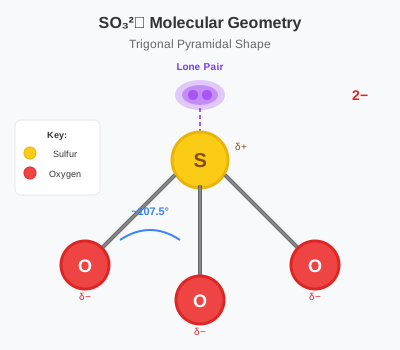
The molecular geometry of SO3 2- (sulfite ion) is trigonal pyramidal with sp3 hybridization. The central sulfur atom has four electron domains (three bonding pairs and one lone pair), giving tetrahedral electron geometry but trigonal pyramidal molecular geometry. Bond angles are approximately 107.5°, and the molecule is polar due to its asymmetrical shape.
If you are taking General Chemistry and struggling with VSEPR theory, Lewis structures, or molecular geometry, you are not alone. The sulfite ion (SO3 2-) is a classic problem that appears on ALEKS Chemistry assignments, Mastering Chemistry modules, and Cengage MindTap quizzes.
This guide breaks down everything you need to know about SO3 2-: how to draw the Lewis structure, determine geometries, identify hybridization, assess polarity, and avoid the most common exam mistakes.
Drawing the Lewis Structure of SO3 2-
Lewis structures are the foundation for determining molecular geometry. Here is the step-by-step process for SO3 2-.
Count Total Valence Electrons
Sulfur (6) + Oxygen × 3 (18) + charge (2) = 26 valence electrons
Identify the Central Atom
Sulfur is less electronegative than oxygen, so sulfur becomes the central atom with three oxygens around it.
Draw Single Bonds
Connect S to each O with single bonds. This uses 6 electrons, leaving 20 remaining.
Complete Octets on Outer Atoms
Place 6 electrons (3 lone pairs) around each oxygen. This uses 18 electrons, leaving 2 remaining.
Place Remaining Electrons on Central Atom
The final 2 electrons form a lone pair on sulfur. This lone pair is what makes SO3 2- different from SO3.
Resonance: The most accurate representation involves three resonance structures where one S=O double bond rotates among the three oxygen positions. For VSEPR purposes, any resonance structure works — the key is recognizing three bonding domains and one lone pair on sulfur.
VSEPR Theory and Geometry
VSEPR (Valence Shell Electron Pair Repulsion) theory predicts molecular geometry based on electron domain repulsion. According to LibreTexts Chemistry, electron domains arrange themselves to minimize repulsion.
For SO3 2-, this distinction is critical:
Electron Geometry
Tetrahedral
Considers all electron domains (3 bonding + 1 lone pair = 4)
Molecular Geometry
Trigonal Pyramidal
Considers only bonded atoms (3 oxygens; lone pair is not counted in the shape)
Why the bond angle is less than 109.5°: Lone pairs repel more strongly than bonding pairs because they are only attracted to one nucleus instead of two. This extra repulsion compresses the O-S-O bond angles from the ideal tetrahedral 109.5° down to approximately 107.5°.

Hybridization of SO3 2-
Hybridization describes how atomic orbitals mix to form new hybrid orbitals for bonding. The number of electron domains determines hybridization:
| Electron Domains | Hybridization | Geometry |
|---|---|---|
| 2 | sp | Linear |
| 3 | sp² | Trigonal Planar |
| 4 — SO3 2- | sp³ | Tetrahedral |
| 5 | sp³d | Trigonal Bipyramidal |
| 6 | sp³d² | Octahedral |
For SO3 2-: Four electron domains require sp³ hybridization. The sulfur atom’s one 3s orbital and three 3p orbitals mix to form four sp³ hybrid orbitals — three form sigma bonds with oxygen atoms, and one holds the lone pair.
Polarity Analysis
Understanding polarity requires distinguishing between bond polarity and molecular polarity.
Bond Polarity: Individual S-O bonds are polar because oxygen (electronegativity 3.44) pulls electron density away from sulfur (electronegativity 2.58). The difference of 0.86 indicates polar covalent bonds.
Molecular Polarity: SO3 2- is polar overall because its trigonal pyramidal shape is asymmetrical. The bond dipoles do not cancel out, creating a net dipole moment pointing from sulfur toward the oxygen atoms.
SO3 2- vs. Similar Molecules
Comparing SO3 2- to related sulfur-oxygen species helps cement your understanding:
| Species | Valence e⁻ | Molecular Geometry | Polar? |
|---|---|---|---|
| SO2 | 18 | Bent | Yes |
| SO3 | 24 | Trigonal Planar | No |
| SO3 2- | 26 | Trigonal Pyramidal | Yes |
| SO4 2- | 32 | Tetrahedral | No |
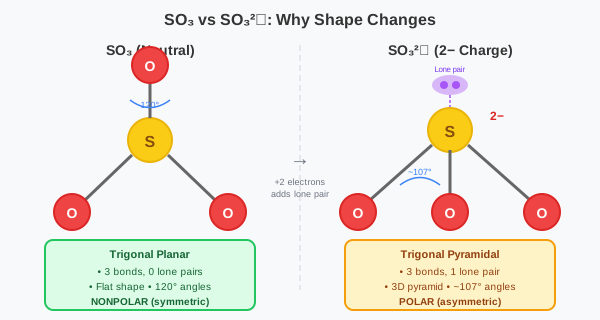
Key insight: The -2 charge on SO3 2- adds 2 electrons compared to neutral SO3. Those extra electrons create the lone pair that changes geometry from flat (trigonal planar) to 3D pyramid (trigonal pyramidal) — and changes polarity from nonpolar to polar.
Common Student Mistakes
These errors account for most lost points on SO3 2- problems.
| Mistake | Why It’s Wrong |
|---|---|
| Calling it trigonal planar | Ignores the lone pair on sulfur. The lone pair makes it trigonal pyramidal (3D), not trigonal planar (flat). |
| Saying it is nonpolar | Asymmetric shapes like trigonal pyramidal are always polar — bond dipoles do not cancel. |
| Forgetting the -2 charge | Changes total valence electrons from 24 to 26. Those 2 extra electrons create the lone pair that changes everything. |
| Using sp² hybridization | sp² corresponds to 3 electron domains. SO3 2- has 4 electron domains (3 bonds + 1 lone pair), which requires sp³. |
| Using 120° bond angles | That figure applies to trigonal planar. Trigonal pyramidal has approximately 107.5°, compressed by lone pair repulsion. |
Platform-Specific Tips
Different chemistry platforms have different quirks when it comes to SO3 2- questions.
Draw any valid resonance structure — do not overthink which one. Scroll through all geometry options before selecting, since trigonal planar and trigonal pyramidal are listed adjacent to each other. Enter bond angles as 107 or 107.5, not 109.5.
Pay attention to whether the question asks for “electron geometry” or “molecular geometry” — they have different answers. “Shape around the central atom” means molecular geometry (trigonal pyramidal). Hybridization is sp³, not sp².
Spelling matters — “trigonal pyramidal,” not “trigonal pyramid.” Rotate the 3D models to see the pyramid shape clearly. For polarity questions, enter “polar” or “yes” depending on the question format.
Struggling with Chemistry Homework?
We complete ALEKS, Mastering Chemistry, and MindTap assignments with an A/B grade guarantee.
Frequently Asked Questions
What is the molecular geometry of SO3 2-?
The molecular geometry of SO3 2- (sulfite ion) is trigonal pyramidal. The central sulfur atom has four electron domains (three bonding pairs and one lone pair), giving tetrahedral electron geometry, but the molecular shape considering only bonded atoms is trigonal pyramidal.
Is SO3 2- trigonal planar or trigonal pyramidal?
SO3 2- is trigonal pyramidal, not trigonal planar. Trigonal planar geometry occurs when there are three bonding groups and zero lone pairs, as in SO3. SO3 2- has one lone pair on the central sulfur atom, which creates a 3D pyramid shape rather than a flat triangle.
What is the bond angle in SO3 2-?
The bond angle in SO3 2- is approximately 107.5°, slightly less than the ideal tetrahedral angle of 109.5°. The compression occurs because the lone pair on sulfur occupies more space than bonding pairs, pushing the oxygen atoms closer together.
What is the hybridization of SO3 2-?
The central sulfur atom in SO3 2- uses sp³ hybridization. Four electron domains (three bonds plus one lone pair) require four sp³ hybrid orbitals — three for bonding with oxygen atoms and one to hold the lone pair.
Is SO3 2- polar or nonpolar?
SO3 2- is polar. The trigonal pyramidal shape is asymmetrical, and the oxygen atoms are more electronegative than sulfur, creating an uneven distribution of electron density. The bond dipoles do not cancel, resulting in a net dipole moment.
What is the difference between SO3 and SO3 2-?
SO3 (sulfur trioxide) is neutral with 24 valence electrons, zero lone pairs on sulfur, trigonal planar geometry, and is nonpolar. SO3 2- (sulfite ion) has a -2 charge with 26 valence electrons, one lone pair on sulfur, trigonal pyramidal geometry, and is polar. The extra electrons create the lone pair that changes everything.
How do you draw the Lewis structure of SO3 2-?
Count 26 total valence electrons (6 from S, 18 from 3 O, and 2 from the -2 charge). Place S in the center with 3 O around it. Draw single bonds, complete octets on the O atoms, and place the remaining 2 electrons as a lone pair on S. The actual structure involves resonance with one double bond rotating among the three oxygen positions.
Can FMMC help with my SO3 2- assignment on ALEKS or Mastering Chemistry?
Yes. Finish My Math Class completes chemistry assignments on ALEKS, Mastering Chemistry, and Cengage MindTap with an A/B grade guarantee. Our experts handle Lewis structures, VSEPR theory, molecular geometry, and all general chemistry topics.
Bottom Line
The molecular geometry of SO3 2- is trigonal pyramidal, shaped by three bonding pairs and one lone pair on the central sulfur atom. The key points to remember:
- 26 total valence electrons (do not forget the -2 charge)
- Trigonal pyramidal molecular geometry (not trigonal planar)
- Tetrahedral electron geometry (4 electron domains)
- sp³ hybridization
- Polar molecule (asymmetric shape)
- Approximately 107.5° bond angles (compressed by the lone pair)
Whether you are stuck on this concept or any other general chemistry topic, our chemistry homework help service handles ALEKS, Mastering Chemistry, and MindTap assignments with an A/B grade guarantee.