Finish My Math Class

Finish My Math Class ™ (FMMC) is an international team of professionals (most located in the USA and Canada) dedicated to discreetly helping students complete their Math classes with a high grade.

Do nurses need to be good at Algebra? We do not think so

Quick Answer: Do Nurses Need Algebra?

No, working nurses rarely use algebra in clinical practice. The math nurses actually need involves basic calculations for medication dosages, IV drip rates, and unit conversions—skills taught specifically in nursing programs. However, most nursing schools require algebra as a prerequisite because accreditation standards mandate it for critical thinking development, not because you’ll graph equations at the bedside.

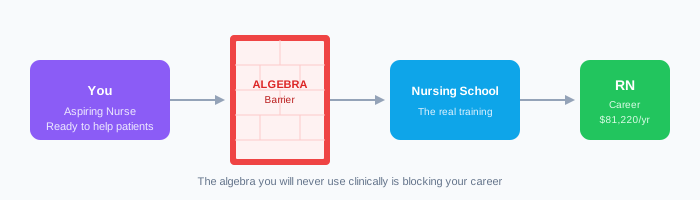
The reality: Algebra is a barrier between you and your nursing career, not a tool you’ll use daily. If math prerequisites are holding you back, professional algebra help from Finish My Math Class lets you focus on clinical skills while experts handle your coursework with our A/B grade guarantee.

Algebra and nursing—two words that rarely appear together in actual healthcare settings. Yet if you’re pursuing a nursing degree, you’ve likely discovered that math requirements stand between you and your clinical training. The question “do nurses need algebra?” frustrates thousands of aspiring nurses every semester, especially when they realize the disconnect between algebraic equations and patient care.

Here’s what this comprehensive guide covers: the actual math nurses use daily, why nursing programs stubbornly require algebra despite its limited clinical application, the accreditation standards driving these requirements, and realistic strategies for handling math prerequisites without derailing your nursing career. Whether you’re struggling through College Algebra or Statistics, understanding this disconnect helps you navigate requirements strategically.
Why Nursing Programs Require Algebra

The short answer: accreditation standards and institutional policy, not clinical necessity. The Commission on Collegiate Nursing Education (CCNE) requires nursing programs to demonstrate students receive broad-based education including quantitative reasoning. Individual state boards of nursing reinforce these standards, creating a nationwide algebra requirement that persists regardless of its practical application.

Nursing programs justify algebra requirements through several academic arguments:

Critical Thinking Development: Colleges argue that solving algebraic problems develops logical reasoning and problem-solving skills transferable to clinical decision-making. While critical thinking matters immensely in nursing, research hasn’t definitively proven algebra specifically enhances clinical reasoning better than actual nursing coursework does.

Academic Rigor Standards: Universities want nursing programs viewed as intellectually rigorous. Including challenging math courses signals academic seriousness to accrediting bodies and the public. Essentially, algebra serves as a credibility marker rather than a clinical tool.

Traditional Curriculum Structure: Nursing education follows decades-old curriculum models. Algebra became a standard prerequisite when fewer nursing programs existed and general education requirements emphasized classical liberal arts training. Changing these entrenched requirements requires institutional consensus that moves glacially.

Weeding Out Function: Some programs use difficult math prerequisites to manage enrollment. If 200 students apply for 50 spots, algebra serves as a filter. This creates frustration for capable nursing students who struggle specifically with abstract mathematics.

Reality Check: The American Association of Colleges of Nursing acknowledges that while quantitative skills matter, the specific mathematical content required varies by program. Translation: algebra requirements are institutional choices, not universal clinical necessities. Yet failing College Algebra can delay your nursing start date by an entire semester or year, costing thousands in tuition and lost nursing income.

↑ Back to Top

The Math Nurses Actually Use in Clinical Practice

Walk into any hospital unit and you’ll see nurses performing calculations constantly—but not the kind you learned in algebra class. Nursing math centers on dimensional analysis, ratio-proportion calculations, and unit conversions. These are straightforward, repeatable processes that follow specific protocols.

Medication Dosage Calculations

This is the most common math nurses perform. The standard formula every nursing student memorizes:

Desired Dose ÷ Available Dose × Quantity = Amount to Administer

Example: A doctor orders 750mg of medication. You have 250mg tablets. How many tablets do you give?
750mg ÷ 250mg × 1 tablet = 3 tablets

This uses division and multiplication—basic arithmetic operations taught in elementary school. No variables. No solving for x. No quadratic equations.

IV Drip Rate Calculations

Intravenous medications require calculating flow rates to ensure patients receive correct dosages over time. The standard formula:

IV Flow Rate (mL/hr) = Total Volume (mL) ÷ Time (hours)

Example: A patient needs 1000mL of saline over 8 hours.
1000mL ÷ 8 hours = 125mL/hr

For gravity IV drips using drop factors:

Drops per Minute = (Volume × Drop Factor) ÷ (Time in minutes)

Example: Administer 1000mL over 8 hours with a drop factor of 15 gtts/mL.
(1000mL × 15) ÷ 480 minutes = 31.25, rounded to 31 drops per minute

Notice what’s missing? No solving for variables. No graphing. No systems of equations. These are plug-and-chug calculations following standardized formulas that nursing programs teach specifically for clinical application.

Weight-Based Dosing

Pediatric and critical care nursing often requires calculating doses based on patient weight:

Dose = Weight (kg) × Ordered Dose (mg/kg)

Example: A 70kg patient needs medication dosed at 5mg/kg.
70kg × 5mg/kg = 350mg total dose

Then convert that to actual tablets or milliliters using the dosage calculation formula above. Still just multiplication and division.

Unit Conversions

Healthcare uses metric measurements, but patient records sometimes include pounds, ounces, and other units requiring conversion. Nurses memorize standard conversion factors:

  • 1 kilogram = 2.2 pounds
  • 1 gram = 1000 milligrams
  • 1 liter = 1000 milliliters
  • 1 inch = 2.54 centimeters

These conversions use multiplication and division with known constants. The National Center for Biotechnology Information confirms that medication errors often stem from unit conversion mistakes, not from lack of algebraic knowledge—emphasizing why nursing programs teach these specific calculations intensively during clinical courses.

Key Insight: Nursing programs dedicate entire courses to pharmacology calculations. You’ll practice these calculations repeatedly using case studies, simulations, and clinical rotations. The math itself is straightforward—the challenge is accuracy under pressure and remembering which formula applies to which situation. This is why experienced nurses emphasize “double-checking” more than mathematical sophistication.

↑ Back to Top

The Reality Gap: Algebra Class vs. Bedside Care

The disconnect between College Algebra and clinical nursing becomes obvious when you compare typical coursework:
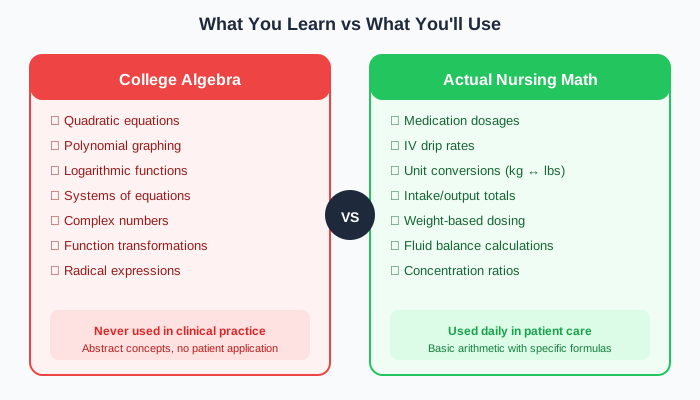
What Algebra Classes Cover

  • Solving quadratic equations using factoring, completing the square, and the quadratic formula
  • Graphing polynomial, rational, exponential, and logarithmic functions
  • Working with systems of linear equations and inequalities
  • Manipulating radical expressions and complex numbers
  • Understanding function composition and transformations

What Nurses Actually Do

  • Calculate medication doses using basic division and multiplication
  • Monitor IV drip rates and adjust flow
  • Convert between measurement units (kg to lbs, mg to g)
  • Calculate intake and output totals for fluid balance
  • Determine appropriate timing for medication administration

See the gap? You spend semesters mastering abstract mathematical concepts you’ll literally never apply in clinical practice. Meanwhile, the calculations nurses perform daily get covered in a few weeks during nursing school’s pharmacology course.

This reality frustrates nursing students who excel at patient care but struggle with theoretical mathematics. A Bureau of Labor Statistics analysis of nursing competencies doesn’t list algebra among essential skills—yet thousands of capable future nurses face delayed graduation or career abandonment because of math prerequisites.

The Harsh Truth: You’re not struggling with nursing—you’re struggling with an administrative requirement. Many excellent nurses barely passed their algebra prerequisites, then excelled once they reached actual nursing coursework. Don’t let College Algebra convince you that you can’t succeed in nursing. These are completely different skill sets.

↑ Back to Top

Common Algebra Requirements by Nursing Program Type

Algebra requirements vary significantly depending on your program type and institution. Understanding what specific courses you’ll face helps you plan strategically.

Associate Degree Nursing (ADN) Programs

Most ADN programs at community colleges require:

  • College Algebra or Intermediate Algebra as prerequisites
  • Minimum grade of C or higher (some require B)
  • Course must be completed within 5-7 years of application

Some ADN programs accept Statistics as an alternative to College Algebra. If your program offers this option, statistics generally provides more relevant content for understanding nursing research and evidence-based practice.

Bachelor of Science in Nursing (BSN) Programs

BSN programs typically require more extensive math:

  • College Algebra as a minimum prerequisite
  • Statistics (often required separately for research courses)
  • Higher minimum grades (usually B or better)
  • Recent completion requirements (completed within 3-5 years)

Accelerated BSN programs for students with previous bachelor’s degrees may waive algebra if you completed it during your first degree, but policies vary by institution.

Direct-Entry MSN Programs

Master’s entry programs for career changers generally require:

  • College-level math documented from previous degree
  • Statistics (absolutely required for graduate-level research)
  • Possible placement testing if previous math coursework is old

Online vs. Traditional Programs

Online nursing programs follow the same accreditation standards as campus programs, meaning algebra requirements remain identical. Some online programs partner with specific community colleges for prerequisite completion, but the math requirements don’t change.

If you’re comparing programs, check whether they require College Algebra specifically or accept alternatives like Business Math, Contemporary Mathematics, or Statistics. Some flexibility exists between institutions despite common accreditation standards.

↑ Back to Top

Skills That Actually Matter More in Nursing

While you’re stressing over polynomial equations, consider what actually makes an exceptional nurse. Healthcare administrators, nursing instructors, and practicing nurses consistently identify these competencies as critical:

Clinical Judgment and Critical Thinking

Nurses constantly assess changing patient conditions and decide whether situations require immediate intervention or continued monitoring. This clinical reasoning develops through patient care experience, case studies, and simulation training—not through algebraic problem-solving. You learn this by managing actual or simulated patients, not by graphing parabolas.

Compassionate Patient Care

Nursing remains fundamentally about human connection. Comforting anxious patients, supporting families through difficult diagnoses, and maintaining dignity during vulnerable moments require emotional intelligence and empathy. No amount of mathematical training develops these essential human skills.

Communication Across Healthcare Teams

Nurses serve as communication hubs between doctors, pharmacists, therapists, social workers, and families. Clearly documenting patient status, advocating for patient needs, and explaining complex medical information in understandable terms determines patient outcomes more than any calculation ability.

Attention to Detail and Accuracy

Yes, accurate dosage calculations matter enormously. But detail orientation extends far beyond math: monitoring subtle changes in patient appearance, catching medication allergies before administration, verifying correct patient identity, and maintaining sterile technique. These skills develop through clinical training and careful practice, not algebra classes.

Time Management Under Pressure

Nurses juggle multiple patients simultaneously while handling urgent situations, documentation requirements, medication schedules, and family communications. Managing this chaos effectively requires prioritization skills and composure under stress—abilities that clinical rotations develop, not abstract mathematics courses.

Physical Stamina and Dexterity

Nursing is physically demanding. Twelve-hour shifts involving constant standing, lifting patients, performing CPR, and maintaining focus despite fatigue require physical conditioning. Manual skills like starting IVs, inserting catheters, and wound care need hand-eye coordination and practice.

The American Nurses Association defines nursing through the nursing process—assessment, diagnosis, planning, implementation, and evaluation. Notice what’s absent from this professional framework? Advanced mathematics.

Perspective Check: If you’re naturally gifted at patient care but struggle with theoretical math, you’re probably going to be an excellent nurse. Don’t let one prerequisite course convince you otherwise. Many successful nurses describe themselves as “not math people”—yet they perform nursing calculations flawlessly because those calculations are straightforward and repetitive once learned in context.

↑ Back to Top

Surviving Math Prerequisites as a Nursing Student

Recognizing that algebra is an administrative hurdle rather than a clinical necessity doesn’t make passing the course easier. Here are realistic strategies for nursing students facing math requirements:

Take Math Early in Your Prerequisite Sequence

Complete algebra requirements before heavily investing in nursing prerequisites like Anatomy & Physiology or Microbiology. If you discover math will be a major obstacle, you haven’t wasted time and money on other prerequisites you can’t use without completing algebra. Getting math finished early also means you can focus entirely on science courses and nursing applications later.

Consider Summer or Winter Sessions

Accelerated sessions let you concentrate solely on algebra for 6-8 weeks rather than juggling it with multiple courses over 16 weeks. The compressed timeline means less time to forget material between classes. However, the faster pace also means less time to recover from early struggles, so this works better for students with solid foundational skills.

Explore Alternative Formats

Some students find online self-paced algebra courses easier because they can slow down for difficult concepts and speed through familiar material. Others need in-person instruction for immediate question-answering. Many colleges offer hybrid formats combining online content with weekly support sessions. Experiment with different formats if your first attempt struggles.

Use Your Nursing Goal as Motivation

When algebra feels pointless (because clinically, it is), remind yourself it’s a temporary barrier. Calculate how much your nursing salary will improve your financial situation. Visualize yourself working in your preferred specialty. Use that motivation to push through problem sets you’ll never apply in practice.

Form Study Groups with Other Nursing Students

You’re not alone in this struggle. Other nursing students face identical frustrations with math requirements. Study groups provide accountability, different explanation styles, and moral support. Plus, nursing students understand the “just need to pass this hurdle” mentality better than math majors who actually enjoy the content.

Seek Campus Resources Proactively

Most colleges offer free math tutoring, workshops, and supplemental instruction. Use these resources from day one, not just when you’re failing. Math skills build cumulatively—falling behind in week three makes week ten nearly impossible. Regular tutoring prevents the snowball effect.

Time Reality Check: College Algebra typically requires 8-12 hours weekly including class time, homework, and study. For nursing students also working jobs, managing families, or taking other prerequisites simultaneously, finding 12 extra hours weekly becomes nearly impossible. This time pressure explains why many capable nursing students struggle—not mathematical inability, but life circumstances conflicting with course demands.

↑ Back to Top

When Professional Help Makes Sense

Despite your best efforts, math prerequisites may remain a barrier. This is where strategic decision-making matters. Failing algebra delays your nursing start date—potentially by an entire year if courses are only offered certain semesters. Each delay costs you in continued tuition, prerequisite course expiration (most expire after 5-7 years), and lost nursing income.

Consider the financial reality: Registered nurses earn a median annual salary of $81,220 according to Bureau of Labor Statistics data. Delaying your nursing career by one year costs approximately $81,000 in lost income, plus whatever you’re currently earning in pre-nursing employment. That’s substantial.

Professional academic assistance services like Finish My Math Class offer an alternative approach. Instead of spending 12+ hours weekly struggling through algebra you’ll never use clinically, expert mathematicians handle your College Algebra coursework while you focus on prerequisites that actually matter for nursing: Anatomy & Physiology, Microbiology, Pathophysiology.

How Finish My Math Class Works for Nursing Students

The service specifically helps students facing prerequisite barriers. Here’s the process:

Expert Assignment: You’re matched with mathematics specialists experienced in College Algebra, Statistics, and other nursing prerequisites. These aren’t tutors—they’re professionals who complete your coursework directly.

Comprehensive Course Management: FMMC handles all aspects of your math course: homework assignments, quizzes, discussion posts, and exams. You remain enrolled in your course, but experts manage the actual work.

Grade Guarantee: Finish My Math Class offers an A/B grade guarantee. If your final grade falls below a B, you receive a full refund. This guarantee eliminates the risk of paying for services that don’t deliver results.

Time Reallocation: Instead of 12 hours weekly on algebra, you spend that time on anatomy, physiology, or nursing applications. You’re not avoiding work—you’re focusing effort where it matters for your career.

Ethical Considerations and Practical Reality

Some students hesitate about academic assistance services, questioning whether this approach is “cheating.” Consider this perspective: algebra requirements exist for administrative reasons, not clinical necessity. You’re not circumventing knowledge needed for safe patient care—you’re navigating an institutional barrier.

Nursing programs will teach you every calculation you need through pharmacology courses. Those courses use context-specific formulas with practical application, making them far easier to learn and retain than abstract algebra. You’re not creating a knowledge gap that endangers patients—you’re acknowledging that limited time and energy are better spent on clinically relevant coursework.

Additionally, professional services follow course policies regarding available resources. If your course allows tutoring, study groups, or outside assistance (which most do), using professional support falls within academic guidelines. FMMC operates transparently and doesn’t violate institutional policies.

Investment Comparison

Compare costs realistically:

  • Traditional approach: 12-16 weeks of stress, potential course failure ($800-1200 tuition wasted), delayed nursing start, lost income during delay ($20,000-80,000 depending on delay length)
  • Professional assistance: Service fee (view current pricing), guaranteed passing grade, on-time nursing program start, immediate progression toward RN license

When you calculate opportunity cost—particularly lost nursing income from delays—professional assistance often proves more economical than repeated attempts or extended timelines.

Explore the full range of services FMMC offers for nursing students, including Statistics (needed for BSN research courses), and prerequisite management across multiple courses simultaneously.

Student Success Context: Check verified testimonials from nursing students who faced identical situations. Many describe algebra as their only obstacle to nursing school admission. After using FMMC for prerequisites, they progressed through nursing programs successfully, passed NCLEX, and now work as licensed nurses. The algebra course they struggled with? Completely irrelevant to their daily clinical work.

↑ Back to Top

Frequently Asked Questions

Is algebra actually required for all nursing programs?

Yes, virtually all accredited nursing programs require college-level mathematics as a prerequisite, with College Algebra being the most common requirement. This stems from accreditation standards set by organizations like the Commission on Collegiate Nursing Education (CCNE) rather than clinical necessity. Some programs accept Statistics or other math courses as alternatives, so check specific program requirements. ADN programs at community colleges occasionally have more flexible math requirements than BSN programs at universities.

What specific algebra topics do nurses use in actual practice?

Nurses don’t use traditional algebra topics like quadratic equations, polynomial graphing, or logarithmic functions in clinical practice. The “math” nurses perform involves basic arithmetic operations (multiplication, division) applied through specific formulas for medication dosages, IV drip rates, and unit conversions. These calculations use fixed formulas taught in nursing school’s pharmacology courses, not algebraic variable manipulation. If you can multiply, divide, and follow step-by-step calculation protocols, you can handle nursing math.

Can I become a nurse if I’m bad at math?

Absolutely yes. Being “bad at math” usually means struggling with abstract mathematical concepts like algebra, not with the practical calculations nurses perform. Nursing calculations are straightforward, repetitive, and follow specific formulas that become automatic with practice. Many excellent nurses describe themselves as “not math people” yet handle dosage calculations flawlessly because those skills are taught contextually during nursing programs. The challenge is passing prerequisite algebra courses—once you’re in nursing school, the math becomes much more manageable and relevant.

Why do nursing programs require algebra if nurses don’t use it?

Nursing programs require algebra primarily due to accreditation standards and institutional policies emphasizing “well-rounded education” and critical thinking development. Colleges argue that solving algebraic problems develops logical reasoning applicable to clinical decision-making, though research hasn’t definitively proven algebra enhances nursing-specific critical thinking better than actual clinical training does. Additionally, algebra serves as an enrollment management tool—difficult prerequisites help programs control admission numbers when more students apply than spots available. The requirement persists due to bureaucratic inertia rather than clinical evidence.

What happens if I fail College Algebra before nursing school?

Failing College Algebra delays your nursing school application, potentially by an entire semester or year depending on when courses are offered. You’ll need to retake the course and achieve the minimum required grade (typically C or B) before applying. This delay costs additional tuition for retaking the course, may cause other prerequisites to expire (most are valid only 5-7 years), and postpones your nursing career start date. Each semester delayed represents lost nursing income—approximately $20,000-40,000 depending on your work situation. This makes getting through algebra efficiently critical for timely nursing career progression.

Do online nursing programs have different math requirements?

No, online nursing programs follow identical accreditation standards as traditional campus programs, meaning algebra requirements remain the same. Whether you attend online or in-person, you’ll need to complete the same prerequisite mathematics courses. Some online programs partner with specific community colleges for prerequisite completion, but the math courses required don’t change. The advantage of online programs is flexibility in when and where you complete prerequisites, not reduced mathematics requirements.

Is Statistics easier than College Algebra for nursing students?

Many nursing students find Statistics more manageable and relevant than College Algebra. Statistics focuses on data interpretation, probability, and research analysis—skills directly applicable to understanding nursing research and evidence-based practice. The calculations in Statistics use more straightforward arithmetic rather than abstract algebraic manipulation. Additionally, Statistics concepts connect more obviously to healthcare (analyzing treatment outcomes, understanding clinical studies), providing motivation that pure algebra lacks. If your program allows Statistics as an alternative to College Algebra, it’s often the better choice for nursing students.

How much time should I spend on algebra homework weekly?

Most College Algebra courses require 8-12 hours weekly including class attendance, homework completion, and study time. This follows the general college guideline of 2-3 hours outside work per credit hour. For nursing students juggling jobs, families, and other prerequisites, finding 12 extra hours weekly becomes challenging. This time commitment explains why many capable students struggle with algebra—not lack of ability, but insufficient time for mastery. If you’re consistently needing more than 12-15 hours weekly, that signals you may benefit from tutoring, course format changes, or professional assistance services.

Will struggling with algebra mean I’ll struggle with nursing school math?

No, algebra struggles don’t predict nursing school math difficulties. They’re completely different skill sets. College Algebra focuses on abstract variable manipulation, graphing complex functions, and theoretical mathematical concepts. Nursing math involves straightforward formulas applied to specific clinical situations: calculating medication doses, IV flow rates, and unit conversions. Nursing programs teach these calculations contextually during pharmacology courses, making them far easier to learn and retain because you understand their practical purpose. Many students who barely passed algebra excel at nursing calculations because the context and relevance make the math click.

What minimum algebra grade do nursing programs require?

Most nursing programs require a minimum C grade in College Algebra, though increasingly competitive programs require B or higher. The specific requirement varies by institution and program type—ADN programs at community colleges sometimes accept C grades, while BSN programs at universities often mandate B minimum. Additionally, programs consider your overall prerequisite GPA, so a C in algebra might be acceptable if other science courses show A’s and B’s. Check your specific program’s requirements early, as this determines whether you can afford a “just pass” approach or need higher achievement.

Can I use a calculator for nursing math calculations?

Yes, nurses use calculators constantly for medication dosage calculations, IV rate adjustments, and unit conversions. Clinical settings provide calculators, smartphones with calculator apps, and medication administration systems with built-in calculation features. Some nursing programs test calculation skills without calculators during exams to ensure students understand the formulas, but real-world nursing practice always includes calculator access. This is another way nursing math differs from algebra courses—clinical care prioritizes accuracy and efficiency over mental calculation ability.

Should I take algebra before or after Anatomy and Physiology?

Take algebra before Anatomy & Physiology if possible. If you discover algebra will be a major obstacle requiring multiple attempts, you haven’t wasted time and tuition on A&P courses you can’t use without completing all prerequisites. Additionally, A&P courses are validity-limited (typically 5-7 years)—getting algebra finished first prevents your A&P credits from expiring while you’re still struggling with math. However, if you’re confident about passing algebra and want to maximize your application competitiveness quickly, some students take both simultaneously. Just recognize this requires significant time commitment for two demanding prerequisite courses.

Are there nursing programs without algebra requirements?

Extremely few accredited nursing programs eliminate algebra entirely, though some accept alternative mathematics courses. Practical nursing (LPN/LVN) programs sometimes have less stringent math requirements, accepting basic math competency rather than college-level algebra. However, LPN programs lead to limited licenses with lower earning potential and fewer career advancement opportunities compared to RN licenses. If you’re pursuing RN licensure through ADN or BSN programs, expect college-level mathematics requirements. Your best strategy is finding programs that accept Statistics or other alternatives rather than searching for algebra-free programs.

How can professional help services guarantee specific grades?

Services like Finish My Math Class guarantee grades by assigning experienced mathematics professionals to complete your coursework rather than just tutoring you through it. These aren’t students or general tutors—they’re specialists in specific mathematics courses who understand exactly what’s required for A/B achievement. The grade guarantee (full refund if final grade falls below B) demonstrates confidence in their expertise. This approach differs fundamentally from tutoring, where your success depends on your own learning and performance. Professional services take direct responsibility for outcomes, which enables legitimate grade guarantees backed by refund policies.

Will using academic assistance services hurt my nursing career?

No, because algebra content isn’t used in clinical nursing practice. You’re not creating knowledge gaps that affect patient care—nursing programs teach all necessary clinical calculations through pharmacology courses regardless of your algebra background. Professional assistance with prerequisites simply removes an administrative barrier so you can focus on clinically relevant coursework like A&P, Microbiology, and actual nursing classes. Once you’re in nursing school, the skills that matter are patient assessment, clinical judgment, and hands-on care—none of which relate to College Algebra. Your algebra grade appears on transcripts but your nursing competence gets evaluated through clinical performance, NCLEX passage, and patient care quality.

↑ Back to Top

Conclusion: Getting Past the Algebra Barrier

Do nurses need algebra? The honest answer is no—not for clinical practice. Working nurses perform straightforward calculations using basic arithmetic and specific formulas taught during nursing school. The algebra you’re struggling through in College Algebra won’t appear during medication administration, patient assessment, or any other nursing activity.

But here’s the frustrating reality: you still need to pass College Algebra to access nursing programs because accreditation standards require it. This administrative hurdle blocks thousands of capable future nurses annually, delaying careers and wasting time on irrelevant coursework while clinically essential skills wait.

Your energy is finite. Every hour spent deciphering quadratic equations is an hour not spent mastering anatomy, practicing patient assessments, or preparing for clinical rotations. Smart students recognize that prerequisite barriers require strategic solutions, not just harder studying.

Finish My Math Class exists specifically for students facing this situation. We handle College Algebra, Statistics, and other mathematics prerequisites while you focus on coursework that actually prepares you for nursing practice. Our A/B grade guarantee means you either get the grade needed for nursing school admission, or you get your money back. No wasted tuition on courses you’ll retake. No delayed applications because of one math class.

Calculate your opportunity cost: What’s one semester delay worth? For most nursing students, that delay represents $20,000-40,000 in lost nursing income, plus additional prerequisite tuition if courses expire. Professional assistance costs a fraction of that lost opportunity.

You’re not avoiding work—you’re allocating limited time strategically. Your dedication to nursing shouldn’t be measured by your ability to factor polynomials. It should be measured by your patient care skills, clinical judgment, and compassion. Get the administrative barriers handled professionally so you can focus on becoming the nurse you’re meant to be.

Ready to move past the algebra obstacle? Contact Finish My Math Class today to discuss your specific situation. Our team understands nursing prerequisites intimately and can create a plan that gets you through math requirements efficiently while you focus on clinically relevant preparation. Your nursing career is waiting—don’t let one unnecessary course stand in your way.

↑ Back to Top

About the author : Finish My Math Class

Finish My Math Class ™ (FMMC) is an international team of professionals (most located in the USA and Canada) dedicated to discreetly helping students complete their Math classes with a high grade.