Finish My Math Class

Finish My Math Class ™ (FMMC) is an international team of professionals (most located in the USA and Canada) dedicated to discreetly helping students complete their Math classes with a high grade.

Is Business Statistics Hard? Complete Guide to Difficulty, Topics & Success Strategies

Quick Answer

Yes, Business Statistics is hard for most students—but not because of the mathematics itself. The difficulty stems from combining mathematical calculations with business interpretation, writing polished explanations in professional language, mastering statistical software (Excel, SPSS, JASP), and navigating strict auto-graded platforms like ALEKS, MyStatLab, and WebAssign. Unlike pure mathematics courses where correct calculations earn full credit, Business Statistics requires you to interpret results in business contexts, explain findings as actionable recommendations, and format answers with extreme precision. Students who excelled in previous math courses often struggle because the course demands simultaneous competence in statistics, business reasoning, technical writing, and software proficiency—a combination that catches most learners off guard. The high difficulty doesn’t reflect student inability but rather the unrealistic breadth of skills the course expects students to possess simultaneously.

If you’re searching “Is Business Statistics hard?” at 2 AM the night before an exam, you’re experiencing what thousands of business students face every semester. Business Statistics consistently ranks among the most feared required courses in undergraduate business programs, MBA curricula, and professional graduate degrees in healthcare administration, public policy, and management.

The course’s reputation for difficulty isn’t unfounded. Unlike traditional mathematics courses where mastering formulas and calculations leads to success, Business Statistics demands a unique combination of skills: mathematical competence, business acumen, professional writing ability, and technical software proficiency. Students who breezed through calculus often find themselves struggling with Business Statistics—not because the mathematics is harder, but because the expectations are fundamentally different.

This comprehensive guide examines why Business Statistics presents such significant challenges, breaks down the specific topics that cause the most difficulty, provides worked examples of key concepts, and offers evidence-based strategies for success. Whether you’re a prospective student planning your degree, currently enrolled and struggling, or simply researching what to expect, understanding Business Statistics’ unique demands helps you prepare effectively.

What Is Business Statistics?

Business Statistics is an applied statistics course focused on using statistical methods to analyze business data, make data-driven decisions, and communicate findings effectively in professional contexts. Unlike theoretical statistics courses in mathematics departments, Business Statistics emphasizes practical application of statistical techniques to real-world business problems.

Course Objectives and Learning Outcomes

According to the American Statistical Association, Business Statistics courses typically aim to develop competencies in:

  • Descriptive statistics: Summarizing and visualizing business data using measures of central tendency, variability, and graphical representations
  • Probability concepts: Understanding random variables, probability distributions, and their applications to business uncertainty
  • Statistical inference: Using sample data to make conclusions about populations through hypothesis testing and confidence intervals
  • Regression analysis: Modeling relationships between variables to predict outcomes and inform business decisions
  • Data communication: Presenting statistical findings clearly to non-technical business audiences
  • Software proficiency: Using tools like Excel, SPSS, or specialized platforms to perform analyses

How Business Statistics Differs from Other Math Courses

Business Statistics occupies a unique position in academic curricula:

  • Applied vs. theoretical focus: Pure statistics courses emphasize mathematical derivations and proofs; Business Statistics emphasizes interpretation and application
  • Context requirements: Every analysis must be framed in business terms—you’re not just calculating a mean, you’re analyzing average customer spending or employee productivity
  • Communication expectations: Correct calculations are insufficient; you must explain findings in clear, professional language suitable for business reports
  • Software integration: Unlike traditional math courses using calculators, Business Statistics requires proficiency with statistical software and spreadsheet programs
  • Ambiguous grading: While mathematics has objectively correct answers, Business Statistics grading often depends on subjective interpretation of whether your explanation is “detailed enough” or “business-appropriate”

Typical Course Structure

Business Statistics courses vary by institution but typically include:

  • Lecture component: Introduction to statistical concepts, formulas, and interpretation guidelines
  • Lab component: Hands-on practice with statistical software, often graded through auto-submission platforms
  • Projects: Comprehensive analyses using real or simulated business data, requiring written reports
  • Exams: Combination of calculations, interpretations, and short-answer explanations
  • Homework: Typically delivered through platforms like ALEKS, MyStatLab, WebAssign, or publisher-specific systems

The combination of theoretical content, practical application, software skills, and professional communication makes Business Statistics more demanding than courses focusing on a single competency area.

Important Context: Research from business education journals shows that Business Statistics serves dual purposes: teaching specific analytical techniques and developing broader “data literacy” competencies increasingly demanded in professional contexts. This dual mandate—technical skill development plus critical thinking development—contributes significantly to the course’s difficulty and explains why simply memorizing formulas doesn’t lead to success.

Why Business Statistics Is So Hard

Understanding specific reasons Business Statistics challenges students helps explain why even mathematically capable learners struggle. The difficulty stems from multiple compounding factors rather than a single obstacle.

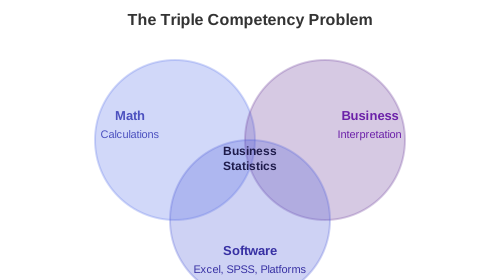
Factor 1: Triple Competency Requirement

Business Statistics simultaneously demands three distinct skill sets:

  • Mathematical proficiency: Calculating means, standard deviations, test statistics, p-values, regression coefficients
  • Business reasoning: Understanding what statistical results mean for marketing strategies, financial decisions, operational efficiency, human resources policies
  • Professional communication: Expressing findings clearly in formal business language, often following APA format or specific rubric requirements

Most courses require competence in one or two areas. Business Statistics demands all three simultaneously, creating cognitive overload for students still developing these skills.

Factor 2: Interpretation Subjectivity

Unlike mathematics where 2+2=4 objectively, Business Statistics interpretations involve judgment calls:

  • Is a correlation of 0.65 “strong” or “moderate”? Different textbooks use different thresholds
  • Does “practical significance” exist even when statistical significance doesn’t? This depends on business context
  • What level of detail makes an explanation “sufficient”? Rubrics rarely specify clearly
  • Which business implications are “most important” to highlight? This varies by industry and situation

Students accustomed to objective grading find this ambiguity frustrating. You can solve problems correctly but lose significant points because your interpretation wasn’t detailed enough, didn’t use the “right” business terminology, or missed implications the grader considered obvious.

Factor 3: Platform and Software Barriers

Most Business Statistics courses deliver content through auto-graded platforms with strict formatting requirements:

  • Zero tolerance for typos: Type “0.05” instead of “0.050” when three decimal places are required? Marked wrong
  • Symbol sensitivity: Use “<" instead of "≤" or vice versa? Marked wrong
  • Rounding inconsistencies: Intermediate rounding can cascade into final answer errors
  • Limited partial credit: Unlike human graders who can see you understood the concept, automated systems mark answers either fully correct or fully wrong
  • Software learning curves: Excel, SPSS, JASP, StatCrunch each have unique interfaces and quirks to master alongside statistical concepts

According to educational technology research from EDUCAUSE, students report spending as much time fighting with software and platforms as actually learning statistics—a significant barrier that doesn’t exist in traditional mathematics courses.

Factor 4: Inadequate Prerequisites

Many institutions require only College Algebra or equivalent as prerequisite for Business Statistics. However, the course actually assumes familiarity with:

  • Functions and graphing (understanding what graphs represent and how to interpret them)
  • Algebra manipulation (solving equations, working with formulas)
  • Summation notation (Σ symbol and what it means)
  • Basic probability concepts (percentages, fractions, ratios)
  • Logical reasoning (if-then statements, understanding conditions)

Students who barely passed prerequisites or completed them years ago often lack the foundational skills Business Statistics assumes, creating immediate struggle from week one.

Factor 5: Compressed Timelines

Business Statistics content that could reasonably fill a full semester often gets compressed into 8-week or even 6-week terms, particularly in:

  • MBA programs: Accelerated formats for working professionals
  • Summer sessions: Condensed timeline to fit break periods
  • Online programs: Self-paced modules with aggressive deadlines

The compressed timeline leaves insufficient time for concepts to sink in before new material arrives. Students report feeling constantly behind, unable to fully master one topic before facing exams on the next.

Factor 6: High-Stakes Positioning

For many students, Business Statistics represents:

  • A required course blocking graduation (can’t proceed without passing)
  • A GPA threat (often taken late in degree programs when cumulative GPA is established)
  • A prerequisite for major-specific courses (delaying this course delays entire program progression)
  • A confidence barrier (previous math trauma or statistics anxiety amplified by course reputation)

The psychological pressure of knowing “I MUST pass this course” increases stress, which impairs learning and performance—creating a self-reinforcing cycle of anxiety and difficulty.

Research Perspective: Studies from business education journals show Business Statistics has among the highest DFW rates (D grade, F grade, or Withdrawal) of required business courses—often 30-40% in large undergraduate programs and 20-30% even in selective MBA programs. This isn’t because business students are mathematically incompetent; it’s because the course design creates perfect conditions for struggle by combining multiple competency demands, compressed timelines, subjective grading, and technology barriers simultaneously.

Prerequisites and Mathematical Background

Understanding what Business Statistics actually requires—versus what institutions list as official prerequisites—helps students assess their readiness and identify preparation gaps.

Official Prerequisites (What Schools Require)

Most Business Statistics courses list minimal prerequisites:

  • College Algebra (or equivalent placement test score)
  • Sometimes: Introduction to Business or Business Foundations
  • Rarely: Any previous statistics coursework

These minimal requirements reflect administrative convenience more than pedagogical reality. Meeting official prerequisites doesn’t guarantee you possess all the skills Business Statistics actually demands.

Actual Mathematical Skills Required

To succeed in Business Statistics without constant struggle, students benefit from:

Essential arithmetic fluency:

  • Working confidently with decimals, percentages, and fractions
  • Understanding order of operations (PEMDAS) and applying it automatically
  • Calculating ratios and proportions
  • Converting between percentages and decimals (0.05 = 5%)
  • Basic mental math for reasonableness checks

Algebraic competence:

  • Solving equations for unknown variables
  • Substituting values into formulas correctly
  • Understanding function notation: f(x), y = mx + b
  • Working with inequalities (>, <, ≥, ≤)
  • Simplifying expressions with exponents and square roots

Graphical interpretation:

  • Reading and creating scatter plots, histograms, bar charts
  • Understanding coordinate systems (x-axis, y-axis)
  • Recognizing patterns and trends in visual data
  • Interpreting slopes and intercepts from graphs

Logical reasoning:

  • Understanding conditional statements (if-then logic)
  • Recognizing cause-and-effect versus correlation
  • Following multi-step procedures systematically
  • Checking whether answers make contextual sense

Non-Mathematical Skills Often Underestimated

Beyond mathematics, Business Statistics success requires:

Reading comprehension:

  • Understanding word problems and extracting relevant information
  • Interpreting what questions actually ask (students often solve the wrong problem)
  • Following complex, multi-part instructions

Writing ability:

  • Explaining technical concepts in clear, professional language
  • Structuring coherent paragraphs with topic sentences and supporting details
  • Following citation and formatting requirements (APA style)

Technology comfort:

  • Basic spreadsheet skills (creating formulas, formatting cells, making charts)
  • Navigating unfamiliar software interfaces
  • Troubleshooting basic technical problems independently
  • Managing file organization and submission systems

Time management:

  • Allocating sufficient time for multi-step assignments
  • Breaking complex projects into manageable tasks
  • Planning ahead rather than last-minute cramming

Self-Assessment: Are You Ready?

Consider additional preparation if you:

  • Barely passed prerequisite mathematics with C or D grades
  • Haven’t taken mathematics in 3+ years and feel rusty
  • Struggle with word problems or translating English into mathematical operations
  • Have limited experience with Excel or statistical software
  • Find technical writing or formal business communication challenging
  • Tend to procrastinate or underestimate assignment time requirements
  • Experience significant mathematics anxiety that interferes with test performance

These warning signs don’t mean you’re incapable of succeeding—they indicate areas where proactive preparation will significantly improve outcomes. Refreshing algebra skills, practicing Excel basics, or reviewing statistical concepts before the course starts can prevent falling behind immediately.

Preparation Resources: Many institutions offer mathematics review workshops, statistics boot camps, or online modules for students entering Business Statistics. According to research from the National Council of Teachers of Mathematics, students who complete preparatory review—even just 10-15 hours of focused prerequisite review—perform significantly better than students who jump into Business Statistics without preparation. The investment in shoring up foundational skills pays substantial dividends in course performance and reduced stress.

Core Topics with Worked Examples

Business Statistics covers numerous concepts, but five core topics consistently cause the most difficulty. Understanding these with worked examples helps demystify the course’s most challenging components.

Topic 1: Hypothesis Testing and P-Values

Hypothesis testing forms the foundation of inferential statistics in business contexts. The process involves using sample data to make conclusions about population parameters.

The fundamental logic:

  • Null hypothesis (H₀): Statement of no effect, no difference, or status quo
  • Alternative hypothesis (H₁ or Hₐ): Statement of effect, difference, or change we’re testing for
  • P-value: Probability of observing sample results at least as extreme as what we got, assuming the null hypothesis is true
  • Significance level (α): Threshold for deciding whether to reject null (commonly 0.05 or 5%)

Example Problem: A business claims its average customer satisfaction score is 7.5 out of 10. You survey 50 customers and find a mean satisfaction score of 7.1 with a standard deviation of 1.2. Test whether customer satisfaction has declined (use α = 0.05).

Solution (Step-by-Step):

  1. State hypotheses:

    H₀: μ = 7.5 (satisfaction has not declined)

    H₁: μ < 7.5 (satisfaction has declined—this is a left-tailed test)
  2. Calculate test statistic:

    Use t-test since population standard deviation is unknown

    t = (x̄ – μ) / (s / √n)

    t = (7.1 – 7.5) / (1.2 / √50)

    t = -0.4 / (1.2 / 7.071)

    t = -0.4 / 0.1697

    t = -2.36
  3. Find p-value:

    Degrees of freedom (df) = n – 1 = 50 – 1 = 49

    Using t-table or software for t = -2.36 with df = 49 (one-tailed)

    p-value ≈ 0.011
  4. Make decision:

    Since p-value (0.011) < α (0.05), we reject the null hypothesis
  5. Business interpretation (CRITICAL):

    “There is statistically significant evidence (p = 0.011) that customer satisfaction has declined from the claimed average of 7.5. The sample mean of 7.1 represents a meaningful decrease that is unlikely to have occurred by chance if the true satisfaction level were still 7.5. Management should investigate causes of declining satisfaction and implement corrective actions to improve customer experience.”

Why students struggle: Getting the math right (steps 1-4) isn’t enough. Professors demand the business interpretation (step 5), and students lose points for explanations that aren’t “detailed enough” or don’t connect findings to business actions. The rubric ambiguity around what constitutes sufficient interpretation creates frustration.

Topic 2: Confidence Intervals

Confidence intervals provide a range of plausible values for population parameters based on sample data. They’re ubiquitous in business reporting: “We’re 95% confident sales will be between $2.3M and $2.7M.”

Key concepts:

  • Point estimate: Sample statistic (like sample mean) used to estimate population parameter
  • Margin of error: How far the interval extends above/below point estimate
  • Confidence level: Percentage (typically 90%, 95%, 99%) indicating long-run accuracy

Example Problem: A company samples 36 transactions and finds mean purchase amount of $45 with standard deviation of $12. Construct a 95% confidence interval for mean purchase amount.

Solution:

  1. Identify values:

    x̄ = $45 (sample mean)

    s = $12 (sample standard deviation)

    n = 36 (sample size)

    Confidence level = 95%
  2. Find critical value:

    For 95% confidence with df = n – 1 = 35

    t-critical value ≈ 2.030 (from t-table)
  3. Calculate standard error:

    SE = s / √n = 12 / √36 = 12 / 6 = 2
  4. Calculate margin of error:

    ME = t × SE = 2.030 × 2 = 4.06
  5. Construct interval:

    Lower bound = x̄ – ME = 45 – 4.06 = $40.94

    Upper bound = x̄ + ME = 45 + 4.06 = $49.06

    95% Confidence Interval: ($40.94, $49.06)
  6. Business interpretation (CRITICAL):

    “We are 95% confident that the true mean purchase amount for all transactions falls between $40.94 and $49.06. This suggests that if we were to repeat this sampling process many times, approximately 95% of the resulting confidence intervals would contain the true population mean. For business planning purposes, management can reasonably expect average transaction values to fall within this range, which informs inventory stocking, revenue forecasting, and pricing strategy decisions.”

Common mistake: Students say “there’s a 95% chance the true mean is between $40.94 and $49.06.” This is WRONG. The interval either contains the true mean or it doesn’t—the 95% refers to the long-run success rate of the method, not the probability for this specific interval. Professors penalize this misinterpretation heavily.

Topic 3: Regression Analysis

Regression analysis models relationships between variables, allowing businesses to predict outcomes and understand how changes in one variable affect another. It’s fundamental for sales forecasting, pricing optimization, and performance analysis.

Key concepts:

  • Dependent variable (Y): The outcome you’re trying to predict or explain
  • Independent variable (X): The predictor variable you believe influences the outcome
  • Regression equation: ŷ = b₀ + b₁x (where b₀ is intercept, b₁ is slope)
  • Correlation coefficient (r): Measures strength and direction of linear relationship (-1 to +1)
  • R-squared (R²): Proportion of variance in Y explained by X (0 to 1)

Example Problem: A retailer collects data on advertising spending (in thousands) and weekly sales (in thousands). The data yields: mean advertising = $8K, mean sales = $50K, standard deviations: s_x = $3K, s_y = $12K, correlation r = 0.85. Find the regression equation and interpret the slope.

Solution:

  1. Calculate slope (b₁):

    b₁ = r × (s_y / s_x)

    b₁ = 0.85 × (12 / 3)

    b₁ = 0.85 × 4

    b₁ = 3.4
  2. Calculate intercept (b₀):

    b₀ = ȳ – b₁x̄

    b₀ = 50 – (3.4 × 8)

    b₀ = 50 – 27.2

    b₀ = 22.8
  3. Write regression equation:

    ŷ = 22.8 + 3.4x

    Where ŷ = predicted sales (thousands), x = advertising spending (thousands)
  4. Calculate R²:

    R² = r² = (0.85)² = 0.7225 or 72.25%
  5. Business interpretation (CRITICAL):

    “The regression equation predicts weekly sales based on advertising spending. The slope of 3.4 indicates that for every $1,000 increase in advertising expenditure, we can expect weekly sales to increase by approximately $3,400, representing a 3.4:1 return on advertising investment. The intercept of 22.8 suggests baseline sales of approximately $22,800 even with zero advertising, likely from regular customers and walk-in traffic. The R² value of 72.25% means that advertising spending explains about 72% of the variation in weekly sales, indicating a strong predictive relationship. However, approximately 28% of sales variation comes from other factors not captured by this model, such as seasonality, competitor actions, or product quality. Management should consider this strong positive relationship when budgeting for marketing campaigns, recognizing that increased advertising spending is likely to generate substantial sales increases.”

Common prediction question: “What sales would you predict if advertising spending is $10,000?”

  • ŷ = 22.8 + 3.4(10) = 22.8 + 34 = 56.8
  • Answer: “The model predicts weekly sales of approximately $56,800 when advertising spending is $10,000.”

Why students struggle: Regression involves multiple calculations (slope, intercept, correlation, R²) that must be executed in correct sequence. Students also struggle distinguishing between correlation (measuring association) and causation (one variable causing changes in another). Additionally, interpreting slope in business terms—not just as “a number”—requires understanding the units and context.

Topic 4: ANOVA (Analysis of Variance)

ANOVA tests whether means of three or more groups differ significantly. In business contexts, it’s used to compare sales across regions, productivity across shifts, or customer satisfaction across product lines.

Key concepts:

  • Null hypothesis: All group means are equal (μ₁ = μ₂ = μ₃ = …)
  • Alternative hypothesis: At least one group mean differs from others
  • F-statistic: Ratio comparing between-group variation to within-group variation
  • P-value: Probability of observing F-statistic this large if all means were equal

Example Problem: A company tests three training methods for customer service representatives. Satisfaction scores (out of 100) after training show:

  • Method A: mean = 82, n = 15
  • Method B: mean = 78, n = 15
  • Method C: mean = 85, n = 15
  • Overall mean = 81.67, F-statistic = 4.32, p-value = 0.021

Question: At α = 0.05, is there evidence that training methods produce different satisfaction outcomes?

Solution:

  1. State hypotheses:

    H₀: μ_A = μ_B = μ_C (all training methods produce equal satisfaction)

    H₁: At least one method produces different satisfaction than others
  2. Decision rule:

    If p-value < α (0.05), reject H₀
  3. Make decision:

    p-value = 0.021 < 0.05, therefore reject H₀
  4. Business interpretation (CRITICAL):

    “There is statistically significant evidence (F = 4.32, p = 0.021) that the three training methods produce different levels of customer satisfaction. Method C (mean = 85) appears most effective, while Method B (mean = 78) appears least effective. However, ANOVA only tells us that differences exist—not specifically which methods differ from which others. To identify specific pairwise differences, follow-up tests (such as Tukey’s HSD) would be necessary. From a business perspective, these findings suggest the company should prioritize Method C for future training programs and investigate why Method B underperforms. The difference of 7 points between Method C and Method B represents a meaningful improvement in customer satisfaction that could translate to increased customer retention and revenue.”

Why students struggle: ANOVA requires understanding variance decomposition (between-group vs. within-group), which is conceptually challenging. Students also confuse ANOVA (comparing 3+ groups) with t-tests (comparing 2 groups). Additionally, the interpretation requires explaining that ANOVA identifies differences exist but doesn’t specify which specific groups differ—a nuance many students miss.

Topic 5: Probability Distributions

Understanding probability distributions—particularly normal distribution—is essential for hypothesis testing, confidence intervals, and quality control applications.

Normal Distribution key properties:

  • Bell-shaped, symmetric around mean
  • Mean = median = mode
  • 68% of data within 1 standard deviation of mean
  • 95% of data within 2 standard deviations of mean
  • 99.7% of data within 3 standard deviations of mean

Example Problem: Customer wait times at a bank are normally distributed with mean = 5 minutes and standard deviation = 1.5 minutes. What percentage of customers wait longer than 7 minutes?

Solution:

  1. Calculate z-score:

    z = (X – μ) / σ

    z = (7 – 5) / 1.5

    z = 2 / 1.5

    z = 1.33
  2. Find probability using z-table or software:

    P(Z < 1.33) = 0.9082
    P(Z > 1.33) = 1 – 0.9082 = 0.0918
  3. Convert to percentage:

    0.0918 × 100 = 9.18%
  4. Business interpretation (CRITICAL):

    “Approximately 9.18% of customers experience wait times longer than 7 minutes. This means that on a typical day with 200 customers, about 18 customers will wait more than 7 minutes, which could negatively impact customer satisfaction. If the bank’s service standard is to keep 95% of customers waiting under 7 minutes, the current performance falls short. Management should consider adding staffing during peak hours or implementing process improvements to reduce average wait time and variability.”

Why students struggle: Z-scores seem abstract—students don’t understand why we standardize values. The z-table is confusing (left-tailed vs. right-tailed probabilities). Applying normal distribution to business contexts requires recognizing when the normal assumption is appropriate, which students often can’t judge independently.

Pattern Across All Core Topics: Notice that every worked example requires two distinct components: (1) correct mathematical execution, and (2) detailed business interpretation explaining what the numbers mean for decision-making. Students who focus only on calculations without developing interpretation skills consistently lose 30-50% of available points, even when their mathematics is flawless. This dual requirement—technical accuracy plus professional communication—is what makes Business Statistics uniquely challenging compared to pure mathematics courses.

Business Statistics vs. General Statistics

Students who’ve taken introductory statistics often assume Business Statistics will be similar content with a business label. This misconception leads to frustration when grading expectations differ dramatically from previous statistics courses.

Fundamental Differences in Course Objectives

Aspect General Statistics Business Statistics
Primary Focus Statistical theory and mathematical foundations Applied decision-making in business contexts
Grading Emphasis Correct calculations and formulas Interpretation, communication, and business recommendations
Problem Types Abstract scenarios with generic data Realistic business scenarios requiring contextual analysis
Software Use Optional or minimal (calculator-based) Essential (Excel, SPSS, JASP required)
Writing Requirements Brief answers, minimal explanation Formal reports, executive summaries, APA formatting
Example Question “Calculate the 95% confidence interval” “Calculate the 95% CI and recommend whether the company should proceed with the expansion based on your findings”

Why the Differences Matter

Students who approach Business Statistics with a General Statistics mindset consistently underperform because they:

  • Provide calculations without context: Writing “reject H₀” earns partial credit in General Statistics but fails rubric requirements in Business Statistics, which demands full sentences explaining what rejection means for the business decision
  • Skip interpretation sections: Assuming the numbers speak for themselves when professors explicitly require verbal explanation of findings
  • Ignore software components: Focusing only on hand calculations while missing that Excel outputs, formatted tables, and professional charts comprise significant portions of grades
  • Use informal language: Writing “the average went up” instead of “mean customer satisfaction increased from baseline,” failing to meet professional communication standards
  • Treat problems as purely mathematical: Missing that questions ask you to act as a business consultant making recommendations, not just a mathematician solving equations

Content Overlap and Divergence

Topics covered in both courses:

  • Descriptive statistics (mean, median, standard deviation, variance)
  • Probability concepts and distributions (normal, binomial)
  • Hypothesis testing (z-tests, t-tests)
  • Confidence intervals
  • Regression analysis (simple linear regression)

Topics more emphasized in Business Statistics:

  • Time series analysis and forecasting
  • Index numbers and business indicators
  • Quality control and process improvement
  • Decision analysis under uncertainty
  • Data visualization for business audiences
  • Excel-based analysis and reporting

Topics more emphasized in General Statistics:

  • Probability theory and counting methods
  • Sampling distributions and Central Limit Theorem proofs
  • Non-parametric tests
  • Experimental design theory
  • Mathematical derivations of formulas
Critical Insight: Business Statistics isn’t harder or easier than General Statistics—it’s differently hard. General Statistics challenges students with mathematical rigor and theoretical understanding. Business Statistics challenges students with ambiguous interpretation requirements, communication standards, and simultaneous demands for technical accuracy and professional presentation. Students who excelled in General Statistics may struggle in Business Statistics not because the math is harder, but because the evaluation criteria have fundamentally changed.

Software and Platforms

Most Business Statistics courses deliver content through online platforms and require statistical software proficiency. Understanding these tools—and their common pitfalls—helps students navigate technological challenges that compound content difficulty.

Common Learning Management Platforms

ALEKS (Assessment and Learning in Knowledge Spaces):

  • Adaptive system that personalizes question difficulty based on performance
  • Knowledge checks periodically reassess understanding and can “un-master” topics
  • Strict answer formatting (decimal places, notation, rounding)
  • Student complaint: “I understood the concept but lost progress in knowledge checks because I forgot material from weeks ago”
  • Survival tip: Review previously mastered topics weekly to prevent knowledge check resets

MyStatLab (Pearson):

  • Auto-graded homework with step-by-step guidance available
  • Extremely particular about answer format (parentheses, spaces, symbols)
  • Limited attempts per problem in many configurations
  • Student complaint: “Typed 0.05 instead of .05 and entire answer marked wrong despite correct methodology”
  • Survival tip: Read format instructions carefully; use platform’s equation editor rather than typing symbols

WebAssign (Cengage):

  • Integrates with textbooks for reading and problem sets
  • Often includes Excel-based assignments submitted as files
  • Variable grading strictness depending on instructor configuration
  • Student complaint: “Excel assignments graded on formatting not just correct answers—lost points for column width”
  • Survival tip: Follow Excel formatting examples exactly; save multiple versions in case of submission errors

MyOpenMath:

  • Open-source alternative to commercial platforms
  • Zero partial credit on most problems
  • Interface less polished than commercial alternatives
  • Student complaint: “Single typo means entire problem wrong; no partial credit available”
  • Survival tip: Work problems on paper first; double-check entries before submitting

Statistical Software Requirements

Microsoft Excel:

  • Nearly universal requirement in Business Statistics
  • Used for: data organization, descriptive statistics, charts, regression analysis, hypothesis testing
  • Common tasks: Creating pivot tables, using Data Analysis ToolPak, formatting professional charts, writing formulas for calculations
  • Learning curve: Moderate—most students have basic Excel exposure but lack statistical analysis skills

SPSS (Statistical Package for Social Sciences):

  • Professional-grade statistical software common in research-focused programs
  • Point-and-click interface for complex analyses
  • Generates detailed output requiring interpretation skills
  • Learning curve: Steep—menu navigation unintuitive for beginners, output overwhelming

JASP:

  • Free, open-source alternative to SPSS
  • User-friendly interface with drag-and-drop functionality
  • Increasingly popular in academic settings
  • Learning curve: Moderate—simpler than SPSS but still requires statistical knowledge to interpret outputs

StatCrunch:

  • Web-based statistical software integrated with some textbooks
  • Simpler interface than SPSS/JASP
  • Limited advanced features compared to professional software
  • Learning curve: Low to moderate—designed for students but still requires understanding what tests to run

Why Platforms and Software Increase Difficulty

According to research from EDUCAUSE, students report several technology-related barriers:

  • Dual learning burden: Learning statistics while simultaneously learning software creates cognitive overload
  • Technical troubleshooting: Time spent fixing software issues, platform glitches, or submission errors detracts from studying content
  • Formatting sensitivity: Auto-graded systems mark answers wrong for technically correct mathematics expressed in slightly different notation
  • No partial credit: Unlike human graders who recognize conceptual understanding despite minor errors, automated systems offer binary right/wrong scoring
  • Accessibility issues: Students with older computers, limited internet access, or disabilities face additional barriers
Technology Reality: Students consistently report spending 30-40% of their Business Statistics study time wrestling with software and platforms rather than learning statistics. This technological overhead doesn’t exist in traditional mathematics courses, representing a hidden difficulty factor that official course descriptions don’t acknowledge. Understanding that platform frustrations are normal—not signs of personal inadequacy—helps maintain perspective when technical issues arise.

Who Struggles Most in Business Statistics

Business Statistics challenges students across demographics, but certain groups face disproportionate difficulties due to how the course is structured and delivered.

Traditional Undergraduate Students

Challenges:

  • Often take Business Statistics in sophomore or junior year before developing business context understanding
  • Limited real-world business experience makes interpretation requirements abstract
  • May lack strong algebra foundation if several years removed from prerequisite mathematics
  • Competing demands from multiple courses, extracurriculars, and social activities

Why difficulty is amplified: Without professional experience, questions like “should the company launch this product based on your regression analysis?” feel impossible to answer confidently. The business reasoning component—not just mathematics—becomes a stumbling block.

MBA and Graduate Students

Challenges:

  • Compressed timeline (6-8 week terms) provides insufficient time to master material
  • Juggling full-time careers, family obligations, and coursework simultaneously
  • Often 5-10+ years removed from last mathematics course
  • High performance expectations (MBA students need B or better to maintain good standing)
  • Statistics typically scheduled in first semester, setting immediate tone for program success

Why difficulty is amplified: Working professionals can’t dedicate 20 hours weekly to one course. The time crunch—not ability—creates failure conditions. Additionally, rusty math skills require refreshing before new learning can occur.

Adult Learners and Non-Traditional Students

Challenges:

  • Significant time gap since previous mathematics coursework (sometimes 15-20 years)
  • Technology platforms unfamiliar (many learned statistics with calculators, not software)
  • Math anxiety accumulated from negative past experiences
  • Limited peer support compared to traditional students who form study groups
  • Balancing education with careers, childcare, and other adult responsibilities

Why difficulty is amplified: Anxiety about returning to mathematics after extended absence becomes self-fulfilling. Students doubt their capabilities, which impairs learning and test performance, which reinforces negative beliefs.

International Students and Non-Native English Speakers

Challenges:

  • Business interpretation requires advanced English proficiency beyond mathematical vocabulary
  • Cultural differences in business communication norms (direct vs. indirect communication styles)
  • Writing requirements demand formal business English many international students haven’t practiced
  • Subtle language in word problems can be misinterpreted, leading to solving wrong questions

Why difficulty is amplified: Students may understand statistics conceptually but struggle expressing interpretations in polished business English. Language barriers prevent demonstrating knowledge, leading to grades that underrepresent actual understanding.

Students in Non-Business Majors

Affected programs: Healthcare Administration, Nursing, Public Health, Public Policy, Education Administration, Information Technology Management

Challenges:

  • Never intended to take business-focused courses but program requires Business Statistics
  • Business terminology and context feel foreign (don’t understand “market segmentation” or “supply chain optimization”)
  • Career goals don’t involve data analysis, making course seem irrelevant
  • Other program courses don’t prepare them for business reasoning

Why difficulty is amplified: Students question why they’re learning business applications of statistics when they plan careers in nursing or education. Perceived irrelevance reduces motivation, which impairs performance.

Common Thread: Notice that different student groups struggle for different reasons—time constraints, language barriers, rusty skills, lack of business context. This diversity of struggle sources reveals that Business Statistics difficulty isn’t about a single factor but rather how course design creates barriers for nearly everyone through some combination of competing demands. Understanding your specific vulnerability helps target preparation efforts effectively.

Effective Study Strategies

Success in Business Statistics requires strategic approaches tailored to the course’s unique demands. Generic study methods developed for other courses often fail because they don’t address the simultaneous requirements for mathematical accuracy, business interpretation, and software proficiency.

Strategy 1: Master Interpretation Templates

Since business interpretation is graded subjectively, developing standardized templates ensures consistency and completeness.

Hypothesis test interpretation template:

  • “There is [statistically significant / not statistically significant] evidence (p = [value]) that [state alternative hypothesis in business terms].”
  • “This finding suggests that [business implication].”
  • “Management should [recommended action] based on these results.”

Confidence interval interpretation template:

  • “We are [X]% confident that the true [parameter in business context] falls between [lower bound] and [upper bound].”
  • “This range indicates [what the interval tells us about business situation].”
  • “For planning purposes, [how business should use this information].”

Regression interpretation template:

  • “For every [unit increase] in [independent variable], we predict a [slope value] [unit] change in [dependent variable].”
  • “The R² value of [value] indicates that [X]% of variation in [dependent variable] is explained by [independent variable].”
  • “This [strong/moderate/weak] relationship suggests [business implication and recommendation].”

Creating flashcards with these templates and practicing until they become automatic ensures you never lose interpretation points for incomplete explanations.

Strategy 2: Build Concept Maps Linking Topics

Business Statistics concepts interconnect extensively. Understanding relationships prevents treating each topic as isolated.

Core concept connections:

  • Hypothesis testing uses confidence intervals: If a confidence interval for a difference includes zero, you would fail to reject H₀ of no difference
  • Regression uses correlation: Correlation coefficient (r) relates to regression slope through standard deviations
  • Z-scores underlie hypothesis tests: Test statistics are fundamentally standardized scores showing how far sample results fall from hypothesized values
  • Normal distribution connects to confidence intervals: The 95% confidence level corresponds to ±1.96 standard deviations in normal distribution

Creating visual diagrams showing these connections helps recognize when knowledge from one topic applies to solving problems in another.

Strategy 3: Practice Interpreting Before Calculating

Most students immediately dive into calculations when seeing problems. Reverse this approach:

  1. Read the problem completely before touching calculator or software
  2. Identify what’s being asked: Is this hypothesis test? Confidence interval? Regression? ANOVA?
  3. Predict business context: What would results mean? What’s the company trying to decide?
  4. Then perform calculations with context in mind
  5. Verify results make business sense before finalizing answer

This approach prevents solving correct mathematics for the wrong question—a common error when students focus exclusively on numbers without understanding context.

Strategy 4: Create Error Logs

Rather than just reviewing wrong answers, maintain a systematic error log:

Problem Type My Error Why I Made It How to Avoid
Confidence intervals Said “95% chance true mean is in interval” Misunderstood what confidence level means Use template: “95% confident” not “95% probability”
Hypothesis testing Used z-test when should use t-test Didn’t check if σ was known Always ask: is population SD known? If no → t-test
Regression Interpreted slope backwards Confused which variable is X vs Y Circle independent (X) and dependent (Y) before calculating

Reviewing your error log before exams targets studying toward your specific weaknesses rather than reviewing everything equally.

Strategy 5: Form Interpretation Study Groups

Unlike pure math where answers are objectively right/wrong, Business Statistics interpretations benefit from peer feedback:

  • Share interpretations and critique each other’s explanations
  • Compare how different people explain the same result—learn varied phrasings
  • Practice “teaching” concepts to group members—explanation reveals understanding gaps
  • Divide labor: different members master different software and share tutorials

However, avoid study groups where members just copy answers without understanding. The goal is collaborative learning, not answer distribution.

Strategy 6: Leverage Professor Office Hours Strategically

Most students wait until failing before seeking help. Instead:

  • Week 1-2: Introduce yourself, clarify expectations, ask about rubric interpretation
  • After first assignment: Review feedback even if you scored well—understand what professor values
  • Before exams: Bring practice problems and interpretations for feedback on quality
  • When confused: Don’t wait days hoping it clicks—address confusion immediately

Professors notice students who engage proactively and may provide benefit of doubt on borderline grades.

Excel and SPSS Basics

Since software proficiency is essential but rarely taught explicitly in Business Statistics courses, understanding core functions helps prevent technology from becoming a barrier.

Essential Excel Skills for Business Statistics

Descriptive Statistics using Data Analysis ToolPak:

  1. Enable ToolPak: File → Options → Add-ins → Manage: Excel Add-ins → Check “Analysis ToolPak”
  2. Data → Data Analysis → Descriptive Statistics
  3. Select input range (your data column)
  4. Check “Summary Statistics” and “Confidence Level for Mean”
  5. Results appear in new worksheet with mean, median, standard deviation, etc.

Creating Scatter Plots for Regression:

  1. Select your X and Y data columns (X in left column, Y in right)
  2. Insert → Charts → Scatter
  3. Click chart → Chart Design → Add Chart Element → Trendline → Linear
  4. Right-click trendline → Format Trendline → Check “Display Equation” and “Display R-squared”
  5. Format chart titles, axis labels for professional appearance

Running Regression Analysis:

  1. Data → Data Analysis → Regression
  2. Y Range: Select dependent variable data (including header)
  3. X Range: Select independent variable data (including header)
  4. Check “Labels” (if you included headers)
  5. Check “Confidence Level” (usually 95%)
  6. Output appears with regression coefficients, R-squared, ANOVA table

Hypothesis Testing (t-test example):

  1. Data → Data Analysis → t-Test: Two-Sample Assuming Equal Variances
  2. Variable 1 Range: Select first sample data
  3. Variable 2 Range: Select second sample data
  4. Hypothesized Mean Difference: Usually 0
  5. Alpha: 0.05 (or your significance level)
  6. Results include t-statistic, p-value, critical values

Common Excel Errors to Avoid:

  • Not including headers when “Labels” is checked (creates errors)
  • Selecting entire columns instead of just data (includes blanks, causes errors)
  • Forgetting to format cells as numbers (text formatted as numbers won’t calculate)
  • Using incorrect cell references in formulas ($A$1 vs. A1)

Essential SPSS Skills for Business Statistics

Entering Data:

  1. Variable View: Define variables (name, type, decimals, labels)
  2. Data View: Enter actual data values
  3. Each row = one case/observation, each column = one variable

Running Descriptive Statistics:

  1. Analyze → Descriptive Statistics → Descriptives
  2. Move variables to “Variables” box
  3. Click “Options” → Select desired statistics (mean, SD, min, max)
  4. Continue → OK

Running t-Tests:

  1. Analyze → Compare Means → Independent-Samples T Test
  2. Move dependent variable to “Test Variable”
  3. Move grouping variable to “Grouping Variable”
  4. Define Groups (specify group codes, e.g., 1 and 2)
  5. OK → Output shows t-statistic, df, p-value (Sig. column)

Running Regression:

  1. Analyze → Regression → Linear
  2. Move dependent variable to “Dependent”
  3. Move independent variable(s) to “Independent(s)”
  4. OK → Output includes coefficients table, R-squared, ANOVA

Interpreting SPSS Output:

  • “Sig.” column = p-value (if less than 0.05, result is statistically significant at α = 0.05)
  • R = correlation coefficient, R² = proportion of variance explained
  • Coefficients table B column = regression slope (unstandardized)
  • Std. Error = measure of estimate precision
Software Learning Tip: Don’t try to memorize every menu location. Instead, create screenshots or short tutorials for tasks you’ll repeat (descriptive statistics, regression, t-tests). Keep these references available during assignments to reduce cognitive load from remembering software procedures while simultaneously solving statistics problems.

Time Management Strategies

Business Statistics’ workload often exceeds what official course descriptions suggest. Effective time management prevents falling irreparably behind.

Realistic Time Budget

According to academic standards, 3-credit courses should require 9-12 hours weekly (3 in class + 6-9 outside class). Business Statistics realistically demands:

  • Traditional semester (16 weeks): 12-15 hours weekly minimum
  • Accelerated term (8 weeks): 20-25 hours weekly
  • Compressed summer (6 weeks): 25-30 hours weekly

Weekly time breakdown:

  • Lectures/class time: 3 hours
  • Reading and note-taking: 2-3 hours
  • Homework assignments: 4-6 hours
  • Software practice: 2-3 hours
  • Exam preparation: 1-2 hours (continuous review)

Weekly Schedule Template

Monday: Attend lecture, review notes same day (3 hours total)

Tuesday-Wednesday: Complete homework problems, work on software assignments (3-4 hours per day)

Thursday: Attend lecture, review notes (3 hours total)

Friday: Finish remaining homework, review concepts from week (2-3 hours)

Weekend: Catch-up time, project work, exam preparation (4-6 hours)

Preventing Procrastination

Business Statistics assignments feel overwhelming, making procrastination tempting. Combat this by:

  • Breaking assignments into micro-tasks: “Solve problems 1-5” is more approachable than “complete homework”
  • Using implementation intentions: “After dinner on Tuesday, I will solve regression problems for 90 minutes”
  • Creating accountability: Study groups or check-in partners who expect you to complete tasks
  • Rewarding progress: Small rewards after completing each section maintain motivation

Emergency Triage When Behind

If you’ve fallen behind, prioritize strategically:

Priority 1 (Do first):

  • Upcoming exams (highest grade weight)
  • Assignments with imminent deadlines
  • Foundational topics required for understanding later content

Priority 2 (Do next):

  • Homework assignments with moderate deadlines
  • Practice problems for currently covered topics

Priority 3 (Skip if necessary):

  • Extra practice on already-mastered topics
  • Optional readings or supplementary materials
  • Perfect formatting on low-weight assignments

Sometimes strategic incompletion on low-value assignments preserves time for high-value work—a difficult but necessary choice when truly overwhelmed.

Career Applications by Major

Understanding how Business Statistics connects to your specific career path increases motivation and helps contextualize abstract concepts.

Business Administration and Management

Direct applications:

  • Strategic planning: Using regression to forecast market trends and guide business strategy
  • Performance analysis: Hypothesis testing to evaluate whether new initiatives actually improve outcomes
  • Quality management: Control charts and process monitoring using statistical methods
  • Customer analytics: Segmentation, satisfaction analysis, lifetime value prediction

Career roles using these skills: Business analyst, operations manager, strategy consultant, project manager

Finance and Accounting

Direct applications:

  • Risk analysis: Probability distributions model investment risk and return scenarios
  • Portfolio optimization: Regression and correlation determine diversification strategies
  • Forecasting: Time series analysis predicts revenue, expenses, cash flows
  • Audit sampling: Statistical sampling ensures audit efficiency while maintaining confidence levels

Career roles using these skills: Financial analyst, investment analyst, auditor, risk manager, treasury analyst

Marketing

Direct applications:

  • Market research: Hypothesis testing evaluates campaign effectiveness and consumer preferences
  • Pricing analysis: Regression models relationship between price and demand
  • Customer segmentation: Cluster analysis and ANOVA identify distinct customer groups
  • A/B testing: Statistical tests determine which webpage, email, or ad performs better

Career roles using these skills: Market research analyst, digital marketing analyst, brand manager, marketing strategist

Healthcare Administration

Direct applications:

  • Quality improvement: Statistical process control monitors patient outcomes and safety metrics
  • Resource allocation: Predictive models forecast patient volumes and staffing needs
  • Cost analysis: Regression identifies drivers of healthcare costs and inefficiencies
  • Clinical effectiveness: Hypothesis testing evaluates whether interventions improve patient outcomes

Career roles using these skills: Healthcare administrator, quality improvement director, healthcare analyst, operations manager

Human Resources

Direct applications:

  • Compensation analysis: Regression models ensure pay equity and competitiveness
  • Turnover prediction: Statistical models identify factors predicting employee retention
  • Training evaluation: Hypothesis testing assesses whether training programs improve performance
  • Recruitment analytics: Statistical analysis optimizes hiring sources and selection methods

Career roles using these skills: HR analytics manager, compensation analyst, talent acquisition manager, organizational development specialist

Career Perspective: According to the U.S. Bureau of Labor Statistics, job postings increasingly require “data literacy” and “analytical skills” even for roles not explicitly titled “analyst.” Business Statistics provides foundational competencies that differentiate candidates in competitive job markets. The course may feel painful now, but the skills transfer directly to professional contexts where data-driven decision-making is increasingly expected at all organizational levels.

Frequently Asked Questions

Is Business Statistics harder than Calculus?

Business Statistics and Calculus are differently hard. Calculus is mathematically more complex with rigorous derivations and proofs, but it’s predictable—once you learn the rules, you can apply them consistently. Business Statistics combines moderate mathematics with interpretation demands, business context requirements, and software proficiency. Many students who excelled in Calculus struggle with Business Statistics because success depends on communication skills and contextual reasoning, not just mathematical ability. The ambiguity in Business Statistics grading (interpretation quality is subjective) makes it feel harder even though the pure mathematics is simpler than Calculus.

Do I need to know Excel for Business Statistics?

Almost certainly yes. Most Business Statistics courses require Excel proficiency for creating charts, calculating descriptive statistics, running regression analysis, and performing hypothesis tests. Some courses additionally require SPSS, JASP, or StatCrunch. The Data Analysis ToolPak in Excel is particularly important—you should enable it and practice using it for descriptive statistics, t-tests, and regression before the course starts. If you’re not comfortable with Excel, investing time in tutorials before the semester significantly improves outcomes. Basic spreadsheet skills (formulas, cell references, formatting) are insufficient—you need statistical analysis functions specifically.

Why do so many students fail Business Statistics?

High failure rates (30-40% DFW rates nationally) result from multiple compounding factors: inadequate prerequisite mathematics skills, simultaneous demands for calculation accuracy plus business interpretation, strict auto-graded platforms that offer no partial credit, insufficient time allocation (students underestimate workload), compressed course timelines (especially in MBA programs), and vague rubrics for interpretation quality. Students aren’t failing because they’re incapable but because course design creates perfect conditions for struggle through unrealistic breadth of simultaneous competency requirements. Additionally, many institutions provide minimal support resources specifically for Business Statistics, leaving students to figure it out independently.

Is Business Statistics required for MBA students?

Yes, virtually all MBA programs require Business Statistics or Quantitative Methods courses covering statistical analysis. Programs position it as essential for “data-driven decision making” expected of business leaders. MBA statistics courses are typically condensed into 6-8 week terms rather than full semesters, creating intense workload compression for students juggling full-time careers and family obligations. Some programs offer preparatory “math boot camps” for students with rusty quantitative skills. Meeting the prerequisite doesn’t guarantee readiness—many MBA students haven’t taken mathematics in 5-10+ years and struggle despite professional success in their careers.

Can I pass Business Statistics if I’m bad at math?

Yes, but it requires strategic effort. Business Statistics mathematics is mostly algebra-level (means, standard deviations, formulas)—not advanced calculus. The difficulty comes from interpretation and application, not mathematical complexity. Students who “hate math” but excel at writing and business reasoning can succeed by: using Excel/SPSS to handle calculations (reducing computational burden), mastering interpretation templates (standardizing communication approach), forming study groups for collaborative learning, and seeking help early when confused. However, basic arithmetic and algebra fluency is necessary—you can’t completely avoid quantitative thinking. If you truly struggle with any quantitative reasoning, expect to invest substantial time and potentially seek tutoring support.

Why are p-values and hypothesis tests so confusing?

P-values confuse students because the concept is inherently counterintuitive. A p-value answers “If the null hypothesis were true, how likely would we observe data this extreme?” which involves conditional probability reasoning most people find unnatural. Students mistakenly think p-values tell you “probability the hypothesis is true” but that’s not what they measure. The formal definition is abstract, and professors rarely provide sufficient intuitive explanation. Additionally, the conventional α = 0.05 threshold seems arbitrary (why 5%?), and interpreting borderline p-values (like 0.051 vs. 0.049) requires nuanced judgment that introductory courses don’t develop. The confusion stems from inadequate conceptual foundation plus pressure to apply rules before understanding underlying logic.

What software is most commonly used in Business Statistics?

Excel is nearly universal—virtually every Business Statistics course requires Excel proficiency for data analysis, chart creation, and statistical calculations using the Data Analysis ToolPak. Beyond Excel, common software includes: SPSS (professional statistical software, steep learning curve), JASP (free open-source alternative to SPSS, increasingly popular), StatCrunch (web-based, simpler interface), Minitab (quality management focus), and R/Python (advanced courses, programming-based). The specific software depends on institution, instructor preference, and program level. Undergraduate courses typically use Excel plus one statistical package. MBA courses often use Excel exclusively. Learning whichever software your course requires is non-negotiable—software assignments typically comprise 20-30% of final grades.

How much time should I spend on Business Statistics weekly?

For traditional 16-week semesters, plan for 12-15 hours weekly minimum: 3 hours class attendance, 2-3 hours reading/note-taking, 4-6 hours homework, 2-3 hours software practice, and 1-2 hours continuous exam preparation. This exceeds the “3 hours per credit hour” rule because Business Statistics assignments take longer than typical courses due to software requirements, interpretation writing, and multi-step problems. Accelerated 8-week terms require 20-25 hours weekly. Compressed 6-week summer sessions demand 25-30 hours weekly. Students who underestimate time requirements fall behind irreparably by Week 3-4. Budget realistic time from Week 1, not when you’re already struggling.

Is it normal to feel completely lost in Business Statistics?

Absolutely normal. Most students report feeling overwhelmed, confused, and anxious in Business Statistics at some point. The course’s reputation for difficulty is well-earned and based on genuine structural barriers (interpretation ambiguity, platform strictness, compressed timelines, vague rubrics) rather than student inadequacy. Feeling lost doesn’t mean you’re incapable—it means the course creates confusion through its design. The key is seeking help early when confusion starts rather than waiting until you’re failing. Resources include: professor office hours, tutoring centers, study groups, supplementary textbooks, YouTube tutorials, and if necessary, professional academic assistance. Normalizing struggle helps prevent the shame and isolation that amplify difficulty.

Should I take Business Statistics in summer session?

Summer sessions compress Business Statistics into 6-8 weeks, requiring 25-30 hours weekly commitment. This works well if: (1) you have no other obligations that summer, (2) you have strong prerequisite mathematics skills, and (3) you can dedicate full-time student effort to one course. Summer sessions fail catastrophically if you’re working full-time, taking other courses simultaneously, or need time for concepts to sink in gradually. The accelerated pace means one week of falling behind equals two weeks behind in regular semester, making recovery nearly impossible. If considering summer, honestly assess whether you can commit 30 hours weekly for the entire term—if not, wait for fall/spring when the slower pace allows better learning and schedule flexibility.

What’s the difference between Business Statistics and Data Analytics?

Business Statistics is a foundational course teaching core statistical methods (hypothesis testing, regression, confidence intervals) applied to business contexts. Data Analytics is typically an advanced course or specialization covering broader data science topics including: data cleaning and preparation, database management, visualization techniques, machine learning basics, and programming (Python/R). Business Statistics is prerequisite-level content required for all business students. Data Analytics is specialized training for students pursuing analytics careers. Business Statistics uses Excel and basic statistical software; Data Analytics uses programming languages and advanced tools. If you find Business Statistics challenging, Data Analytics will be substantially more difficult as it assumes Business Statistics mastery as foundation.

Can I test out of Business Statistics with AP Statistics credit?

Policies vary by institution. Some schools accept AP Statistics scores of 4-5 for Business Statistics credit; others require you to take the business-specific course regardless of AP credit because of the business interpretation and software requirements that AP Statistics doesn’t cover. Even if your school accepts AP credit, consider whether you have: (1) retained the statistical knowledge since taking AP (often 1-2 years ago), (2) developed business interpretation skills AP didn’t teach, and (3) proficiency with Excel for statistical analysis. If you took AP Statistics 2+ years ago, barely passed with a 3, or never learned Excel, retaking Business Statistics may provide better foundation for future courses that assume statistical proficiency. Check your specific program’s prerequisite requirements for advanced courses before deciding.

Are online Business Statistics courses harder than in-person?

Online Business Statistics courses present different challenges than in-person sections. Online advantages: flexible scheduling, ability to pause lectures and review content repeatedly, avoiding commute time. Online disadvantages: requires exceptional self-discipline, limited immediate help when stuck on problems, technology issues can derail progress, harder to form study groups, reduced accountability from instructor interaction. Success in online Business Statistics requires: strong time management, proactive help-seeking when confused, reliable technology setup, and self-motivation to maintain pace without external structure. Students who struggle with procrastination, need social learning environments, or have limited technology access typically perform better in face-to-face sections despite schedule inconvenience.

What happens if I fail Business Statistics?

Failing Business Statistics (grade below C in most programs) requires retaking the course before progressing to prerequisites-dependent courses. Consequences include: delayed graduation (if Business Statistics blocks major courses), GPA damage (F remains on transcript even after retake, though some schools replace grade), financial cost (tuition for retaking), and potential academic probation (if overall GPA falls below threshold). Before failing, consider: strategic withdrawal by drop deadline (W on transcript, no GPA impact), incomplete grade (if extenuating circumstances), or intensive tutoring investment to salvage passing grade. If you do fail, identify specific weaknesses (calculations? interpretations? software? time management?) and address them before retaking. Many students succeed on second attempt with better preparation and realistic time allocation.

How can I get help with Business Statistics?

Multiple support options exist: (1) Professor office hours—free, tailored to your specific course, but availability limited; (2) Campus tutoring centers—free, peer tutors, but may not specialize in business statistics; (3) Private tutoring—expensive ($40-80/hour), personalized, flexible scheduling; (4) Study groups—free, collaborative learning, but quality depends on group members’ knowledge; (5) YouTube tutorials—free, unlimited access, but not customized to your assignments; (6) Textbook supplementary resources—free with textbook purchase, practice problems and solutions; (7) Professional academic services—comprehensive support for assignments, projects, and exams when other options haven’t worked. The most effective approach combines multiple resources: attend office hours for concept clarification, use tutoring for practice problem support, form study groups for accountability, and leverage professional help when facing insurmountable time constraints or repeated failure despite effort.

Conclusion: Business Statistics Is Hard—But Manageable with the Right Approach

So, is Business Statistics hard? The honest answer: yes, for most students. The difficulty stems not from impossibly complex mathematics but from the course’s unique demand for simultaneous competence in calculation, business interpretation, professional communication, and software proficiency. Students who excelled in previous mathematics courses often struggle because success criteria have fundamentally changed from computational accuracy to contextual application and communication.

The key insights from this comprehensive analysis:

  • Difficulty is structural, not personal: High DFW rates (30-40%) reflect course design challenges—interpretation ambiguity, platform strictness, compressed timelines, vague rubrics—not student inadequacy
  • Triple competency requirement creates overload: Business Statistics simultaneously demands mathematical proficiency, business reasoning, and professional communication—a combination most courses don’t require
  • Software and platforms amplify challenges: Auto-graded systems, strict formatting requirements, and statistical software learning curves add technological barriers to content difficulty
  • Time investment is non-negotiable: 12-15 hours weekly minimum for traditional semesters, 20-25+ hours for accelerated formats—underestimating workload guarantees failure
  • Strategic study approaches matter: Interpretation templates, concept mapping, error logs, and targeted practice significantly improve outcomes compared to generic study methods
  • Help-seeking timing is critical: Students who seek support in Weeks 1-3 when confusion starts succeed far more often than those who wait until failing

Making Strategic Decisions About Support

Students facing Business Statistics should honestly assess their situation:

If you have adequate time (12-15 hours weekly), solid prerequisites, and access to support resources: Business Statistics is challenging but manageable through consistent effort, strategic study approaches, and proactive help-seeking when concepts don’t click.

If you’re working full-time, taking multiple courses, caring for family, or lack strong mathematical background: The course becomes substantially more difficult. Consider whether this is the optimal semester for Business Statistics or if waiting for a lighter term would improve outcomes. Summer sessions sound appealing for “getting it over with” but catastrophically fail for students who can’t dedicate 25-30 hours weekly.

If you’ve already fallen behind or are repeating after previous failure: Identify specific weaknesses (calculations? interpretations? software? time management?) and address them systematically. Repeating the same approach expecting different results doesn’t work.

When Traditional Approaches Aren’t Enough

Some students exhaust all traditional support options—office hours, tutoring, study groups, extended study time—and still struggle due to circumstances beyond their control: unsustainable work schedules, family emergencies, health issues, or simply insurmountable deficits in prerequisite knowledge that can’t be remedied mid-semester.

For students in these situations, professional academic assistance provides an option when traditional approaches haven’t worked. Services like comprehensive statistics support offer help with homework, projects, and exams when you need guaranteed results rather than continued struggle. With an A/B grade guarantee and expertise in Business Statistics’ specific requirements—mathematical accuracy, business interpretation, software proficiency, and platform navigation—such services help students complete the course successfully when circumstances make traditional success paths unavailable.

The Bigger Picture

Business Statistics represents one challenging semester (or 6-8 weeks) in your academic journey. While painful in the moment, the statistical literacy, analytical thinking, and data interpretation skills the course develops have genuine professional value. According to labor market research, “data literacy” increasingly appears in job postings across business functions, making Business Statistics knowledge—however painfully acquired—a career differentiator.

The course won’t feel relevant until you’re in professional contexts using regression to forecast sales, hypothesis tests to evaluate marketing campaigns, or confidence intervals to estimate project budgets. But those applications eventually materialize for most business graduates, making the struggle worthwhile despite immediate frustration.

Whether you succeed through independent study, tutoring support, or professional assistance, the goal remains completing Business Statistics with the grade needed to progress toward your degree and career objectives. Every student’s situation is unique—choosing the approach that fits your specific circumstances rather than comparing yourself to idealized scenarios is what matters.

Business Statistics is hard. Passing it doesn’t have to be impossible.

Need help navigating Business Statistics successfully? Contact us to discuss how we can support your specific situation with homework, projects, exams, or comprehensive course assistance.

About the author : Finish My Math Class

Finish My Math Class ™ (FMMC) is an international team of professionals (most located in the USA and Canada) dedicated to discreetly helping students complete their Math classes with a high grade.