
The Delta Symbol: Δ, δ, and ∇ Explained
The delta symbol appears in almost every quantitative subject — but it does not mean the same thing in all of them. Uppercase Δ signals finite change in algebra and physics. Lowercase δ defines infinitesimal neighborhoods in calculus. The inverted form ∇ (nabla) is an entirely different operator used in multivariable calculus and electromagnetism. This guide covers all three: what each means, where each appears, and how to use them correctly.
Quick Answer
Δ (uppercase): Finite change — Δx = x₂ − x₁. Also the discriminant in algebra: Δ = b² − 4ac.
δ (lowercase): Infinitesimal or abstract change — used in ε-δ limit proofs, the Dirac delta function, and the Kronecker delta.
∇ (nabla): Vector differential operator — gradient (∇f), divergence (∇·F), curl (∇×F). Looks like an upside-down delta but is a separate symbol entirely.
On This Page
- What Is the Delta Symbol?
- A Brief History of Delta
- Uppercase Delta (Δ) in Mathematics
- Lowercase Delta (δ) in Mathematics
- Nabla (∇): The Upside-Down Delta
- Delta in Algebra: The Discriminant
- Delta in Calculus
- Delta in Statistics
- Delta in Physics and Engineering
- Unicode and Encoding Reference
- How FMMC Can Help
- FAQ
1) What Is the Delta Symbol?
Delta (Δ, δ) is the fourth letter of the Greek alphabet. In mathematical and scientific notation, it is one of the most versatile symbols in use — appearing in algebra, calculus, statistics, physics, engineering, computer science, and chemistry. The core meaning across most uses is change or difference, but the specific form of that meaning varies significantly depending on whether the symbol is uppercase or lowercase, and what subject you are working in.
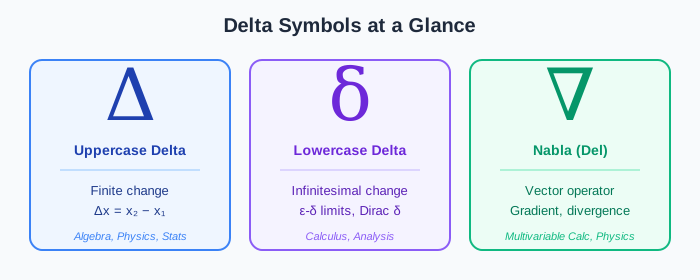
The three forms to know are uppercase Δ for finite measurable change, lowercase δ for infinitesimal or formally abstract change, and nabla ∇ for the vector differential operator. All three appear frequently in college-level coursework, often in the same course.
2) A Brief History of Delta
Delta derives from the Phoenician letter dalet, which represented a door or opening. The Greeks adopted it as the fourth letter of their alphabet and gave it the triangular shape that persists today. The uppercase form Δ is a triangle, which made it a natural symbol for geometry and change — two concepts with deep roots in ancient mathematics.
European mathematicians in the 17th and 18th centuries began systematizing the use of Δ to denote differences and increments. Leibniz and Newton, working independently on calculus, introduced notation for infinitesimal change; the lowercase δ eventually became the standard for the infinitely small quantities that calculus requires. William Rowan Hamilton introduced the nabla symbol ∇ in the 19th century for use in vector analysis, where it became the foundation of modern field theory.
Today delta notation is standardized across virtually every quantitative discipline. A student who understands what each form of the symbol means — and when each is used — has a significant advantage in courses where multiple forms appear in the same problem.
3) Uppercase Delta (Δ) in Mathematics
Uppercase Δ is the most commonly encountered form of delta in introductory coursework. Its fundamental meaning is a finite, measurable change in a quantity between two specific values.
This notation appears across subjects in similar forms. In algebra and coordinate geometry, Δx and Δy describe the horizontal and vertical change between two points, and their ratio Δy/Δx is the slope of the line connecting them. In physics, Δt is the elapsed time between two measurements, Δv is the change in velocity, and ΔE is the change in energy. In statistics, Δμ or Δσ can represent the change in a population mean or standard deviation between two conditions.
The uppercase form is also used in a structurally different way in algebra: the discriminant of a quadratic equation is written as Δ = b² − 4ac. Here Δ is not a change between two values — it is a calculated quantity that determines the nature of the equation’s roots. This dual use of Δ in the same algebra course (change vs. discriminant) is a common source of confusion. The context makes clear which meaning applies: Δx means change in x, while a standalone Δ in the context of a quadratic equation means the discriminant.
4) Lowercase Delta (δ) in Mathematics
Lowercase δ is used in contexts where the change being described is either infinitesimally small or formally abstract rather than a specific numerical difference. It appears most prominently in three distinct roles.
The ε-δ definition of a limit
In real analysis and introductory calculus, the formal definition of a limit states: for every ε > 0 there exists a δ > 0 such that if |x − c| < δ then |f(x) − L| < ε. Here δ represents the radius of an interval around the input value c — how close x must be to c to guarantee f(x) stays within ε of the limit L. This is the most rigorous definition in calculus, and δ in this context is a tool for constructing mathematical proofs rather than a quantity you compute directly.
The Dirac delta function
The Dirac delta function δ(x) is a generalized function (technically a distribution) that is zero everywhere except at x = 0, where it is infinite in such a way that its integral over all real numbers equals 1. It models an instantaneous impulse — a force applied at a single instant, a charge at a single point, a signal at a single moment. It appears in differential equations, signal processing, quantum mechanics, and electromagnetism.
The Kronecker delta
The Kronecker delta δᵢⱼ is a function of two indices: it equals 1 when i = j and 0 when i ≠ j. It is used extensively in linear algebra and tensor notation to express conditions like orthonormality of basis vectors or to simplify summations. If you see δᵢⱼ in a matrix or tensor expression, it is selecting diagonal entries or enforcing an identity condition.
5) Nabla (∇): The Upside-Down Delta
Nabla (∇), also called del, looks like an inverted Δ but is a completely separate symbol with a completely separate function. It is not a form of delta — it is a vector differential operator. When applied to different types of functions, it produces three distinct operations.
Gradient (∇f)
When nabla acts on a scalar function f, the result is the gradient vector ∇f. The gradient points in the direction of the steepest increase of f and has magnitude equal to the rate of that increase. In a temperature field, ∇T points toward the hottest direction at any given point. Gradient is the first operation students typically encounter with nabla, usually in Calculus III.
Divergence (∇·F)
When nabla is dotted with a vector field F, the result is the divergence ∇·F, a scalar that measures whether the field is expanding outward from a point (positive divergence, a source) or collapsing inward (negative divergence, a sink). Divergence appears in fluid dynamics and Maxwell’s equations for electromagnetism.
Curl (∇×F)
When nabla is crossed with a vector field F, the result is the curl ∇×F, a vector that measures the rotational tendency of the field at each point. High curl means the field is swirling. Low curl means it is not. Curl is fundamental in describing magnetic fields and fluid rotation.
Why students confuse ∇ and Δ
The visual similarity is the entire source of confusion. ∇ is Δ rotated 180 degrees. But operationally they have nothing in common. Δ is a subtraction operator. ∇ is a vector derivative operator. If you see ∇ in a problem, you are doing multivariable calculus or vector analysis — not computing a difference.
6) Delta in Algebra: The Discriminant
In algebra, the most important use of Δ is the discriminant of a quadratic equation. Given the equation ax² + bx + c = 0, the discriminant is:
The sign of Δ tells you everything about the nature of the roots before you solve the equation. You do not need to apply the quadratic formula to know how many real solutions exist — the discriminant answers that question first.
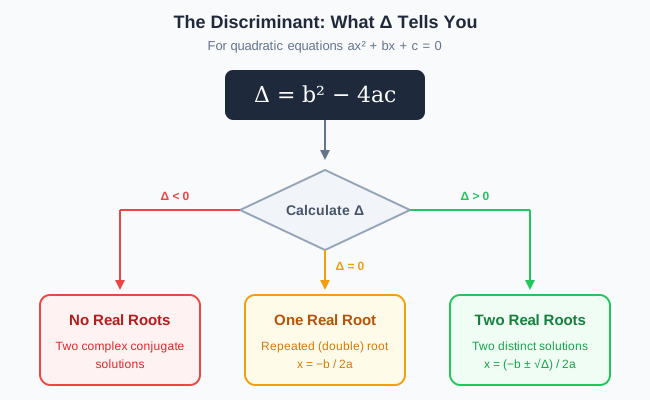
The discriminant is tested in College Algebra, Precalculus, and any course that covers quadratic equations. It is also the foundation for understanding complex numbers — when Δ < 0, the square root of a negative number appears in the quadratic formula, which is where imaginary numbers enter the picture. For a full treatment of quadratic methods, see our algebra help page.
7) Delta in Calculus
Delta connects algebra to calculus through the concept of the derivative. The conceptual leap from Δy/Δx (average rate of change) to dy/dx (instantaneous rate of change) is precisely what calculus is built on, and delta notation is how that transition is expressed.
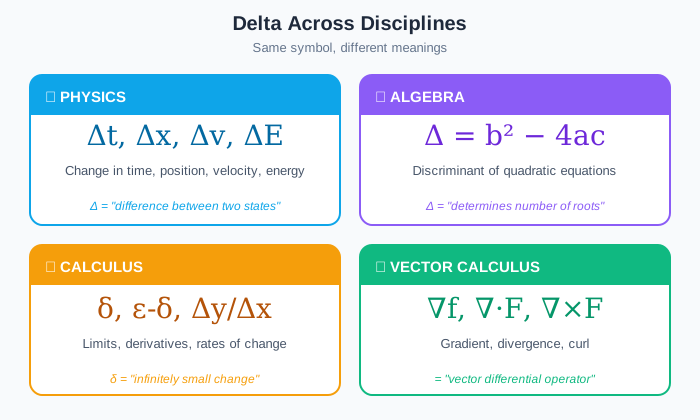
In precalculus and early calculus, Δy/Δx is the slope of the secant line through two points on a curve. As Δx gets smaller, the secant line approaches the tangent line. In the limit as Δx approaches zero, Δy/Δx becomes the derivative dy/dx — the instantaneous rate of change at a single point. The entire derivative definition is a statement about what happens to a ratio of deltas as one of them approaches zero.
The formal ε-δ definition of a limit is where lowercase δ enters. For a limit to exist at x = c, you need to be able to make f(x) arbitrarily close to L (within any ε you choose) by keeping x close enough to c (within some δ). The proof consists of finding the right δ for any given ε. These proofs are notoriously difficult for students encountering them for the first time. For help with derivatives, limits, and ε-δ proofs, see our calculus help page.
8) Delta in Statistics
In statistics, Δ most commonly appears when comparing two groups or two conditions. The difference between means is written Δμ = μ₁ − μ₂, following the standard pattern of Δ as a subtraction of two values of the same quantity. This shows up in hypothesis testing whenever you are testing whether a true difference exists between two populations.
Effect size and Cohen’s d
Cohen’s d is a standardized effect size statistic that expresses the difference between two means in units of standard deviation. While it uses the letter d rather than Δ, it is conceptually a delta — a normalized measure of how large a difference is relative to variability. In research methods and biostatistics courses, understanding the relationship between Δ (raw difference) and standardized effect size measures is a core competency.
The delta method
The delta method is a technique for approximating the variance of a nonlinear function of a random variable using a Taylor series expansion. It is used when you have an estimate of a parameter and want to propagate uncertainty through a transformation of that parameter. This appears in advanced statistics, econometrics, and biostatistics courses. For help with statistics coursework across platforms, see our statistics help page.
9) Delta in Physics and Engineering
Physics uses uppercase Δ more consistently than almost any other discipline. Every kinematic quantity has a delta form, and the pattern is always the same: final value minus initial value.
| Symbol | Meaning | Example |
|---|---|---|
| Δt | Change in time | Δt = t₂ − t₁ |
| Δx | Displacement | Δx = x_final − x_initial |
| Δv | Change in velocity | a = Δv / Δt |
| ΔE | Change in energy | Work-energy theorem: W = ΔKE |
| ΔT | Change in temperature | Q = mcΔT (heat transfer) |
Engineering extends this further: Δ appears in structural analysis for deflection calculations, in circuit theory for voltage drop across a component, and in thermodynamics for entropy and enthalpy changes. The Heisenberg uncertainty principle in quantum mechanics is also expressed using Δ: ΔxΔp ≥ ℏ/2, where Δx is the uncertainty in position and Δp is the uncertainty in momentum. For help with physics coursework, see our physics help page.
10) Unicode and Encoding Reference
Need to type a delta symbol in a document, code, or online tool? Here is every format you might need.
| Symbol | Name | Unicode | HTML Entity | LaTeX |
|---|---|---|---|---|
| Δ | Capital Delta | U+0394 | Δ | \Delta |
| δ | Lowercase Delta | U+03B4 | δ | \delta |
| ∇ | Nabla | U+2207 | ∇ | \nabla |
Keyboard shortcuts
Windows: Alt + 916 for Δ, Alt + 235 for δ (numeric keypad required). In Microsoft Word, type 0394 then press Alt + X to convert to Δ.
Mac: Control + Command + Space opens the character viewer — search “delta” to find both forms. Or use the Greek keyboard layout.
LaTeX: Use \Delta for Δ and \delta for δ inside math mode. \nabla for ∇.
11) How FMMC Can Help
If delta is showing up in your coursework and you are stuck — whether it is the discriminant in College Algebra, ε-δ proofs in Calculus, ∇ in Calc III, or Δ notation in a physics or statistics course — FMMC’s experts cover every subject and every platform. We handle full courses and individual assignments, backed by an A/B grade guarantee.
Algebra
Discriminants, quadratics, polynomials. Algebra help →
Calculus
Limits, derivatives, ε-δ proofs, vector calc. Calculus help →
Statistics
Hypothesis testing, effect size, inference. Statistics help →
Physics
Kinematics, thermodynamics, E&M. Physics help →
Stuck on a delta problem right now? Tell us your course, platform, and what you are working on.
Also on FMMC
If you are working with the DeltaMath platform specifically, see our DeltaMath help page for platform-specific guidance.
FAQ
What does Δ mean in math?
In math, Δ (uppercase delta) generally means “change” or “difference.” Δx = x₂ − x₁ represents the change in x between two values. In algebra, Δ also represents the discriminant of a quadratic equation (Δ = b² − 4ac), which determines how many real roots the equation has.
What is the difference between Δ and δ?
Δ (uppercase) represents a finite, measurable change between two specific values — like the difference between two points on a graph. δ (lowercase) represents an infinitesimally small or formally abstract quantity — used in ε-δ limit proofs, the Dirac delta function, and the Kronecker delta. Both are Greek letters but they serve different mathematical roles even within the same course.
What is ∇ and how is it different from Δ?
∇ (nabla) is a vector differential operator used in multivariable calculus. When applied to a scalar function it gives the gradient ∇f. When dotted with a vector field it gives divergence ∇·F. When crossed with a vector field it gives curl ∇×F. Despite looking like an upside-down Δ, nabla has nothing to do with finite differences — it is a calculus operator, not a subtraction symbol.
What is the discriminant and what does its sign tell you?
The discriminant Δ = b² − 4ac is calculated from the coefficients of ax² + bx + c = 0. If Δ > 0, the equation has two distinct real roots and the parabola crosses the x-axis twice. If Δ = 0, there is one repeated real root and the parabola is tangent to the x-axis. If Δ < 0, there are no real roots — the solutions are complex conjugates — and the parabola does not touch the x-axis at all.
What is the ε-δ definition of a limit?
The ε-δ definition states that the limit of f(x) as x approaches c equals L if: for every ε > 0 there exists a δ > 0 such that if |x − c| < δ then |f(x) − L| < ε. In plain terms: you can keep f(x) as close to L as you want by keeping x close enough to c. The δ is the radius of the input interval you need, and it depends on the ε you are trying to achieve.
How is delta used in physics?
In physics, Δ consistently means “final value minus initial value” for any quantity. Δt is elapsed time (t₂ − t₁), Δx is displacement (x_final − x_initial), Δv is change in velocity, ΔE is change in energy, and ΔT is change in temperature. The pattern is universal: delta always tells you how much something changed, not where it started or ended.
How do I type the delta symbol?
On Windows, use Alt + 916 for Δ or Alt + 235 for δ with a numeric keypad. In Microsoft Word, type 0394 then press Alt + X. On Mac, use Control + Command + Space and search “delta” in the character viewer. In LaTeX, use \Delta for Δ and \delta for δ inside math mode. The Unicode code points are U+0394 for Δ and U+03B4 for δ.
Can FMMC help with courses that use delta notation?
Yes. FMMC handles algebra, calculus, statistics, and physics courses across all major platforms. Whether delta appears as the discriminant in College Algebra, ε-δ proofs in Calculus, or Δ notation in a physics course, our team covers it. See our contact page to get a free quote.
Stuck on a Course That Uses Delta?
Whether it’s the discriminant in College Algebra, ε-δ proofs in Calculus, or ΔT in Physics — FMMC’s experts handle it. A/B guaranteed or your money back.
Or email: info@finishmymathclass.com • A/B Guarantee • DeltaMath Help