
Equations and Inequalities
Equations and inequalities are the backbone of algebra. An equation pins down an exact value. An inequality describes a range. Both use the same core solving steps — with one critical rule that applies only to inequalities. This guide covers everything from linear equations and inequalities through compound inequalities and absolute value, with worked examples, practice problems, and a breakdown of the mistakes that cost students the most points.
The Core Rules
Equations give exact answers: Solve for the specific value (or values) that make the equation true. The answer is one or more numbers.
Inequalities give solution sets: Solve for the range of values that satisfy the inequality. Write the answer in inequality or interval notation.
The sign-flip rule: When you multiply or divide both sides of an inequality by a negative number, you must reverse the inequality symbol. Adding or subtracting never flips it.
Absolute value splits into cases: Isolate the absolute value first, then write two equations or a compound inequality depending on the symbol used.
Table of Contents
1) Equations vs. Inequalities — Key Differences
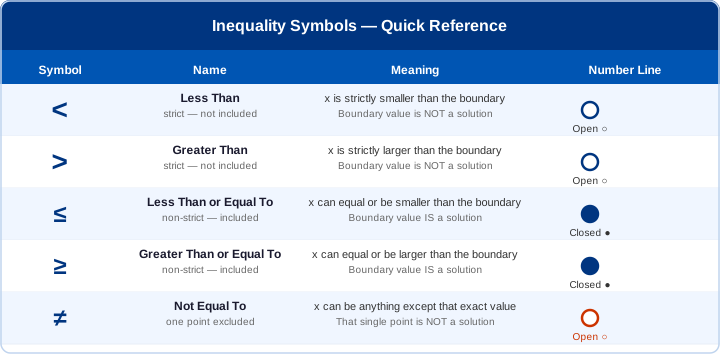
An equation uses an equals sign (=) to state that two expressions have exactly the same value. Solving an equation means finding the specific value or values that make that statement true.
An inequality uses a comparison symbol to state that one expression is greater than, less than, or not equal to another. Solving an inequality produces a range of values — a solution set rather than one exact answer.
Equation: exact answer
2x + 3 = 11 → x = 4. One specific value satisfies the equation.
Inequality: solution set
2x + 3 < 11 → x < 4. Every number less than 4 satisfies it.
Interval notation quick reference
x ≤ 4 → (−∞, 4] bracket: 4 is included
x > −1 → (−1, ∞) always parenthesis with ∞
x ≥ −1 → [−1, ∞)
2) Solving Linear Equations — Quick Review
Solving a linear equation means isolating the variable using inverse operations. The same process applies directly to inequalities, so this review is worth doing before moving on. For a full treatment, see our solving linear equations guide.
The process step by step
Simplify both sides first — distribute, combine like terms, clear fractions if present. Then move all variable terms to one side and all constants to the other. Finally, divide (or multiply) to isolate the variable.
3x = 14 + 7 = 21
x = 21 ÷ 3 = 7
2x + 8 − 3 = 11 ← distribute
2x + 5 = 11
2x = 6
x = 3
3) Solving Linear Inequalities
Solving a linear inequality uses the exact same steps as solving an equation — with one critical exception that trips up students more than anything else in this topic.
The Sign-Flip Rule: When you multiply or divide both sides by a negative number, you must reverse the inequality symbol.
Adding or subtracting — even negative numbers — never flips the sign. Only multiplication and division by a negative trigger the flip.
Why does the sign flip?
Multiplying by −1 reverses the order of all numbers on the number line. Since 3 > 2, multiplying both by −1 gives −3 < −2. The relationship flips. The same thing happens to your inequality whenever you divide by a negative coefficient.
Example 1 — No sign flip needed
2x < 12
x < 6 ← divided by +2, no flip
Answer: x < 6, or (−∞, 6)
Example 2 — Sign flip required
−3x > 6
x < −2 ← divided by −3, FLIP the sign
Answer: x < −2, or (−∞, −2)
4) Compound Inequalities
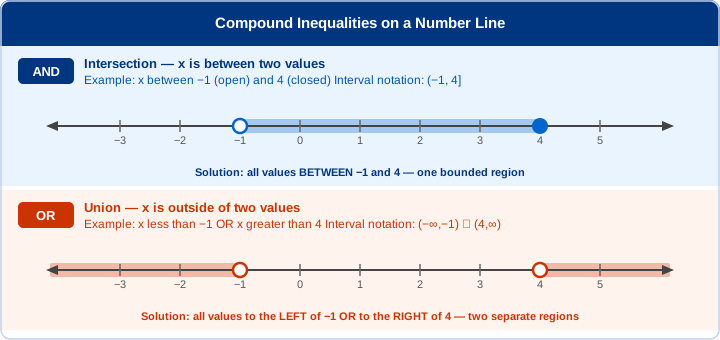
A compound inequality joins two inequalities with the word and or the word or. The choice between those two words completely changes the solution set — getting them confused is one of the most common errors in this topic.
AND — Intersection
Both conditions must be true at once. The solution is the overlap — a single bounded region. Written as a three-part statement: −2 < x < 5.
OR — Union
At least one condition must be true. The solution is the combined set — two separate outer regions. Written as: x < −2 or x > 5.
Solving AND compound inequalities
Write the AND inequality as a single three-part statement and perform the same operation on all three parts simultaneously.
−4 ≤ 2x < 6 ← subtract 3 from all parts
−2 ≤ x < 3 ← divide all parts by 2
Answer: [−2, 3)
Solving OR compound inequalities
Solve each inequality separately, then join the two solution sets with “or.”
Left: 3x < −3 → x < −1
Right: 2x > 6 → x > 3
Answer: (−∞, −1) ∪ (3, ∞)
5) Absolute Value Equations
The absolute value of a number is its distance from zero. Distance is always non-negative, so |x| = 5 is satisfied by x = 5 and x = −5. That two-case structure is the foundation of every absolute value equation.
The absolute value rule for equations
If |A| = 0: one solution only, A = 0
If |A| = negative number: no solution
Always isolate the absolute value expression before splitting into two cases.
Example 1 — Standard case
Case 1: 2x − 3 = 7 → x = 5
Case 2: 2x − 3 = −7 → x = −2
Answer: x = 5 or x = −2
Example 2 — Isolate first
3|x + 1| = 15 ← add 6
|x + 1| = 5 ← divide by 3
Case 1: x + 1 = 5 → x = 4
Case 2: x + 1 = −5 → x = −6
Answer: x = 4 or x = −6
6) Absolute Value Inequalities
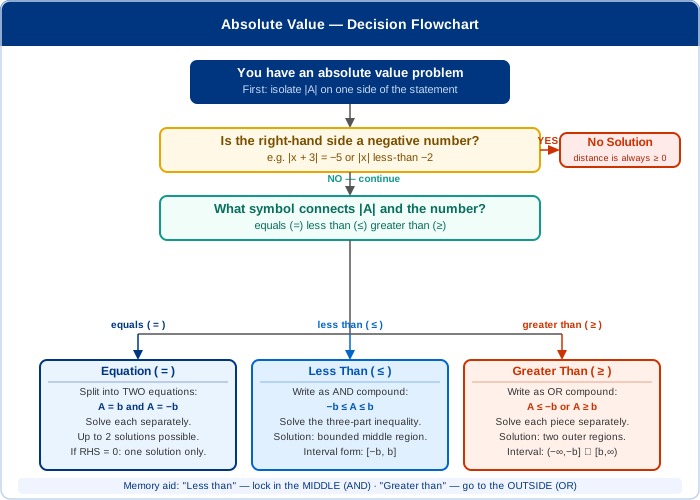
Absolute value inequalities combine the distance-from-zero concept with compound inequalities. The direction of the symbol determines which compound form you write — this is one of the most testable patterns in algebra.
“Less than” → AND
|A| < b becomes −b < A < b
Lock it in the middle. One bounded region.
“Greater than” → OR
|A| > b becomes A < −b or A > b
Go to the outside. Two separate regions.
Example 1 — Less than
−3 ≤ x − 4 ≤ 3 ← AND form
1 ≤ x ≤ 7 ← add 4 to all parts
Answer: [1, 7]
Example 2 — Greater than
2x + 1 < −5 or 2x + 1 > 5 ← OR form
x < −3 or x > 2
Answer: (−∞, −3) ∪ (2, ∞)
Special cases to know:
|A| < negative number → No solution. Distance cannot be less than a negative.
|A| > negative number → All real numbers. Distance is always ≥ 0, so always greater than any negative.
7) Graphing Inequalities on a Number Line
Every inequality solution can be graphed on a number line. Two conventions must be applied correctly every time: the type of dot at each endpoint, and which direction to shade.
Closed Dot • — used with ≤ or ≥
The endpoint is included in the solution set. Matches bracket notation [ ] in interval form.
Open Dot ° — used with < or >
The endpoint is not included in the solution set. Matches parenthesis notation ( ) in interval form.
x ≥ −1 → closed dot at −1, shade RIGHT
−2 < x ≤ 5 → open dot at −2, closed dot at 5, shade BETWEEN
x < −1 or x > 4 → open dots at −1 and 4, shade both OUTER regions
When in doubt, test a point. Pick any number from the region you shaded and plug it into the original inequality. If it makes the inequality true, you shaded the right direction.
8) Common Mistakes
These are the errors that show up most consistently on algebra exams and homework platforms. Most come down to one skipped step or one forgotten rule.
Forgetting to flip the inequality sign
The most common error in this entire topic. After dividing or multiplying by a negative, circle the symbol and confirm it reversed. It is easy to do the arithmetic correctly and still write the wrong answer because you forgot the flip.
Confusing AND vs. OR in compound inequalities
AND narrows the solution to an intersection; OR widens it to a union. Pay close attention to the connecting word. A three-part statement like −2 < x < 5 is always AND.
Not isolating the absolute value before splitting
In 2|x − 1| + 4 = 10, you must get |x − 1| = 3 before writing two cases. Splitting before isolating produces wrong answers every time.
Wrong dot type on number line graphs
Strict inequalities (< and >) get open dots. Non-strict (≤ and ≥) get closed dots. Mixing these up costs easy points on exams and is one of the first things instructors check.
Assuming absolute value always gives two solutions
|A| = 0 has exactly one solution. |A| = negative number has no solution at all. Always check the right-hand side before writing any cases.
9) Practice Problems with Solutions
Work through each problem before opening the solution. They cover every major concept from this guide.
Problem 1 — Linear Inequality
Show Solution
−4x ≥ 8
x ≤ −2 ← divided by −4, sign flips
Answer: (−∞, −2]
Problem 2 — Compound Inequality (AND)
Show Solution
−2 < 2x ≤ 8 ← add 1 to all parts
−1 < x ≤ 4 ← divide all parts by 2
Answer: (−1, 4]
Problem 3 — Compound Inequality (OR)
Show Solution
Right: 3x − 2 > 10 → x > 4
Answer: (−∞, −3) ∪ (4, ∞)
Problem 4 — Absolute Value Equation
Show Solution
Case 2: 3x + 6 = −15 → x = −7
Answer: x = 3 or x = −7
Problem 5 — Absolute Value Inequality (Less Than)
Show Solution
−8 < 5x − 2 < 8
−6 < 5x < 10
−6/5 < x < 2
Answer: (−1.2, 2)
Problem 6 — Absolute Value Inequality (Greater Than)
Show Solution
4 − x ≤ −6 or 4 − x ≥ 6
x ≥ 10 or x ≤ −2 ← divide by −1, signs flip
Answer: (−∞, −2] ∪ [10, ∞)
10) How FMMC Can Help
Equations and inequalities appear in every algebra module and on nearly every proctored exam. If you are behind on assignments or need help across a full algebra course, FMMC’s experts handle every module with an A/B guarantee. This topic connects directly to our solving linear equations guide and our factoring guide.
Algebra Homework
Every equations and inequalities module handled accurately on MyMathLab, ALEKS, WebAssign, and Hawkes. See our algebra homework help page.
Proctored Exams
Algebra exams on Honorlock and Respondus supported. See our proctored exam page.
A/B Guarantee
A or B grade or your money back — see our guarantee.
Behind on algebra or exam coming up? Tell us your course, platform, and next due date.
FAQ: Equations and Inequalities
When do you flip the inequality sign?
You flip the inequality sign whenever you multiply or divide both sides by a negative number. Adding or subtracting — even negative values — never flips the sign. For example, dividing both sides of x > 4 by −1 gives x < −4. The relationship reverses because multiplying by a negative number reverses the order of all real numbers.
What is the difference between interval notation and inequality notation?
They describe the same solution set in different formats. Inequality notation uses symbols: x < 4 or −1 ≤ x < 7. Interval notation writes the same answers as (−∞, 4) or [−1, 7). Parentheses exclude the endpoint; brackets include it. Infinity always gets a parenthesis.
Can an absolute value equation have no solution?
Yes. If the absolute value is set equal to a negative number — for example |x + 3| = −5 — there is no solution. Absolute value represents distance from zero and is always non-negative. Always check the right-hand side before writing two cases. If it is negative, write “no solution” and stop.
How do I know if a compound inequality is AND or OR?
Look at the connecting word. If the problem says “and” or is written as a three-part expression like −3 < x < 7, it is an AND inequality — the solution is the intersection where both conditions hold at once. If it says “or,” the solution is the union of values satisfying at least one condition.
Why does |x| < a give an AND inequality but |x| > a gives an OR?
|x| < a means x is within a units of zero, which confines x to a bounded region: −a < x < a. Both conditions hold at once — that is AND. |x| > a means x is more than a units from zero, which describes two outer regions: x < −a or x > a. Either region works — that is OR. The same logic applies when the absolute value contains an expression rather than just x.
Can FMMC help with equations and inequalities homework?
Yes. FMMC handles algebra homework across MyMathLab, ALEKS, WebAssign, and Hawkes Learning. See our algebra homework help page or get a free quote.
Algebra Homework Piling Up?
Tell us your course, platform, and next due date. FMMC’s algebra experts handle every assignment — A/B guaranteed or your money back.
Or email: info@finishmymathclass.com • A/B Guarantee • Algebra Help