
How Many ALEKS Topics Equal 1 Percent?
Quick Answer
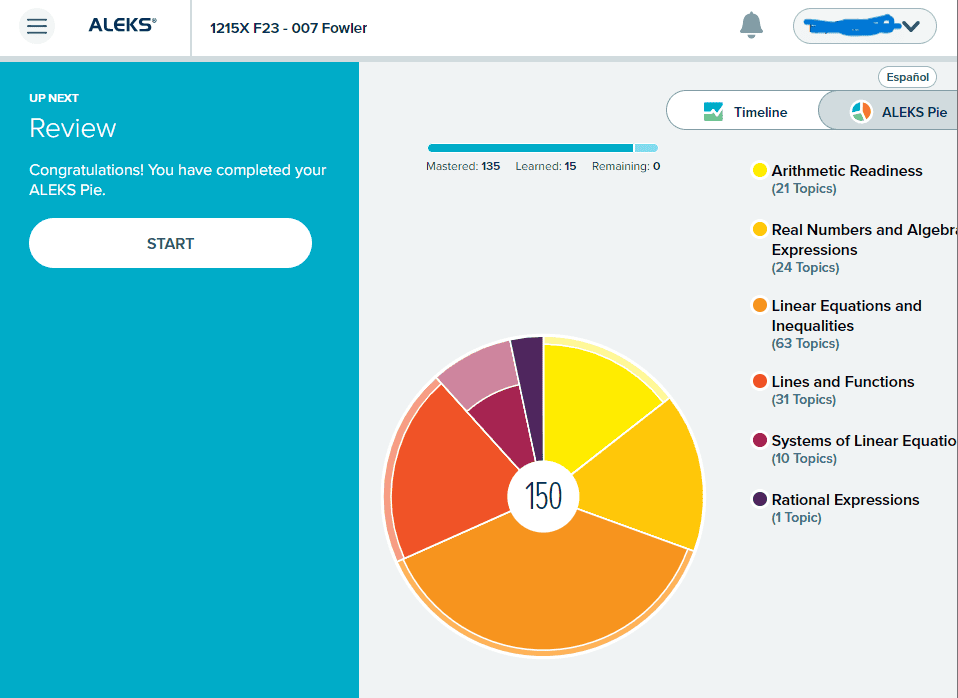
Most ALEKS courses require 1.5 to 2.5 topics per 1% of your pie. The exact number depends on your course’s total topic count. To find your ratio: check your pie chart for total topics, then divide by 100. A 200-topic course = 2 topics per percent. A 250-topic course = 2.5 topics per percent.
Need help finishing your ALEKS pie? Get expert ALEKS help | A/B Grade Guarantee
On This Page
Topics Per Percent by Subject
ALEKS courses vary in total topic count based on subject and instructor customization. Here are typical ranges:
| Subject | Typical Total Topics | Topics per 1% | Topics for 10% |
|---|---|---|---|
| Basic Math | 150-180 | 1.5-1.8 | 15-18 |
| Pre-Algebra | 180-220 | 1.8-2.2 | 18-22 |
| Beginning Algebra | 220-260 | 2.2-2.6 | 22-26 |
| Intermediate Algebra | 240-280 | 2.4-2.8 | 24-28 |
| College Algebra | 200-250 | 2.0-2.5 | 20-25 |
| Precalculus | 220-270 | 2.2-2.7 | 22-27 |
| Trigonometry | 140-180 | 1.4-1.8 | 14-18 |
| Statistics | 160-200 | 1.6-2.0 | 16-20 |
| General Chemistry | 200-240 | 2.0-2.4 | 20-24 |
How to Find Your Course’s Total Topics
The table above shows ranges, but your specific course may differ based on instructor settings. Here’s how to find your exact number:
Method 1: Pie Chart Hover
Hover your cursor over the ALEKS pie chart. A tooltip displays “X of Y topics mastered” — Y is your total topic count.
Method 2: Reports Tab
Click “Reports” in your ALEKS navigation, then select “Progress Report” or “Time and Topic Report.” Your total topics appear in the course information section.
Method 3: Ask Your Instructor
Instructors see exact topic counts in their dashboard and can tell you the precise number.
Your formula: Total Topics ÷ 100 = Topics per 1%
Why Topic Counts Vary
Even courses with the same name can have different topic counts:
- Instructor customization: Professors can add or remove topics based on course objectives
- Institutional requirements: Different schools have varying content standards
- Combined courses: Some institutions merge subjects (Algebra I + II) creating 300+ topic courses
- Prerequisite inclusion: Some courses include review material, others don’t
This is why “College Algebra” at one school might require 2.0 topics per percent while the same course name elsewhere requires 2.8 — a 40% difference in workload.
Quick Calculation Example
Your Scenario: 45% → 90% in College Algebra
Step 1: Find total topics → Your course has 220 topics
Step 2: Calculate topics per 1% → 220 ÷ 100 = 2.2 topics per percent
Step 3: Calculate percentage gap → 90% – 45% = 45% needed
Step 4: Calculate topics needed → 45 × 2.2 = 99 topics to master
Now you know exactly what you’re working with.
What This Means for Time
Once you know how many topics you need, the natural question is: how long will that take?
Average time per topic: 10-15 minutes for most math topics, 15-20 minutes for Chemistry or word-heavy Statistics problems. This includes reading the explanation, solving practice problems, and demonstrating mastery.
Using the example above (99 topics needed):
- At 12 minutes per topic: 99 × 12 = 1,188 minutes = ~20 hours
- At 2 hours per day: ~10 days to go from 45% to 90%
- At 1 hour per day: ~20 days
Reality check: Add 20-30% buffer time. Knowledge Checks can remove topics you’ve already mastered, and later topics tend to be harder than early ones. That 20-hour estimate is more realistically 25-28 hours of actual work.
Running out of time? Our experts can help you reach your target percentage while you focus on other priorities.
Important: Your Percentage Can Go Down
ALEKS uses Knowledge Checks to verify you’ve retained material. If you fail Knowledge Check questions, topics get removed from your mastered pie — your percentage decreases even without doing anything wrong. Learn how Knowledge Checks work.
Frequently Asked Questions
How long does it take to complete 1% in ALEKS?
For most courses, 1% equals about 2 topics. At 10-15 minutes per topic, expect 20-30 minutes per percentage point. Harder subjects like Chemistry or Statistics take longer per topic. See which subjects take longest.
Why did my percentage go down?
ALEKS Knowledge Checks periodically test your retention. If you miss questions on previously mastered topics, ALEKS removes them from your pie. This is normal but frustrating. Full Knowledge Check guide.
Can I speed up my ALEKS progress?
Yes. A strong Initial Knowledge Check can skip you past 60-90% of topics you already know. Learn how to maximize your Initial KC. For ongoing work, see our guide to finishing ALEKS fast.
Why does my friend’s ALEKS have different topics than mine?
ALEKS is adaptive — it shows you topics based on what you already know. Two students in the same class will see different “ready to learn” topics depending on their Initial Knowledge Check results and what they’ve mastered.
How many topics do I need to reach 100%?
Check your pie chart for total topics (hover or see Reports). That’s how many you need. For a 200-topic course, you need all 200 mastered. For 250 topics, you need all 250.
Is it faster to work on easy topics first?
Sometimes. Easy topics boost your percentage quickly early on. But ALEKS has prerequisite chains — some topics only unlock after you master foundational ones. Focus on “ready to learn” topics that unlock the most dependent topics for fastest overall progress.
Why is my progress slower near the end?
Two reasons: (1) Later topics tend to be harder and take longer to master, and (2) fewer topics remain, so each one represents a smaller percentage gain. A course with 200 topics means each topic = 0.5%. Near the end, gaining 5% requires 10 harder topics instead of 10 easier ones from the beginning.
Related ALEKS Guides
- ALEKS Initial Knowledge Check Hack
- Complete Guide to ALEKS Knowledge Checks
- Complete All ALEKS Topics Fast
- Hardest ALEKS Subjects
- Easiest ALEKS Subjects
- How to Cheat on ALEKS: What Actually Works
Get ALEKS Help by Subject
See what our clients say | View pricing | Our guarantee