
Sophia Learning markets itself as self-paced and flexible, which creates the impression that courses can be finished in whatever time you have available. That is partly true — but the actual completion speed depends on factors most students do not anticipate, particularly how touchstone grading delays create minimum calendar timelines that no amount of effort can compress. This page explains how Sophia courses are structured, what actually controls completion speed, which courses finish fastest, and realistic timeframes across subject categories.
Quick Answer
Fast milestone-only courses like Introduction to Ethics or Ancient Greek Philosophers can be completed in 3–7 days with focused effort. Math and science courses typically take 14–21 days due to problem-solving complexity. Writing-intensive courses like English Composition take 14–30 days because each essay touchstone requires human grader review with 24–72 hour turnaround. The biggest variable most students underestimate is not how fast they work through content — it is how many touchstones a course has and how long each one takes to grade.
Table of Contents
1) How Sophia Courses Are Structured
2) What Actually Controls Completion Speed
3) Realistic Timeframes by Course Type
1) How Sophia Courses Are Structured
Sophia courses use two distinct assessment types, and the difference between them is the single most important thing to understand about completion speed.
Milestones (Auto-Graded)
Milestones are multiple-choice or objective question assessments graded instantly by the platform. There are no grading delays — you submit, you get a result, you move on. Practice versions with unlimited attempts are available before the graded milestone. Students who know the material can complete milestones in minutes. These are the assessments that make fast Sophia completions possible.
Touchstones (Human-Graded)
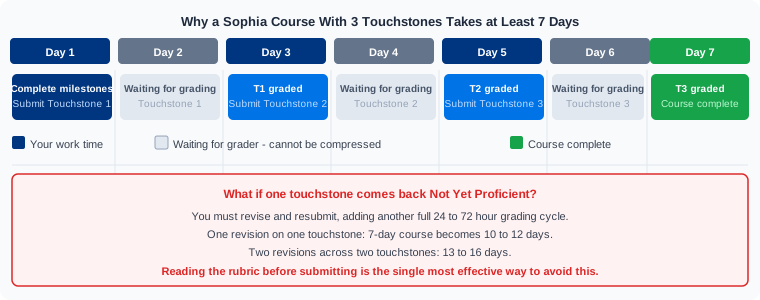
Touchstones are essays, problem-solving assignments, or projects reviewed by a human evaluator. Each touchstone adds a mandatory 24–72 hour wait for grading, regardless of how fast you complete it. If a touchstone comes back as Not Yet Proficient, revision and resubmission adds another grading cycle. A course with three touchstones has a minimum calendar completion time of roughly 7 days even if you could theoretically finish all the work in a single afternoon.
Most Sophia courses also include learning content — videos, readings, and interactive activities — that is not graded and can be skipped or skimmed if you already know the material. Challenge assessments are ungraded practice versions of milestones that help identify gaps before the graded version.
2) What Actually Controls Completion Speed
Completion speed on Sophia comes down to four variables, in rough order of importance.
Number of Touchstones in the Course
This is the dominant factor. A course with one touchstone has a minimum completion time of roughly 2–3 days. A course with four touchstones has a minimum of 8–12 days just from grading wait time, regardless of how much time you can dedicate. Before enrolling in a course under time pressure, check how many touchstones it contains.
Subject Difficulty and Prior Knowledge
A student with strong math background can move through College Algebra milestones quickly and produce passing touchstone work on the first attempt. A student for whom algebra is genuinely new material needs substantially more time — both to learn the content and to produce work that earns a Proficient rating. Quoted completion times almost always assume meaningful prior familiarity with the subject.
Touchstone Pass Rate on First Submission
A touchstone that comes back Not Yet Proficient requires revision and resubmission, adding another full grading cycle. A single revision on one touchstone can add 3–5 days to the total course timeline. Students who do not read rubric criteria carefully before submitting frequently end up with longer completion times than students who take more time upfront to produce strong first drafts.
Hours Available Per Day
Daily time investment determines how quickly you work through milestones and complete touchstone assignments. However, grading wait time is fixed regardless of how many hours you put in — which means daily hours matter primarily for milestone-heavy courses and less for touchstone-heavy ones. Putting in more hours cannot shorten grading turnaround.
3) Realistic Timeframes by Course Type
The table below reflects realistic completion ranges based on course structure and subject difficulty. The lower end assumes strong prior knowledge and dedicated study time; the upper end assumes the subject is mostly new and time is limited to a few hours per day.
| Course Type | Realistic Range | Primary Driver | Examples |
|---|---|---|---|
| Philosophy / Ethics | 3–7 days | Milestone-heavy, minimal touchstones | Intro to Ethics, Ancient Greek Philosophers, Intro to Philosophy |
| Social Sciences | 7–14 days | Moderate touchstone count, essay work | Intro to Psychology, Intro to Sociology, U.S. History I & II |
| Business / Economics | 7–14 days | Conceptual milestones plus application touchstones | Microeconomics, Macroeconomics, Intro to Business, Principles of Finance |
| Math / Statistics | 14–21 days | Problem-solving touchstones, calculation-heavy milestones | College Algebra, Statistics, Precalculus, Quantitative Literacy |
| Science | 14–21 days | Conceptual difficulty, lab-based touchstones | Intro to Chemistry, Environmental Science, Human Biology |
| Writing / English | 14–30 days | 4–6 essay touchstones, longest grading cycles | English Composition I & II, Principles of Public Speaking |
These ranges assume moderate subject familiarity. Students for whom the subject is genuinely new should add 50–100% to the lower bound. The ranges also assume touchstone submissions pass on the first attempt — failed submissions that require revision add one full grading cycle per touchstone.
| Daily Hours Available | Fast Courses (Ethics, Philosophy) | Moderate (Psychology, History) | Slow (Algebra, English Comp) |
|---|---|---|---|
| 1–2 hours/day | 7–14 days | 14–21 days | 21–30+ days |
| 3–4 hours/day | 4–7 days | 7–14 days | 14–21 days |
| 6+ hours/day | 3–5 days | 5–10 days | 10–16 days |
4) Fastest and Slowest Sophia Courses
Course selection is the single most controllable factor in how quickly you complete Sophia work. If you are under time pressure, choosing the right course matters more than how many hours you put in.
Fastest Courses (3–7 days)
Introduction to Ethics — primarily milestone-based, 1–2 touchstones, straightforward content. Consistently the fastest Sophia course.
Ancient Greek Philosophers — conceptual learning, milestone-heavy, minimal written work.
Introduction to Philosophy — similar structure to Ethics, multiple-choice heavy.
Approaches to Studying Religions — informational content, minimal complex analysis.
Moderate-Speed Courses (7–14 days)
Introduction to Psychology and Introduction to Sociology — balanced mix of milestones and touchstones, moderate essay complexity.
U.S. History I & II — substantial content volume and multiple touchstones, but the writing is generally straightforward.
Microeconomics and Macroeconomics — conceptual milestones plus scenario-based application touchstones.
Slowest Courses (14–30 days)
College Algebra and Precalculus — calculation-heavy problem-solving touchstones. 14–21 days for strong math students, 21–30+ for those weak in algebra.
Statistics — data analysis touchstones, conceptually demanding milestones.
Introduction to Chemistry — lab-based touchstones, formula-heavy milestones.
English Composition I & II — consistently the slowest category. Each course has 4–6 essay touchstones, each requiring research and writing, each with a 24–72 hour grading turnaround.
5) How to Finish Faster
Several strategies reduce completion time without affecting the quality of your work. These are practical adjustments to how you sequence and time your work — not shortcuts.
Skip Content You Already Know
Videos, readings, and activities are not graded. Go directly to the challenge (practice) milestone to identify gaps, review only those sections, then take the graded milestone. Saves several hours per course for students with prior subject knowledge.
Submit Touchstones Tuesday–Thursday
Grading turnaround is fastest mid-week when more evaluators are active. Friday afternoon and weekend submissions often sit until Monday. This timing difference alone can shift your completion date by 3–4 days.
Work Multiple Courses in Parallel
While waiting for a touchstone to be graded on one course, work on milestones for another. Pair a slow touchstone-heavy course (Algebra) with a fast milestone-heavy course (Ethics) so you are always making progress somewhere.
Read the Rubric Before Every Touchstone
The most common cause of revision is not failing to understand the material — it is not addressing what the rubric specifically requires. A single revision adds a full grading cycle. Fifteen minutes reading the rubric before starting always saves more time than it costs.
6) How FMMC Can Help
FMMC helps students complete Sophia Learning courses in math, science, and statistics — the subject areas where most students hit the longest delays. We handle touchstone assignments, milestones, and full course completion. All work is backed by our A/B grade guarantee.
Math and Statistics
College Algebra, Statistics, Precalculus, and Quantitative Literacy completed by subject-matter experts. We handle both touchstone problem sets and milestone work. See our Sophia Learning answers page.
Science Courses
Introduction to Chemistry, Environmental Science, and Human Biology handled by science specialists familiar with Sophia’s lab-based touchstone requirements and rubric standards. See our Sophia Learning answers page.
A/B Guarantee
All Sophia work is backed by our A/B grade guarantee. If we take on your course or assignment and you do not receive an A or B, we make it right.
Stuck on a Sophia math or science course?
Tell us the course name, how far you have gotten, and your deadline. We will assess what is involved and give you a quote. See how our Sophia service works →
Need Help With a Sophia Learning Course?
Tell us the course, your timeline, and what you need covered. We will get back to you with a quote.
7) Frequently Asked Questions
What is the absolute fastest you can finish a Sophia course?
Milestone-only courses like Introduction to Ethics have been completed in 1–2 days by students who already knew the material and dedicated a full day to the work. Realistically, even the fastest courses take 3–5 days because touchstone grading adds a mandatory wait period. Courses with multiple touchstones cannot be completed in fewer days than the number of grading cycles they require, regardless of how fast you work.
How many Sophia courses can you complete in one month?
Students working 20–30 hours per week on milestone-heavy courses can realistically complete 3–4 courses in a month. Students working 5–10 hours per week or taking math and writing courses should expect 1–2. The most efficient approach is working multiple courses in parallel so grading wait time on one course does not stop progress entirely.
Do touchstone grading delays really add that much time?
Yes. A course with three touchstones has a minimum calendar completion time of roughly 7–9 days from grading waits alone, even if the total work could theoretically be completed in a single day. Weekend and holiday submissions extend this further. This is the most underestimated variable in Sophia completion planning — the timeline diagram in section 1 shows exactly how the days stack up.
What happens if I fail a touchstone?
A touchstone returned as Not Yet Proficient requires revision and resubmission. Each revision adds another 24–72 hour grading cycle to your timeline. Most touchstones allow 2–3 submission attempts. Exceeding the allowed attempts without passing means you cannot complete the course and must restart. This is why reading rubric criteria carefully before the first submission matters so much — a single revision on one touchstone can add nearly a week to your total completion time.
Can I skip the learning content and go straight to assessments?
Yes. Sophia’s videos, readings, and interactive activities are not graded and can be skipped. The practical approach is to take the challenge (practice) milestone first to identify gaps, then review only the content sections relevant to what you missed before taking the graded milestone. Students who already know the subject can often move through entire courses by going directly to challenge milestones and then graded assessments.
How long does it take to transfer Sophia credits to my college?
Sophia partner schools (including WGU, SNHU, Capella, and Purdue Global) typically process transcripts within 1–3 weeks. Non-partner schools that accept ACE credit recommendations evaluate on a case-by-case basis, which can take 4–12 weeks. If you are working against a graduation or financial aid deadline, complete Sophia courses at least 4–6 weeks before the deadline for partner schools, and 8–14 weeks for non-partners.
What subjects does FMMC help with on Sophia Learning?
FMMC handles Sophia math courses (College Algebra, Statistics, Precalculus, Quantitative Literacy), science courses (Chemistry, Environmental Science, Human Biology), and accounting. These are the subject areas where most students hit the longest delays and most benefit from expert help. See our Sophia Learning answers page for full details, or visit our Sophia course help page to learn how the service works.
Is it worth paying for help with a Sophia course?
It depends on the course and your situation. For math and science courses where you lack the background to complete touchstone problem sets accurately, getting help avoids failed touchstone submissions that add grading cycles and extend your timeline significantly. For students facing firm deadlines — subscription expiry, graduation, or program admission — the time savings from expert help can be substantial. For fast milestone-based courses in subjects you know, independent completion is straightforward. See our Sophia course help page for details on how the service works.