
Business Calculus is harder than most business majors expect and easier than they fear — but only if your algebra foundation is solid. This page gives an honest difficulty assessment: what makes it hard, how it compares to other math courses, how difficulty varies by major, and where students actually lose points on exams. For a full overview of what the course covers, see our Business Calculus guide.
Quick Answer
Business Calculus is moderately hard for students with strong algebra and genuinely difficult for those without it. The hardest parts are optimization word problems and the chain rule — both require multi-step thinking under time pressure. It is harder than Statistics for most students, easier than Calculus I for all of them. Your algebra preparation going in is the single best predictor of how hard it will feel.
Table of Contents
1) What Makes Business Calculus Hard
2) How Hard Compared to Other Math Courses
4) What Kills Students on Exams
1) What Makes Business Calculus Hard
Business Calculus difficulty comes from two distinct sources: what students bring in, and specific course content that demands multi-step thinking. The visual below separates them, because the fix is different depending on which category is causing the problem.
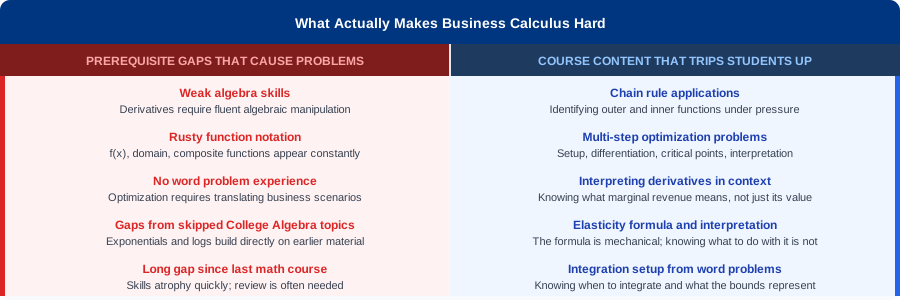
Weak algebra is the leading cause of failure. Business Calculus is not primarily a course about new concepts — much of it is applying calculus rules to expressions that then require significant algebraic simplification to solve. If you cannot factor, manipulate rational expressions, or work fluently with exponents and logarithms, you will lose points on nearly every problem even when your calculus setup is correct. The derivative step is often the easiest part of the problem.
The left column — prerequisite gaps — is fixable before the course starts or in the first two to three weeks. Targeted algebra review makes a measurable difference. The right column — course content that trips students — requires working through the material itself: chain rule applications, multi-step optimization, and integration setup from business word problems do not respond well to passive review. They require practiced problem-solving under realistic conditions.
A simple heuristic for identifying which column is your problem: if you earned a B or better in College Algebra within the last 18 months, your risk is the right column — focus your effort on chain rule practice and optimization word problems specifically. If you earned a C, struggled through it, or it was more than two years ago, address the left column first. Trying to learn derivatives while also relearning how to factor and manipulate rational expressions at the same time is where students fall the furthest behind.
2) How Hard Compared to Other Math Courses
Business majors typically encounter several math requirements across their degree. Where Business Calculus sits relative to those courses matters for planning and expectation-setting.
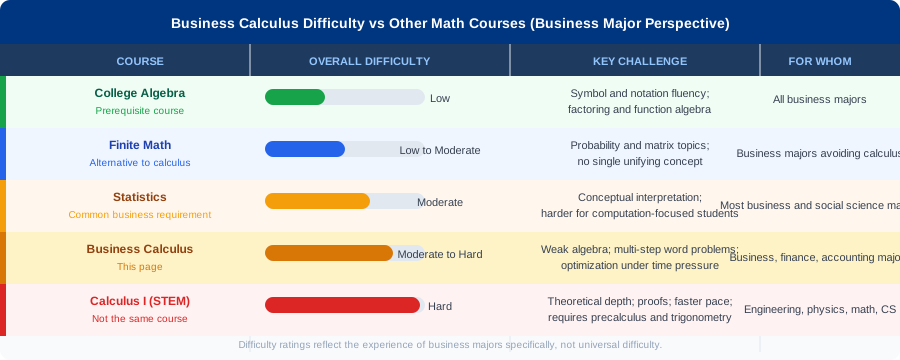
The comparison that matters most for most business students is Business Calculus vs Statistics, since both frequently appear as degree requirements and some programs let you choose. Business Calculus is harder for most students — it builds procedurally, meaning weak derivatives hurt you in optimization, which hurts you in everything that follows. Statistics topics are more independent of each other. The exception is student type: if you are stronger at conceptual reasoning than algebraic computation, Statistics can feel harder because interpretation is tested relentlessly. If you are strong at algebra and comfortable with procedures, Statistics tends to be the easier of the two. Finite Math is lighter than either if your program allows it. Calculus I is harder than Business Calculus by every measure — but “easier than Calculus I” leaves a lot of room to still be difficult for someone who has not taken math seriously in years.
3) How Hard by Major
Business Calculus difficulty is not uniform across business programs. The table below reflects patterns in who tends to struggle and who tends to manage, based on typical preparation and relevance of the material to each major.
| Major | Typical Difficulty | Why |
|---|---|---|
| Finance | Manageable | Strongest quantitative preparation of any business major. Compound interest, marginal analysis, and present value are directly relevant to later coursework, which motivates engagement. Students with recent College Algebra tend to handle the algebra load. |
| Accounting | Manageable to Moderate | Accounting students tend toward detail-orientation that helps with procedural accuracy. The course is less directly relevant than for Finance, which can reduce motivation. Students who are strong on computation but impatient with word problem interpretation sometimes lose points on applied questions. |
| Business Administration | Moderate to Hard | The broadest group with the most variable preparation. General BA students often have the weakest algebra backgrounds and the least direct connection between Business Calculus content and their intended career path. Students who completed College Algebra recently do fine; those who took it years ago under duress are the most at risk. |
| Marketing | Hard for Many | Marketing students frequently choose the major specifically because it seems less quantitative. Business Calculus lands as a surprise. The disconnect between the course content and perceived career relevance makes sustained engagement difficult. Demand elasticity is the one topic that resonates; the rest often feels abstract. |
| Economics | Varies Significantly | Economics students who take Business Calculus (versus Calculus I) are often in business school economics tracks. Those with strong quantitative preparation find it manageable. The content — marginal analysis, optimization, elasticity — is more directly relevant to economics than to any other business discipline, which helps. |
The single strongest predictor across all majors is not the major itself — it is how recently you completed College Algebra and how well you did. A marketing student who got an A in College Algebra last semester will outperform a finance student who scraped through it three years ago more often than not.
4) What Kills Students on Exams
There is a difference between finding the material hard in general and losing points on exams specifically. The following are the failure patterns that appear most consistently.
Optimization setup errors. Most students can differentiate a function they are handed. Far fewer can correctly construct the function from a word problem description before differentiating. An optimization problem that asks you to maximize profit given cost and revenue functions requires you to build the profit function first, then differentiate it, then solve, then verify you have a maximum and not a minimum. Students who skip or rush the setup step produce correct-looking work that answers the wrong question.
Chain rule identification failures. The chain rule applies whenever you are differentiating a composite function — a function inside another function. On exams, problems are not labeled by which rule to use. Students who only practiced the chain rule in isolation, when the problem type was obvious, fail to recognize it when it appears inside a more complex expression. The tell is a pattern of losing points on problems that looked easy.
Interpretation questions answered with numbers only. Business Calculus exams frequently ask what a derivative value means, not just what it is. A marginal cost of $4.50 at a production level of 200 units means something specific: producing the 201st unit costs approximately $4.50. Students who write only the number without the interpretation lose partial or full credit. This is particularly common on optimization problems where a final answer of x = 150 units needs to be stated as a production recommendation.
Sign errors in critical point classification. Second derivative tests require correctly evaluating the second derivative at a critical point and interpreting the sign. Negative means maximum; positive means minimum. Students who compute correctly but flip the interpretation — or who forget to apply the test at all — lose points on every optimization problem on the exam.
Time mismanagement on mixed exams. Business Calculus exams often mix problem types: some quick derivative rules, some elasticity calculations, one or two full optimization problems. Students who spend too long on early problems run out of time on the optimization questions, which typically carry the most weight. Spending fifteen minutes on a five-point problem and then rushing a twenty-point optimization is a grading pattern that produces failing exam scores even when the student understands the material.
If you are mid-semester and already seeing these patterns
Addressing exam strategy and weak topic areas before the next test matters more than reviewing material you already understand. Contact us with your current grade, your platform, and what is coming up on your syllabus and we can tell you what is realistic to fix before it counts. Get in touch →
5) Platform Difficulty: ALEKS vs MyMathLab vs WebAssign
The platform your institution uses affects how difficult the course feels in practice, independent of the math itself. ALEKS is the most time-demanding: its adaptive mastery model will not let you advance past a topic until the system judges you proficient, and Knowledge Checks can reset progress that felt complete. Students consistently underestimate the total time ALEKS requires and run out of semester. MyMathLab is more predictable — fixed problem sets by section, clear weekly workload, guided steps when you are stuck. WebAssign is the most notation-strict of the three; answer entry is less forgiving about format even when the math is correct. If you have a choice of section and one uses ALEKS while another uses MyMathLab, and all else is equal, MyMathLab is the lower-risk option. For platform-specific support, see our ALEKS, MyMathLab, and WebAssign pages.
6) How FMMC Can Help
FMMC works with Business Calculus students at all stages — before the course starts, mid-semester when a grade is at risk, and at the end when a final exam is the last chance to recover.
Calculus Help
Business Calculus and applied calculus coursework across all levels and platforms. Calculus help →
ALEKS Support
Full ALEKS course completion and topic-by-topic assistance. ALEKS help →
Algebra Foundation
If algebra is the underlying issue, we cover that too. Algebra help →
All work is backed by our A/B grade guarantee. If we take on your course or assignment and you do not receive an A or B, we make it right.
Already Struggling?
Mid-semester is the right time to reach out — not after finals. Tell us where you are, what platform you are on, and what is coming up. We will tell you honestly what is fixable.
7) Frequently Asked Questions
Should I take Business Calculus or Statistics first?
If your program requires both and gives you a choice of order, take Statistics first. Statistics is more forgiving on individual topics and does not require the algebraic fluency that Business Calculus demands. Completing Statistics first also gives you another semester to strengthen any algebra weaknesses before Business Calculus. If your program sequences them or requires one as a prerequisite for the other, follow that order.
Is Business Calculus hard for marketing majors?
Yes, more so than for most other business majors. Marketing students often choose the major specifically because it seems less quantitative, so Business Calculus lands as an unwelcome surprise. The disconnect between the course content and perceived career relevance makes it harder to stay motivated through the material. Demand elasticity is the one topic most marketing students find intuitive. The rest — derivatives, optimization, integration — tends to feel abstract without a clear connection to marketing work. Students in this position benefit from getting support early rather than hoping it gets more relevant as the semester progresses.
What is the hardest part of Business Calculus?
For most students, optimization problems are the hardest part. They require translating a business word problem into a function, differentiating it, finding critical points, classifying them with a derivative test, and interpreting the result — all under exam time pressure. Each step is a potential failure point, and professors test the full sequence rather than individual steps in isolation.
Can you pass Business Calculus without being good at math?
Passing is possible with strong effort and consistent practice, but it requires genuine engagement with the material. Business Calculus is not a course you can coast through or memorize your way past. Understanding what derivatives and optimization mean in business terms matters as much as executing the procedures correctly.
Is Business Calculus hard for finance majors?
Less hard than for other business majors, generally. Finance students tend to have stronger quantitative preparation and more immediate context for topics like compound interest, present value, and marginal analysis. Students who recently completed College Algebra with a strong grade typically manage Business Calculus with consistent practice.
Is ALEKS harder than MyMathLab for Business Calculus?
In terms of time required, ALEKS is typically harder. Its adaptive mastery model means you cannot skip topics or move on until you demonstrate proficiency. Students frequently underestimate how long ALEKS takes. MyMathLab assigns fixed problem sets by section, which makes the workload more predictable. The math is the same — the difference is in how each platform structures progress.
How many students fail Business Calculus?
Failure and withdrawal rates vary by institution, but the course is widely recognized as a significant academic hurdle for business students. Weak algebra preparation is the most consistent predictor of poor outcomes. Students who enter with a recent, solid College Algebra background pass at significantly higher rates than those who completed it years earlier or struggled through it.
Does FMMC help students who are failing Business Calculus mid-semester?
Yes. Mid-semester is actually the most common point when students reach out. Addressing the problem before a failing grade is recorded gives you more options than waiting until after final exams. Contact us through our contact page with your current standing, platform, and remaining assignments and we will tell you what is realistic.