

Quick Answer: Is Liberal Arts Math Hard?
Liberal Arts Math is designed as the most accessible college-level mathematics option for non-STEM majors. It typically covers logic, set theory, basic probability, financial mathematics, voting theory, and geometric reasoning—avoiding complex algebra and calculus. Most students find it easier than College Algebra or Statistics, but it’s not effortless. The course requires logical thinking, problem-solving skills, and comfort with unfamiliar topics like voting systems and mathematical proofs.
Struggling with Liberal Arts Math? Get expert help for courses like MGF1106 and MGF1107 with our A/B grade guarantee.
Is Liberal Arts Math Hard? Complete Guide for Non-STEM Majors
Comprehensive analysis of Liberal Arts Math difficulty, topics covered, comparison with other mathematics courses, and strategies for success. Includes platform guidance, student perspectives, and expert support options.
What Is Liberal Arts Math?
Liberal Arts Mathematics represents a general education approach to college-level mathematics designed specifically for non-STEM majors. Unlike mathematics courses that prepare students for calculus or advanced technical fields, Liberal Arts Math emphasizes practical applications, logical reasoning, and real-world problem-solving relevant to humanities, social sciences, arts, and communications students.
Liberal Arts Math appears under various titles across institutions. Florida colleges often use MGF1106 (Liberal Arts Math I) and MGF1107 (Liberal Arts Math II). Texas institutions frequently offer MATH 1332 (Contemporary Mathematics). Other common designations include MAT130 (Topics in Mathematics), MATH 1030 (Quantitative Reasoning), or MATH 110 (Mathematics for Liberal Arts).
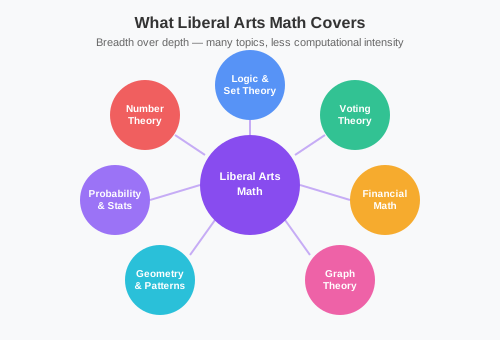
According to the Mathematical Association of America, Liberal Arts Math courses aim to develop quantitative literacy—the ability to interpret, evaluate, and communicate using mathematical and statistical information in everyday contexts. The goal is not preparing students for advanced mathematics but rather equipping them with practical reasoning skills for informed citizenship and professional competence.
This philosophical approach means Liberal Arts Math values conceptual understanding over computational speed, emphasizes application over abstraction, and prioritizes explanation and reasoning over memorization of procedures.
What Makes Liberal Arts Math Challenging
While Liberal Arts Math avoids advanced algebra and calculus, it presents unique challenges that surprise many students expecting an easy course.
It’s Still Mathematics
Requires abstract reasoning, logical deduction, and problem-solving. Math phobia doesn’t disappear just because calculus isn’t on the syllabus.
Weak Foundational Skills
Assumes basic proficiency in arithmetic, fractions, percentages, and algebraic thinking. Many students haven’t done math in years.
Unfamiliar Topic Types
Voting theory, graph theory, and mathematical logic are completely new. Logic proofs confuse students accustomed to computational math.
Word Problem Intensity
Most problems require translation from English to mathematics. Reading comprehension matters as much as calculation ability.
Platform Frustrations
ALEKS demands mastery. MyMathLab has strict formatting. WebAssign limits attempts.
Explanation Requirements
Students must justify reasoning in complete sentences—surprising those who assumed math means only numbers.
Common Student Complaints: “I thought this was basic arithmetic—why am I doing logic puzzles?” · “I didn’t expect to explain answers in sentences.” · “ALEKS won’t let me progress until everything is perfect.” · “MyMathLab marked my answer wrong even though it was right.”
What Makes Liberal Arts Math Easier Than Other Courses
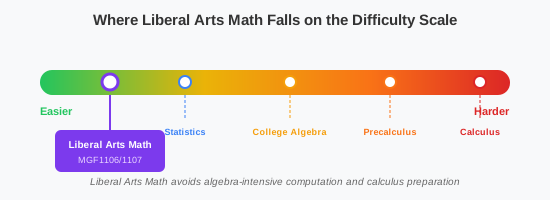
Despite challenges, Liberal Arts Math offers genuine advantages compared to College Algebra, Statistics, or higher mathematics courses.
No Calculus or Advanced Algebra: Liberal Arts Math completely avoids calculus concepts (limits, derivatives, integrals) and advanced algebra (polynomial division, rational expressions, logarithmic equations). You’ll never factor trinomials, complete the square, or graph rational functions.
Conceptual Over Computational: Emphasis falls on understanding concepts and applying reasoning rather than executing complex calculations. Most arithmetic can be done with calculators.
Practical, Real-World Applications: Financial mathematics teaches loan calculations you’ll actually use. Probability helps interpret news about risks. Voting theory explains election systems. This relevance makes material more engaging than abstract formulas.
More Generous Grading: Liberal Arts Math courses typically exhibit higher average grades than College Algebra or Calculus. Instructors recognize students are non-majors fulfilling requirements. Grade curves tend to be more forgiving.
Better Support Services: Because Liberal Arts Math serves students who struggle with mathematics, many institutions provide additional tutoring centers, supplemental instruction, and instructor office hours specifically geared toward math-anxious students.
Realistic Perspective: Liberal Arts Math is easier than College Algebra for most students, but “easier” doesn’t mean “effortless.” You still need to attend class, complete assignments, study for exams, and engage with mathematical concepts. The reduced complexity makes success more achievable, not automatic.
Liberal Arts Math vs Other Mathematics Courses
Understanding how Liberal Arts Math compares to alternative general education mathematics courses helps students make informed decisions about which course best fits their abilities and degree requirements.
| Course | Typical Students | Main Topics | Difficulty |
|---|---|---|---|
| Liberal Arts Math | Humanities, arts, communications | Logic, voting theory, probability, financial math | Medium |
| College Algebra | Business, pre-nursing, science | Functions, equations, polynomials, logarithms | Medium-Hard |
| Elementary Statistics | Psychology, sociology, health sciences | Descriptive stats, hypothesis testing, regression | Medium |
| Precalculus | STEM majors, pre-engineering | Advanced functions, trigonometry, analtic geometry | Hard |
Choosing Between Liberal Arts Math and Statistics
This is the most common decision point for non-STEM students. Both courses satisfy general education requirements at most schools, but they serve different purposes.
Choose Liberal Arts Math if: You have high math anxiety, your major doesn’t specifically require statistics, you prefer variety in topics over depth in one area, or you want to avoid heavy data analysis.
Choose Elementary Statistics if: Your major is psychology, sociology, education, public health, or any field requiring research literacy. Statistics provides more directly transferable skills for reading research papers.
Why College Algebra Is Harder
College Algebra builds the algebraic foundation for calculus and technical fields. It requires fluency in solving equations, graphing complex functions, understanding function transformations, and executing multi-step algebraic manipulations. According to education research, College Algebra has among the highest failure rates of any college course. Liberal Arts Math offers substantially better pass rates for mathematically underprepared students.
Who Struggles Most With Liberal Arts Math
Certain student populations encounter predictable challenges with Liberal Arts Math despite its relative accessibility.
Non-Traditional Students
Returning after years in workforce. Math skills have atrophied. Balancing college with work and family limits study time.
Math Anxiety / Learning Disabilities
20-25% of students experience math anxiety. Dyscalculia, ADHD, or processing disorders create genuine challenges.
English Language Learners
Word problems and written explanations create disproportionate challenges. Must parse complex sentences while solving math.
Limited Technology Skills
Navigating ALEKS, formatting MyMathLab answers, troubleshooting issues becomes additional burden beyond math content.
Support Resources Matter: Students in these categories benefit most from professional course assistance. Rather than struggling through math requirements while managing other challenges, strategic use of expert support ensures you pass with strong grades. Our Liberal Arts Math service helps students who face these obstacles achieve success without the struggle.
Why Students Think It’s Easy and Get Blindsided
The most common Liberal Arts Math failure pattern involves students underestimating course demands, procrastinating, falling behind, and realizing too late that they’re failing.
Marketing as the “Easy” Math Option: Academic advisors frequently describe Liberal Arts Math as the easiest mathematics course. Students hear “easy” and assume they can coast through with minimal effort. But “easier” means “less computationally intensive,” not “requires no work.”
Unexpected Abstract Content: Students expect practical arithmetic and financial calculations. They’re shocked when the course introduces logic proofs, voting paradoxes, or graph theory—topics completely outside previous mathematical experience.
Platform Mastery Requirements: Students underestimate platform demands, particularly ALEKS’s mastery model. ALEKS doesn’t allow progression without demonstrating competency. Students accustomed to partial credit hit brick walls when knowledge checks repeatedly test previously learned material.
Procrastination Consequences: Believing the course is easy, students postpone homework and skip early quizzes. By midterm, they’re failing and far behind. Self-paced online courses exacerbate this—what could have been manageable 4 hours weekly becomes impossible 40-hour crash course.
Prevention Strategy: Treat Liberal Arts Math like any college course requiring regular attendance, timely assignment completion, and consistent study. If you’ve already procrastinated and need to catch up quickly, our emergency support services can help you recover before it’s too late.
Strategies for Success in Liberal Arts Math
Students who approach Liberal Arts Math strategically achieve better outcomes with less stress.
Start Strong From Day One: Complete the first week’s assignments immediately. This establishes routine, identifies platform quirks early, and reveals topic areas needing extra attention.
Master Platform Requirements: Learn how answers should be formatted, what precision is required, and whether calculators are allowed. Understanding technical requirements prevents correct mathematics from being marked wrong.
Focus on Conceptual Understanding: Liberal Arts Math tests whether you understand concepts and can apply them to new situations, not whether you’ve memorized procedures. Focus on understanding what different mathematical tools do and when to use them.
Practice Reading Word Problems Carefully: Most errors come from misreading problems rather than mathematical mistakes. Develop a systematic approach: read the entire problem, identify what’s being asked, note given information, determine relevant concepts, solve, and check whether your answer makes sense.
Use Available Support Resources: Most schools offer tutoring centers, supplemental instruction, and instructor office hours specifically for mathematics support. Use these early when you’re confused, not late when you’re failing.
Consider Professional Help: If you’re struggling despite best efforts, if you don’t have time for consistent coursework, or if math anxiety prevents productive study, professional course assistance provides a viable alternative. Rather than risking failure or damaging your GPA, strategic support ensures you pass with strong grades.
How Finish My Math Class Helps
Finish My Math Class specializes in Liberal Arts Math support across all platforms and course formats. We’ve helped thousands of non-STEM students pass mathematics requirements without the stress and time investment that derails academic progress.
Complete Course Support: We handle entire Liberal Arts Math courses from start to finish including homework, quizzes, projects, and exams on platforms like ALEKS, MyMathLab, WebAssign, and institution-specific systems.
Targeted Assignment Help: Need help with specific challenging topics like logic proofs or voting theory? We provide targeted assistance for difficult assignments while you handle other sections independently.
Course-Specific Expertise: We have extensive experience with Florida courses like MGF1106 and MGF1107, Texas MATH 1332, and other state-specific Liberal Arts Math courses.
Guaranteed Results: Our A/B grade guarantee provides confidence: we guarantee A or B final grades or provide full refund. We’re accountable for your success, not just effort.
Frequently Asked Questions
Is Liberal Arts Math easier than College Algebra?
What platform is Liberal Arts Math typically taught on?
What happens if I fail Liberal Arts Math?
Is Liberal Arts Math a good choice if I hate math?
Does Liberal Arts Math count toward graduation?
Can I switch from College Algebra to Liberal Arts Math?
How much time does Liberal Arts Math take per week?
What are common topics in Liberal Arts Math courses?
Final Thoughts on Liberal Arts Math Difficulty
So is Liberal Arts Math hard? The answer depends on your perspective, preparation, and approach. Compared to College Algebra, Precalculus, or Calculus, Liberal Arts Math is demonstrably easier with higher pass rates and more forgiving grading. For students pursuing humanities, arts, communications, or social sciences, it represents the most accessible path to satisfying mathematics requirements.
However, “easier” doesn’t mean “effortless.” Liberal Arts Math still requires mathematical thinking, regular time investment, and engagement with unfamiliar concepts. Students who underestimate the course, procrastinate, or assume their math anxiety won’t matter because “it’s the easy math” often struggle and fail.
Success in Liberal Arts Math comes from realistic expectations, consistent effort, and willingness to seek help when needed.
Need Help With Liberal Arts Math?
If you’re overwhelmed, behind, or just don’t have time for a general education requirement that doesn’t relate to your career goals, we understand. Our Liberal Arts Math support ensures you pass with strong grades while preserving time and energy for courses that matter to your major.
- Complete course management for MGF1106, MGF1107, MATH 1332, and all Liberal Arts Math variants
- All platforms supported: ALEKS, MyMathLab, WebAssign, Canvas, and more
- A/B grade guarantee or full refund
- Confidential service with secure communication
Don’t let a general education math requirement delay your graduation or damage your GPA. Contact us today for confidential Liberal Arts Math support that guarantees your success.