
Embry-Riddle (ERAU) MATH 241 Help & Answers
Hire an expert to help you ace Calculus & Analytic Geometry I
MATH 241 Embry-Riddle Help: Calculus & Analytic Geometry I
The engineering calculus gateway. MATH 241 is where future aerospace engineers, electrical engineers, and computer scientists prove they can handle the mathematical rigor their degrees demand. Four credits, four exams, no graphing calculators — and we’re here to help you through it.
Quick Answer: What is MATH 241?
MATH 241 Calculus and Analytic Geometry I is a 4-credit course covering limits, derivatives, and integration of algebraic and transcendental functions. You’ll use WebAssign (Cengage) for homework, Stewart’s Calculus: Early Transcendentals textbook, and Canvas for proctored exams. Required for all engineering majors at ERAU.
✓ Engineering Calculus Experts
From related rates to optimization to transcendental derivatives — we handle the rigorous calculus that engineering programs demand.
Table of Contents
Course Overview: Engineering Calculus
MATH 241 Calculus and Analytic Geometry I is the foundation of Embry-Riddle’s engineering mathematics sequence. Unlike the aviation-focused MATH 111/112 track, MATH 241 uses a rigorous, theoretical approach designed for students pursuing Aerospace Engineering, Electrical Engineering, Computer Science, Mechanical Engineering, and Engineering Physics.
This is a 4-credit course — one full credit more than MATH 112 — reflecting the additional depth and rigor required. You’ll work with Stewart’s Calculus: Early Transcendentals, the same textbook used at top engineering schools nationwide, and complete homework through Cengage WebAssign.
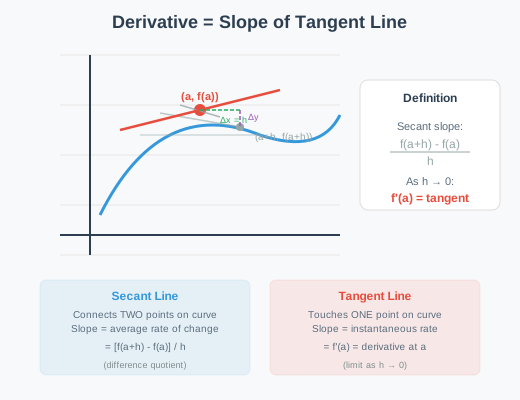
The derivative represents the instantaneous rate of change — the foundation for understanding motion, forces, and change in engineering systems.
The course description is straightforward but demanding: limits and continuity; differentiation and integration of algebraic and elementary transcendental functions; applications of first and second derivatives and integration. What that means in practice is nine weeks of intensive calculus covering everything from basic limit laws to the Fundamental Theorem of Calculus.
Course Specifications
Credits
4 credit hours
Textbook
Stewart, Calculus: Early Transcendentals (8th ed.)
Platform
Cengage WebAssign + Canvas
Prerequisites
MATH 142, MATH 143, or ALEKS placement
Calculator
Scientific only (no graphing)
Exams
4 proctored exams (Respondus/Honorlock)
MATH 241 vs. MATH 112: Which Track?
Embry-Riddle offers two calculus pathways, and choosing the wrong one can delay your degree. Here’s the fundamental difference:
| Attribute | MATH 241 (Engineering) | MATH 112 (Aviation) |
|---|---|---|
| Credits | 4 credits | 3 credits |
| Textbook | Stewart, Calculus: Early Transcendentals | Washington & Evans, Basic Technical Mathematics |
| Platform | Cengage WebAssign | Pearson MyMathLab |
| Calculator Policy | Scientific only (no graphing) | Scientific or graphing allowed |
| Required For | Aerospace, Electrical, Mechanical Engineering; Computer Science | Professional Aeronautics, Aircraft Maintenance, Aviation Business |
| Transcendental Functions | Extensive coverage (exp, log, inverse trig) | Basic coverage |
| Sequel Courses | MATH 242 → MATH 243 (Calc II & III) | Terminal (no sequel required) |
If you’re in an engineering program, you need MATH 241 — there’s no substitute. MATH 112 won’t satisfy your degree requirements, and MATH 241’s deeper treatment of transcendental functions prepares you for the differential equations and advanced mathematics in your upper-level courses.
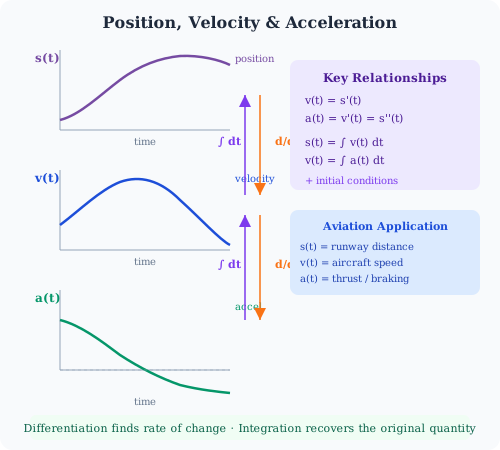
Engineering applications require understanding how position, velocity, and acceleration relate through differentiation and integration.
Topics and Module Structure
MATH 241 covers a comprehensive set of calculus topics over 9 modules. The course builds systematically from limits through integration, with each topic serving as a foundation for what follows.
Required Skills (from Official Syllabus)
Calculate left, right, and two-sided limits, infinite limits, and limits at infinity
Examine functions for points of discontinuity
Distinguish between secant and tangent lines, average and instantaneous rate of change
Compute derivatives using the limit definition
Calculate derivatives of algebraic and trigonometric functions
Solve related rates and applied max-min problems
Interpret Rolle’s Theorem and the Mean Value Theorem
Analyze functions for intervals of increase/decrease, concavity, extrema, and inflection points
Evaluate antiderivatives using appropriate substitutions
Calculate areas using Riemann integrals
Evaluate definite integrals using the Fundamental Theorem of Calculus
Application Discussion Topics
Each module includes application discussions that connect calculus concepts to real-world problems. Based on course materials, these include:
- Module 1: Ohm’s Law — limits and electrical resistance
- Module 2: Solving Functions — derivative applications
- Module 4: Speeding Bullet — related rates with projectile motion
- Module 5: Distance, Rate, Angle — trigonometric derivatives
- Module 6: Virtual Study Hall — collaborative problem solving
- Module 7: Airplane Landing Path — optimization of approach angle
- Module 8: Rate of Growth — exponential and logarithmic derivatives
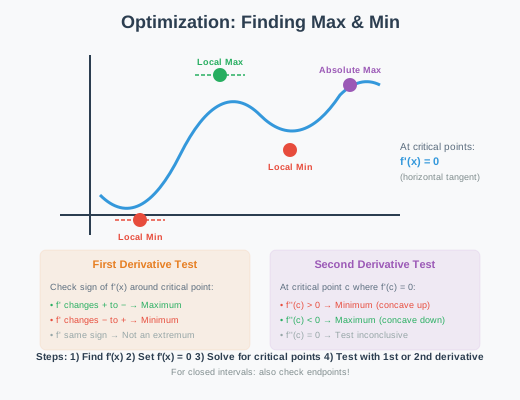
Optimization problems — finding maximum and minimum values — are central to engineering applications from aircraft design to circuit efficiency.
Why MATH 241 Challenges Engineering Students
MATH 241 has a well-earned reputation as a difficult course. The combination of theoretical rigor, restricted calculator access, and the sheer volume of material creates challenges even for strong students:
No Graphing Calculator Safety Net
Unlike many calculus courses, MATH 241 prohibits graphing calculators on exams. You must sketch curves, identify behavior, and verify answers by hand. This requires deeper conceptual understanding.
Transcendental Function Complexity
MATH 241 covers derivatives of exponential, logarithmic, and inverse trigonometric functions in depth. Keeping track of derivative formulas for sec⁻¹(x), ln(u), and e^(f(x)) while applying chain rule is demanding.
Related Rates Translation
Related rates problems require translating physical scenarios into mathematical relationships, differentiating implicitly with respect to time, and solving for unknown rates. Each step introduces potential errors.
Four High-Stakes Exams
With four equally-weighted proctored exams, there’s less room to recover from a poor performance. Each exam covers cumulative material, so early struggles compound throughout the course.
WebAssign’s Strict Input Requirements
WebAssign can be unforgiving with answer formatting. An algebraically correct answer in the “wrong” form may be marked incorrect, frustrating students who understand the concept but not the platform’s expectations.
How We Help With MATH 241
We’ve supported hundreds of engineering students through MATH 241’s rigorous demands. Here’s how our service works:
WebAssign Homework Completion
We work through your Cengage WebAssign assignments with proper formatting so answers are accepted. Full solutions help you understand the process for exam preparation.
Application Discussion Solutions
From Ohm’s Law to airplane landing paths, we provide detailed solutions for your Canvas discussion problems that demonstrate proper mathematical reasoning.
Quiz Support
WebAssign quizzes test your understanding under time pressure. We help ensure you’re prepared and can assist with quiz completion when appropriate.
Exam Preparation
While proctored exams must be taken yourself, we prepare you with topic reviews, practice problems, and the conceptual understanding you need to succeed without a graphing calculator.

The Fundamental Theorem of Calculus connects differentiation and integration — mastering this relationship is essential for MATH 241 success.
Exam Structure and Preparation
MATH 241 includes four proctored exams, all weighted equally toward your final grade. Exams are administered through Canvas using Respondus LockDown Browser or Honorlock, depending on your section.
Exam Day Requirements
- Scientific calculator only — no graphing calculators permitted
- No formula sheets or notes of any kind
- Webcam and microphone for proctoring
- Stable internet connection throughout exam
- Clear workspace with no secondary devices
- Valid photo ID for identity verification
The no-graphing-calculator policy is strictly enforced and fundamentally changes how you must prepare. You need to be comfortable sketching curves, identifying asymptotes, and verifying derivative results by hand. This is where thorough homework practice becomes essential — the patterns you learn from WebAssign problems are the same patterns you’ll see on exams.
Related ERAU Courses
MATH 241 connects to the broader Embry-Riddle mathematics ecosystem. Here’s how it fits:
Frequently Asked Questions
Ready to Conquer Engineering Calculus?
Don’t let MATH 241 derail your engineering career. Our calculus specialists are ready to help.
There are many reasons why students need help with their coursework. In any case, it is never too late to ask for help. So, what are you waiting for? Let’s connect!