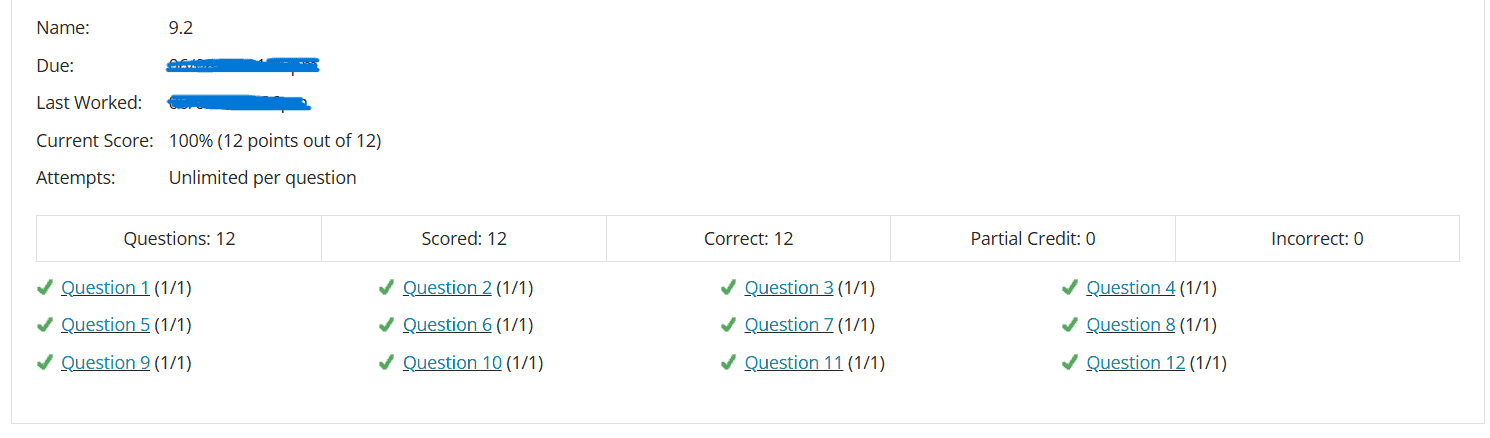
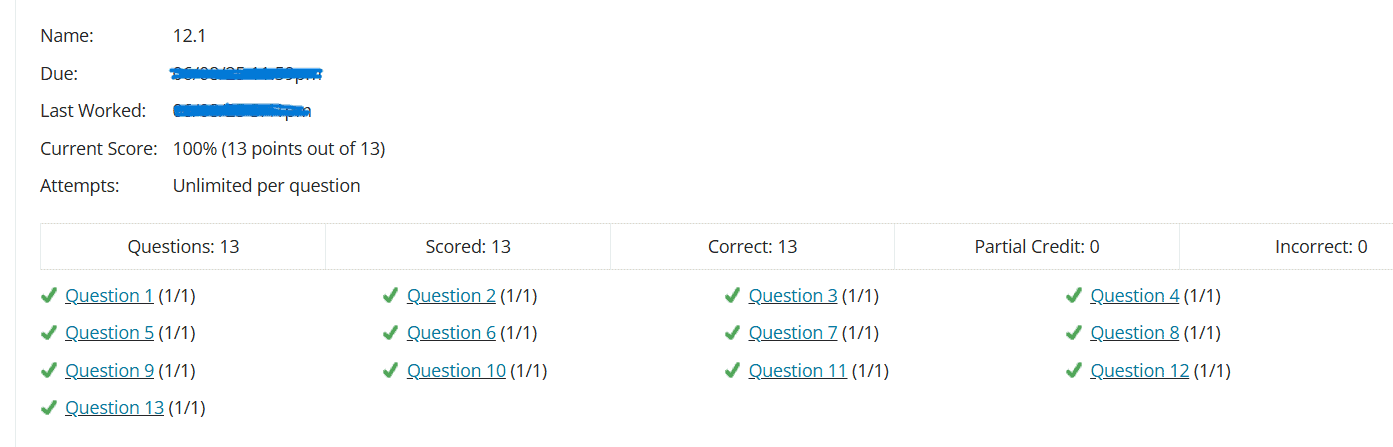
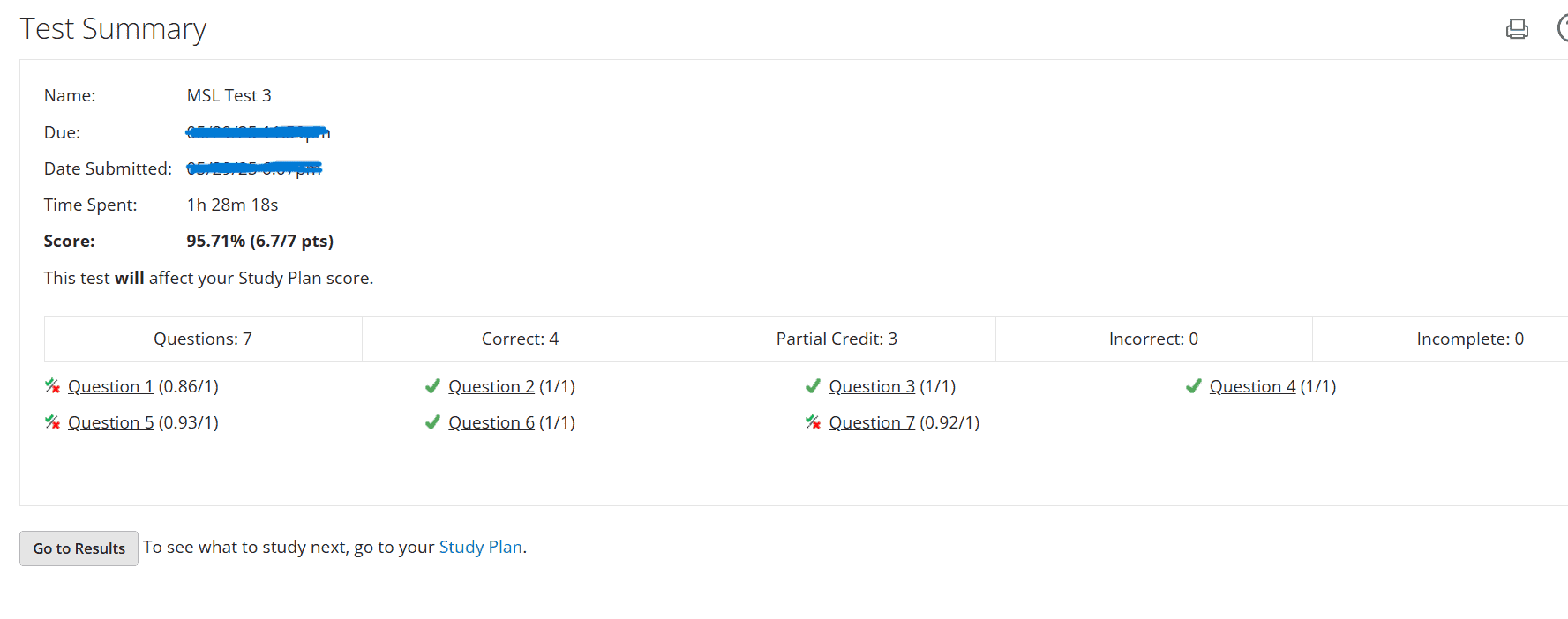
MyMathLab Calculus Answers & MyLab Math Calculus Help
Expert help with ALL Calculus courses — including quizzes, assignments, and proctored exams. A/B grade guarantee
MyMathLab & MyLab Math Calculus Help: Expert Answers & Assignment Completion
Whether you’re stuck on limits, derivatives, or integrals, trying to complete Calculus assignments on MyMathLab or MyLab Math can feel overwhelming. From poorly written questions to confusing interface bugs, these Pearson platforms aren’t designed to help you learn—they’re built to test your patience. That’s where Finish My Math Class comes in.
Calculus is already one of the most challenging courses in higher education. According to the Mathematical Association of America, Calculus courses have some of the highest withdrawal and failure rates across all STEM disciplines. When you add MyMathLab’s rigid grading system, technical glitches, and formatting nightmares into the mix, it’s no wonder students feel defeated before they even begin.
You’re not struggling because you’re bad at math. You’re struggling because MyMathLab’s design prioritizes automated grading over genuine learning. The platform punishes small formatting errors, offers minimal feedback on complex multi-step problems, and often presents questions that don’t match the instructional materials. This isn’t a reflection of your abilities—it’s a flaw in the system itself.
Table of Contents
- Who Is This Page For?
- Why Calculus in MyMathLab/Mylab Math Is So Difficult
- We Handle All Types of Calculus
- Real Help for Real Users
- Why Students Prefer Finish My Math Class
- Supported Courses & Variants
- Platforms We Handle
- How It Works
- Common Student Complaints
- Frequently Asked Questions
- Get Started
Who Is This Page For?
This page is built for students who are struggling with Calculus in MyMathLab or MyLab Math. Whether you’re:
- A STEM major overwhelmed by Calc 2 or Calc 3 assignments
- A Business major taking Applied Calculus just to check a box
- A nursing or health sciences student stuck in required math credits
- A working adult juggling classes and job responsibilities
- Or simply a student who’s tired of fighting the Pearson system
Finish My Math Class is here to make sure you don’t just survive your Calculus course — you crush it with an A or B, guaranteed.
Maybe you’re a pre-med student who needs to maintain a competitive GPA for medical school applications, but Calculus 2 is threatening to derail your entire trajectory. Perhaps you’re an engineering major who excels in hands-on problem-solving but finds MyMathLab’s abstract, poorly-explained problems incomprehensible. Or you might be a returning adult student who hasn’t touched mathematics in over a decade and finds yourself expected to master differential equations with minimal institutional support.
Whatever your situation, you’re dealing with a perfect storm: difficult course content, an unforgiving platform, and often inadequate instructional support. Many professors assign MyMathLab homework as “automatic grading” without realizing how the platform’s limitations create barriers to actual learning. Research from EDUCAUSE shows that while automated homework systems can increase efficiency, they often sacrifice pedagogical effectiveness—particularly in conceptually demanding courses like Calculus.
Why Calculus in MyMathLab/Mylab Math Is So Difficult
- Strict syntax requirements (even tiny typos = wrong answer) – MyMathLab’s answer parser is notoriously unforgiving. You might enter “2x(x+1)” when the system expects “2x²+2x”, and despite mathematical equivalence, you’ll be marked wrong. The platform doesn’t recognize alternative valid forms, doesn’t offer partial credit for correct methodology, and provides no indication of whether your error was conceptual or merely formatting-related.
- Word problems disguised as math problems – Calculus word problems in MyMathLab often bury the mathematical core under layers of confusing context. A problem about “the rate at which water drains from a conical tank” requires you to parse geometry, set up related rates equations, and apply chain rule—all while deciphering ambiguous phrasing about what the question is actually asking.
- Randomized questions with little or no feedback – While question randomization prevents answer sharing, it creates a new problem: examples and solutions from your textbook, lecture, or “Help Me Solve This” feature may use completely different numbers or even different function types. If your homework problem involves exponential decay but the example shows exponential growth, you’re left guessing how to adapt the methodology.
- Time limits and proctoring tools that increase pressure – Timed assessments transform Calculus from a reasoning exercise into a speed challenge. When you’re racing against a clock while simultaneously wrestling with MyMathLab’s interface quirks, your working memory becomes overwhelmed. Add webcam monitoring, screen recording, and the anxiety of being watched, and even students who know the material struggle to perform.
- AI detection tools that punish legitimate attempts to get help – MyMathLab increasingly incorporates behavioral analytics that flag “suspicious” patterns. If you’re consulting legitimate resources, taking breaks to think through problems, or working with a study group, you might trigger false positives that lead to academic integrity investigations. The system assumes any deviation from “normal” patterns indicates cheating rather than different learning approaches.
- Graph and equation editor nightmares – MyMathLab’s graphing tools and equation editors are clunky and counterintuitive. Want to enter a piecewise function? Good luck navigating the multi-step input process. Need to graph a derivative? The interface requires clicking through multiple menus that aren’t logically organized. Students waste valuable time fighting the technology rather than focusing on the mathematics.
- Inconsistent partial credit policies – Some MyMathLab questions offer no partial credit whatsoever—one mistake anywhere in a multi-step problem means zero points. Other questions have opaque partial credit algorithms that seem arbitrary. You might lose 20% for a rounding error on one problem but receive full credit despite a conceptual mistake on another. This inconsistency makes it impossible to understand what the system values.
- Disconnect from actual Calculus understanding – MyMathLab optimizes for checkable answers rather than mathematical reasoning. You can’t show your work, explain your thought process, or demonstrate understanding of why a method works. The platform reduces Calculus—a subject about rates of change, accumulation, and mathematical modeling—to a series of fill-in-the-blank exercises that miss the conceptual depth entirely.
The American Mathematical Society has published extensive research on effective mathematics pedagogy, emphasizing the importance of formative feedback, opportunities for revision, and assessment that values process alongside correct answers. MyMathLab’s design philosophy contradicts virtually every evidence-based practice for teaching mathematics effectively.
We Handle All Types of Calculus
Whether you’re taking Calculus 1, 2, or 3 — or a specialized course like Business Calculus — we have real experts ready to assist you. We know the structure of each course and the topics that cause the most confusion.
Calculus 1 (Differential Calculus)
- Limits & Continuity – Understanding epsilon-delta definitions, one-sided limits, limits at infinity, and identifying discontinuities. Students often struggle with the conceptual leap from algebraic manipulation to rigorous limit analysis.
- Derivative Rules – Power rule, product rule, quotient rule, chain rule, and implicit differentiation. MyMathLab’s formatting requirements make chain rule problems particularly frustrating—you must nest parentheses precisely or face automatic failure despite correct mathematical reasoning.
- Tangent Lines & Rates of Change – Finding instantaneous rates, tangent line equations, and understanding the derivative as slope. Word problems in this section often involve physics applications that require translating between mathematical and physical contexts.
- Graph Analysis with Derivatives – Using first and second derivatives to determine increasing/decreasing intervals, concavity, inflection points, and optimization. MyMathLab’s graphing interface makes it difficult to visualize these relationships effectively.
- Related Rates – These word problems combine geometry, trigonometry, and differentiation in ways that confound even strong students. MyMathLab provides minimal scaffolding for setting up the relationships between variables.
- Exponential and Logarithmic Differentiation – Rules for e^x, ln(x), and logarithmic differentiation for complex expressions. The platform’s answer parser is particularly strict about simplified forms in this section.
Calculus 2 (Integral Calculus)
- Techniques of Integration – U-substitution, integration by parts, trigonometric substitution, partial fractions, and numerical integration methods. Each technique has specific formatting requirements in MyMathLab that aren’t always intuitive. Students report spending more time guessing correct input syntax than actually learning integration methods.
- Applications of Integrals – Area between curves, volume of solids of revolution (disk, washer, and shell methods), arc length, and surface area. These problems require setting up complex integrals correctly—if your bounds or integrand setup is wrong, MyMathLab provides zero credit and minimal feedback about where your approach failed.
- Sequences & Series – Convergence tests (ratio, root, comparison, limit comparison, integral test), power series, Taylor and Maclaurin series. This is arguably the most conceptually challenging unit in Calc 2, and MyMathLab’s all-or-nothing grading makes it nearly impossible to learn from mistakes.
- Parametric and Polar Functions – Derivatives and integrals in polar/parametric form, arc length, and area calculations. The notation for these problems is complex, and MyMathLab’s equation editor struggles with multiple variable types.
- Improper Integrals – Determining convergence/divergence of integrals with infinite bounds or discontinuous integrands. These problems involve limit notation that MyMathLab’s parser frequently misinterprets.
- Differential Equations – Separable equations, slope fields, and basic modeling. While not always included in Calc 2, when present, these introduce an entirely new problem-solving framework that MyMathLab’s rigid structure poorly accommodates.
Calculus 3 (Multivariable Calculus)
- Partial Derivatives – Computing first and higher-order partial derivatives, mixed partials, and understanding the gradient. The notation becomes significantly more complex, and MyMathLab’s handling of subscript notation is inconsistent.
- Multiple Integrals – Double and triple integrals, changing order of integration, and applications to volume and mass. Setting up these integrals requires three-dimensional visualization that MyMathLab’s 2D interface cannot support effectively.
- Vector Functions – Derivatives and integrals of vector-valued functions, arc length, curvature, and tangent/normal vectors. Vector notation in MyMathLab requires precise formatting of angle brackets, i/j/k components, or other notational systems.
- Gradient, Divergence & Curl – Vector calculus operations, line integrals, Green’s theorem, Stokes’ theorem, and the divergence theorem. These advanced topics represent the pinnacle of undergraduate calculus and are notoriously difficult even without platform complications.
- Optimization in Multiple Variables – Critical points, second derivative test for functions of two variables, Lagrange multipliers. MyMathLab’s handling of constraint equations in optimization problems is particularly problematic.
- Cylindrical and Spherical Coordinates – Converting between coordinate systems and setting up integrals appropriately. The coordinate transformation notation is complex, and MyMathLab provides minimal guidance on correct syntax.
Business Calculus
- Marginal Cost/Revenue/Profit – Using derivatives to analyze business functions and make economic decisions. While conceptually simpler than pure mathematics courses, Business Calculus adds the challenge of economic terminology and context that confuse students who aren’t familiar with business concepts.
- Optimization Problems – Maximizing profit, minimizing cost, and finding optimal production levels. Word problems in this section are lengthy and require careful parsing to identify the mathematical core.
- Elasticity of Demand – Calculating and interpreting price elasticity using derivatives. This application combines economic theory with mathematical technique in ways that MyMathLab’s compartmentalized approach handles poorly.
- Applied Integrals for Business Models – Consumer and producer surplus, present and future value of income streams, and continuous growth models. These problems often involve compound interest and exponential functions that require precise decimal handling—another area where MyMathLab’s rounding requirements cause frustration.
- Probability and Statistics Applications – Some Business Calculus courses include probability density functions and expected values, requiring integration techniques in statistical contexts.
Regardless of which Calculus variant you’re taking, our experts have completed the specific course on MyMathLab and understand both the mathematical content and the platform’s idiosyncrasies. We don’t just know Calculus—we know how to make MyMathLab accept correct answers in the exact format it demands.
Real Help for Real MyMathLab & MyLab Math Users
We assist with every component of your Calculus course:
- Practice problems – Master concepts without the stress of grading pressure. We can work through practice sets with you or complete them independently to help you see solution patterns.
- Homework assignments – Weekly problem sets that count toward your grade. Our experts complete these accurately and on time, ensuring you maintain the homework average you need.
- Unit quizzes – Timed assessments that test comprehension of recent material. We handle the time pressure and formatting requirements so you don’t have to.
- Proctored midterms and finals – High-stakes exams with webcam monitoring and lockdown browsers. We have proven methods for providing assistance even under surveillance conditions.
- Cumulative reviews – End-of-chapter or pre-exam review assignments that cover multiple topics simultaneously.
- Project-based assessments – Some Calculus courses include written projects, modeling assignments, or research components that go beyond MyMathLab’s typical problem format.
- Lab components – Courses with computer lab sessions using software like Mathematica, Maple, or MATLAB alongside MyMathLab assignments.
Whether you need help with a single difficult assignment or want us to handle your entire semester, we customize our support to match your specific needs and budget. Many students use our services strategically—handling routine assignments themselves but getting expert help on high-stakes assessments or particularly challenging units like series convergence or multivariable optimization.
Why Students Prefer Finish My Math Class
- Human experts — not bots or generators (see why that matters). AI tools like ChatGPT cannot reliably solve MyMathLab Calculus problems because they can’t interact with the platform’s interface, don’t understand its specific formatting requirements, and frequently make computational errors in multi-step calculus problems. Our experts are real mathematicians who have completed these exact courses.
- A/B grade guarantee on all Calculus assignments (read details). We’re so confident in our work that we promise you’ll receive an A or B on every assignment we complete, or you don’t pay. This guarantee is possible because we don’t cut corners, don’t use automated tools, and don’t accept projects we can’t complete to our standards.
- Discreet, secure help that keeps you protected. We understand the sensitivity of academic assistance services and maintain strict confidentiality. Your information is never shared, your login credentials are encrypted, and we operate with professionalism and discretion.
- Flexible pricing for partial or full-course support (see pricing). Whether you need help with a single exam, weekly homework assistance, or complete course management, we offer pricing structures that fit different budgets and needs.
- Subject-specific expertise – We don’t assign random tutors. Your Calculus work is handled by experts who specialize in Calculus and have proven track records on MyMathLab specifically.
- Fast turnaround times – Even on tight deadlines, we deliver quality work. Many assignments are completed within 24-48 hours, and rush service is available for urgent requests.
- Consistent communication – You’re never left wondering about status. We provide updates, answer questions promptly, and maintain open communication throughout the process.
- No technical hassles – We handle all the platform navigation, formatting frustrations, and technical troubleshooting. You simply receive completed work that’s ready to submit or already submitted on your behalf.
Our approach differs fundamentally from answer key websites, homework help forums, or AI chatbots. Those resources might work for basic algebra, but Calculus on MyMathLab requires genuine mathematical expertise combined with platform-specific knowledge. We provide both.
Supported Courses & Variants
MyMathLab offers dozens of Calculus textbook integrations. We’ve worked with all major titles:
- University Calculus: Early Transcendentals – A comprehensive text covering all three semesters of Calculus with emphasis on rigor and proof.
- Calculus for Business, Economics, Life Sciences, and Social Sciences – Applied Calculus focused on real-world applications rather than theoretical mathematics.
- Thomas’ Calculus – One of the most widely used Calculus textbooks, known for clear explanations and extensive problem sets.
- Briggs/Cochran Calculus – A newer text emphasizing conceptual understanding and multiple representations of mathematical ideas.
- Calculus: Graphical, Numerical, Algebraic – Often used in AP Calculus and college courses, this text emphasizes multiple approaches to problem-solving.
- Stewart’s Calculus: Early Transcendentals – Another extremely popular text known for its balance of theory and applications.
- Rogawski/Adams Calculus – Emphasizes understanding through visualization and conceptual reasoning.
- Larson/Edwards Calculus – Features strong technology integration and extensive online resources.
Different textbooks organize content differently, emphasize different applications, and have varying levels of rigor. Our experts are familiar with these variations and adapt their approach based on which text your course uses. When you contact us, let us know your textbook title and edition—this helps us match you with the most appropriate specialist.
Platforms We Handle
- MyMathLab – Pearson’s original homework and assessment platform, still widely used despite being gradually replaced by MyLab Math.
- MyLab Math – Pearson’s updated platform with improved interface and mobile compatibility, though many of the underlying problems remain.
- Pearson+ Integration – Courses that integrate MyLab with Pearson’s subscription eTextbook service, creating additional access complications.
- Canvas + MyMathLab LTI integrations – Many universities embed MyMathLab within Canvas using LTI (Learning Tools Interoperability) connections. We’re experienced with these hybrid setups and can navigate the dual-platform requirements.
- Blackboard + MyLab integrations – Similar to Canvas integrations, these combine university LMS with Pearson platforms.
- Brightspace/D2L + MyLab – Another common LMS integration we regularly encounter.
- Standalone MyLab courses – Direct Pearson access without LMS integration.
Platform navigation can be surprisingly complex, especially when access codes, course IDs, and institutional logins create multiple authentication layers. We handle all of this technical complexity so you don’t have to troubleshoot access issues while also trying to learn Calculus.
How It Works
Getting help is simple and straightforward:
- Contact us with your course info and deadline – Use our contact form or reach out via Reddit (u/StudyRescue). Provide your course name, textbook, upcoming deadlines, and specific needs.
- Get a quote within minutes – We’ll review your requirements and provide transparent pricing with no hidden fees. Quote turnaround is typically under an hour, often within minutes.
- We complete your work accurately and on time – Once you approve the quote and provide access, our expert begins work immediately. You’ll receive progress updates and can communicate with your assigned specialist throughout.
- You get high grades or your money back (see A/B Guarantee) – We stand behind every assignment we complete. If we don’t deliver an A or B, you receive a full refund—no arguments, no hassles.
The entire process is designed for efficiency and peace of mind. You shouldn’t have to spend hours explaining your situation, waiting for responses, or worrying about whether the work will be done correctly. We’ve streamlined everything to minimize your time investment while maximizing results.
Most students are understandably hesitant the first time they seek academic assistance services. We understand these concerns and address them through transparency, guarantees, and proven results. Check our testimonials to see feedback from students who’ve successfully used our services for Calculus and other mathematics courses.
Common Student Complaints About MyMathLab/MyLab Math Calculus
🔗 Parentheses Sensitivity Is Too Strict
“I know how to do the derivative by hand, but MyMathLab keeps marking it wrong because I didn’t use parentheses exactly how they wanted. It’s infuriating.”
Commentary: The grading system penalizes formatting over correctness, frustrating even well-prepared students. This reflects a fundamental flaw in automated assessment—the inability to recognize mathematically equivalent expressions. Research from the American Statistical Association on assessment design emphasizes that effective testing should measure understanding, not notation preferences.
😵 Confusing or Poorly Worded Problems
“The word problems are so vague. It’s like they want you to fail by confusing you with bad phrasing.”
Commentary: Many problems are written poorly or ambiguously, making them harder than they need to be. Quality assessment requires clarity—students should struggle with mathematical concepts, not with parsing unclear language. When problems are ambiguous, they test reading comprehension and guessing skills rather than Calculus knowledge.
📉 Disconnect Between Instruction & Homework
“I watched all the videos and read the textbook, but the problems in MyLab were nothing like what was explained. Total disconnect.”
Commentary: Students often report that there’s a major gap between what’s taught and what’s tested. This pedagogical mismatch creates a frustrating situation where diligent students who complete all assigned learning activities still cannot successfully complete assessments. Effective course design requires alignment between instruction and assessment—a principle MyMathLab frequently violates.
🛑 Technical Glitches & Platform Lockouts
“The platform crashed during my timed quiz and I got locked out. Customer support told me to ask my instructor. My instructor said to talk to tech support.”
Commentary: Platform instability and finger-pointing between support channels leave students stuck. When technology fails during high-stakes assessments, the responsibility should fall on the platform provider, not the student. Unfortunately, MyMathLab’s support structure often leaves students caught between Pearson support and institutional IT, with neither taking ownership of technical problems.
🎲 Over-Randomization of Variables
“They randomized the numbers and functions so much that the example in the textbook was useless. I couldn’t even follow the logic.”
Commentary: Over-randomization makes it difficult to apply examples or build consistency in solving problems. While preventing answer sharing is important, excessive randomization that changes problem structure or difficulty level undermines learning. Students need to practice similar problems to develop pattern recognition and procedural fluency—but MyMathLab’s randomization often makes each problem feel entirely unique, preventing the repetition necessary for skill development.
⏰ Time Pressure Creates Anxiety, Not Assessment
“I can solve these problems when I have time to think, but the 2-minute timer per question turns it into panic mode. This isn’t testing my Calculus knowledge—it’s testing my ability to work under stress.”
Commentary: Artificial time constraints transform Calculus from a reasoning exercise into a speed challenge. While timed assessments have some validity, the tight time limits in many MyMathLab configurations measure test-taking speed rather than mathematical understanding. This particularly disadvantages students with documented accommodations, non-native English speakers, and anyone who processes information more deliberately.
📱 Mobile Experience Is Unusable
“I tried to do my homework on my phone because my laptop died, and it was completely unusable. The equation editor doesn’t work right on mobile, and half the buttons are cut off.”
Commentary: Despite marketing claims about mobile compatibility, MyMathLab’s mobile experience remains deeply flawed for Calculus work. Complex mathematical notation, graphing tools, and multi-step problems require desktop functionality that mobile interfaces cannot adequately provide. This creates equity issues for students who rely primarily on mobile devices for internet access.
These complaints aren’t isolated incidents—they represent systemic problems that affect thousands of students every semester. If you’re experiencing these frustrations, you’re not alone, and you’re not failing. The platform is failing you. Our service exists specifically to help students navigate these unreasonable obstacles and achieve the grades they deserve despite MyMathLab’s limitations.
📚 Frequently Asked Questions (FAQ)
⚙️ Platform & Technical Issues
Can you do my work even if it’s proctored?
Yes — we offer strategies and secure assistance even for proctored MyMathLab exams. Our methods are proven and discreet, designed to work within various proctoring environments including Respondus LockDown Browser, Honorlock, and ProctorU.
What if I have a timed quiz?
Our team can handle timed quizzes and exams — just send us the details in advance. We coordinate timing to ensure we’re available during your assessment window and can work efficiently under time constraints.
Can you help with Canvas + MyLab integrations?
Absolutely. Many universities use MyLab Math via Canvas, and we’ve worked with dozens of them. We understand how grade passback works, how to navigate the dual-platform interface, and how to ensure work completed in MyLab properly syncs to Canvas gradebooks.
What if MyMathLab crashes during my assignment?
We maintain backup strategies and can quickly adapt if technical issues arise. If you’re working with us during a live assessment and the platform fails, we’ll help you document the issue and can resume work immediately when access is restored.
Do you work with the mobile app?
While we prefer desktop access for complex Calculus work, we can work within mobile constraints if that’s your only option. However, we’ll be candid about limitations—some problem types are nearly impossible on mobile.
📈 Performance & Results
What kind of grades can I expect?
We guarantee an A or B on every project we accept — or you don’t pay. Period. Our experts maintain extremely high accuracy rates because we don’t rush, don’t use unreliable shortcuts, and thoroughly check work before submission.
What if I’ve already failed an assignment?
We can help salvage your grade and boost your average — but contact us early for best results. If you’re already struggling, don’t wait until you’re failing the course. Early intervention allows us to maximize the impact of strong performance on remaining assignments.
Can you guarantee a specific grade (like an A+)?
We guarantee A or B. While we frequently achieve A+ results, we can’t promise perfection on every single problem because MyMathLab’s grading can be unpredictable. Our guarantee reflects what we can confidently deliver consistently.
How do you maintain such high accuracy?
Our experts work methodically, double-check calculations, verify answer formats match MyMathLab’s expectations, and draw on extensive experience with platform quirks. We also review work before submission and maintain quality control standards.
🔍 Subjects & Courses
Do you support Calc 1, Calc 2, and Calc 3?
Yes — including all standard and honors versions, as well as Business Calculus. Our expert pool includes specialists for each level, so you’re matched with someone who has specific expertise in your course content.
Can you help with Thomas’ Calculus or University Calculus?
Yes — these are common on MyMathLab, and our experts are familiar with their structure. We’ve completed these specific textbook integrations many times and know their particular emphases and problem types.
What about Advanced Calculus or Real Analysis?
While we primarily focus on the standard Calculus sequence, we can handle some advanced topics. Contact us with your specific course details and we’ll let you know if we have appropriate expertise available.
Do you help with Calculus-based Physics or Engineering courses?
If the work is in MyMathLab and involves Calculus content, yes. Many Engineering Calculus courses or Physics courses with Calculus prerequisites use MyMathLab for mathematics components.
🧾 Pricing & Guarantees
How much does it cost?
Pricing depends on the assignment type and deadline. Contact us for a fast custom quote. Generally, individual assignments range from $30-150 depending on length and complexity, while full-semester packages offer better per-assignment rates.
What’s the A/B Guarantee?
If we don’t earn you at least a B, you don’t pay. Read more here. This guarantee is legally binding and we honor it without argument or hassle.
Do you offer payment plans?
For full-semester support, yes—we can arrange payment schedules that align with your budget. We’re flexible and understand student financial constraints.
What payment methods do you accept?
We accept all major credit cards, PayPal, Venmo, and can accommodate other payment methods upon request. All transactions are secure and confidential.
🧠 Human vs AI
Why not just use ChatGPT?
MyMathLab’s platform can detect AI-based help — and AI can’t handle randomized or multi-step Calculus problems with precision. ChatGPT makes frequent errors in Calculus, cannot interact with MyMathLab’s interface, and doesn’t understand formatting requirements. We’ve written extensively about this: AI vs Human Help comparison.
Are you better than answer bots?
Yes. Answer bots fail on logic-based or graphing problems. We use human experts with proven track records. Automated tools cannot handle MyMathLab’s nuanced requirements, cannot adapt to unexpected problem variations, and frequently provide wrong answers with confident certainty.
What about Wolfram Alpha or Symbolab?
These are excellent tools for checking work or learning methods, but they can’t complete MyMathLab assignments for you. They don’t interface with the platform, don’t handle MyMathLab’s specific formatting, and can’t submit answers. They’re useful supplementary resources, but not comprehensive solutions.
Do you use any automation in your process?
No. Every problem is solved by a human expert. We don’t use scripts, bots, or automated answer generators. Our quality comes from genuine mathematical expertise, not technological shortcuts.
🔒 Privacy & Security
Is my information safe?
Absolutely. We use encrypted storage for all credentials, never share client information, and maintain strict confidentiality protocols. Your privacy is paramount.
Will my school find out?
We operate discreetly and our methods are designed to appear as normal student work. We match pacing to your historical patterns and don’t create suspicious activity that would trigger institutional flags.
What happens to my login information after you’re done?
All credentials are securely deleted from our systems after work is completed. We don’t retain access to accounts or store passwords long-term.
⏱️ Timing & Deadlines
How quickly can you complete work?
Turnaround depends on assignment complexity and current workload. Many assignments are completed within 24-48 hours. Rush service is available for urgent deadlines, though it may incur additional fees.
What if I have a deadline in a few hours?
Contact us immediately—we offer emergency service for truly urgent situations. While we can’t always accommodate same-day requests, we’ll be honest about what’s possible and do our best to help.
Can you work on recurring weekly assignments?
Yes, this is very common. Many students engage us for ongoing weekly homework help throughout the semester. We can establish a regular schedule that works with your course calendar.
Get Started Today
Ready to stop stressing about Calculus in MyMathLab or MyLab Math? Contact us now or send a message on Reddit at u/StudyRescue. We’ll give you a custom quote and match you with a real expert.
Don’t let MyMathLab’s broken system derail your academic goals. Whether you’re aiming for medical school, engineering graduate programs, or simply need to pass a required course, your Calculus grade matters. You’ve invested time and money in your education—make sure that investment pays off with the grades you need.
Thousands of students have successfully used our services to navigate MyMathLab’s frustrations while maintaining the GPAs necessary for their career aspirations. You don’t have to struggle alone. Reach out today and let us show you how much easier Calculus can be with expert support.
Remember: We guarantee A/B results or you don’t pay. You have nothing to lose and everything to gain. Take the first step toward better grades and reduced stress—contact us now.
Related Resources:
There are many reasons why students need help with their coursework. In any case, it is never too late to ask for help. So, what are you waiting for? Let’s connect!