

The Normal Distribution Explained: Bell Curve, Z-Scores & the 68-95-99.7 Rule
Quick Answer
The normal distribution (bell curve) is a symmetric probability distribution where most values cluster around the mean. Key facts: 68% of data falls within 1 standard deviation, 95% within 2, and 99.7% within 3. Use z-scores (z = (x−μ)/σ) to convert any normal distribution to the standard normal for probability calculations.
The normal distribution is the most important concept in statistics. It shows up everywhere — from test scores to heights to measurement errors. If you’re taking any statistics course, you’ll spend weeks on this topic. Understanding it now will make everything else (hypothesis testing, confidence intervals, regression) click into place.
This guide covers everything you need: what the bell curve actually represents, how to use the 68-95-99.7 rule, how z-scores work, and how to avoid the mistakes that trip up most students.
📑 Table of Contents
What Is the Normal Distribution?
The normal distribution (also called the Gaussian distribution or bell curve) is a continuous probability distribution that’s symmetric around its mean. It’s completely defined by two parameters:
- Mean (μ): The center of the distribution — where the peak sits
- Standard deviation (σ): The spread — how wide or narrow the bell is
The shape is always the same: a symmetric bell with most values clustered near the mean and fewer values in the tails. Change μ, and the whole curve shifts left or right. Change σ, and the curve gets wider (more spread) or narrower (less spread).
Anatomy of the Bell Curve
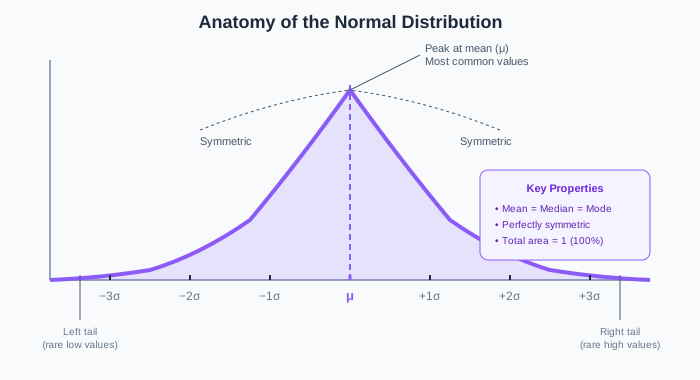
Key properties of the normal distribution:
Symmetric
Left and right sides are mirror images
Mean = Median = Mode
All three measures of center are equal
Total Area = 1
100% of probability under the curve
Asymptotic Tails
Tails approach but never touch the x-axis
The 68-95-99.7 Rule (Empirical Rule)
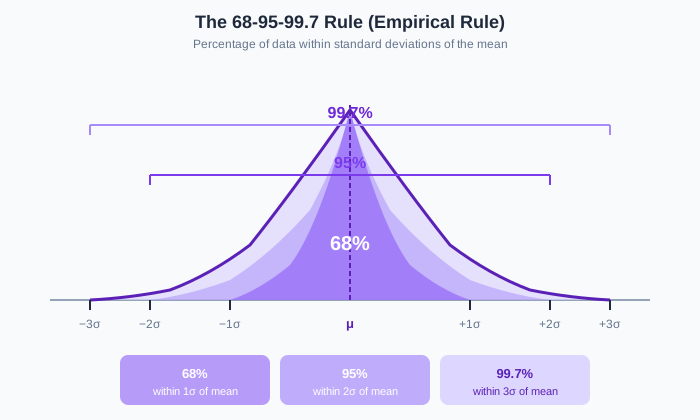
The 68-95-99.7 rule (also called the Empirical Rule) is a shortcut for estimating probabilities without calculation. It tells you what percentage of data falls within 1, 2, or 3 standard deviations of the mean:
| Range | % of Data | What It Means |
|---|---|---|
| μ ± 1σ | 68% | About 2/3 of all data points |
| μ ± 2σ | 95% | Almost all data points |
| μ ± 3σ | 99.7% | Virtually all data points |
Example: Test Scores
Suppose exam scores are normally distributed with μ = 75 and σ = 10.
- 68% of students score between 65 and 85 (75 ± 10)
- 95% of students score between 55 and 95 (75 ± 20)
- 99.7% of students score between 45 and 105 (75 ± 30)
This means scoring below 55 or above 95 is rare (only 5% combined), and scoring below 45 or above 105 is extremely rare (only 0.3% combined).
Z-Scores: Standardizing the Normal Distribution
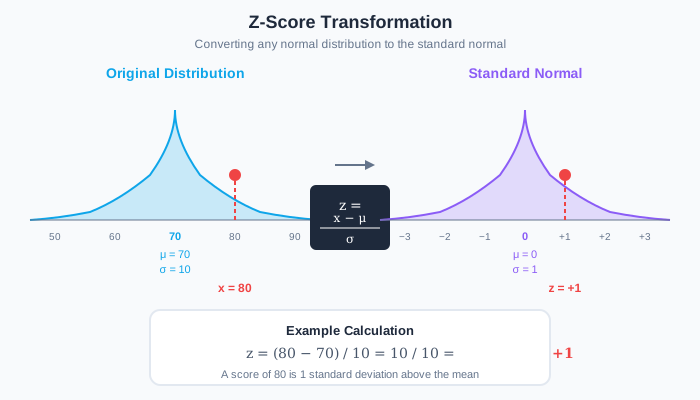
A z-score tells you how many standard deviations a value is from the mean. The formula is:
z = (x − μ) / σ
Where:
- x = your data value
- μ = population mean
- σ = population standard deviation
Interpreting Z-Scores
| Z-Score | Interpretation |
|---|---|
| z = 0 | Exactly at the mean |
| z = +1 | 1 standard deviation above the mean |
| z = −1 | 1 standard deviation below the mean |
| z = +2 | 2 standard deviations above (top ~2.5%) |
| z = −2 | 2 standard deviations below (bottom ~2.5%) |
Z-scores are powerful because they let you compare values from different distributions. A z-score of +1.5 means the same thing whether you’re looking at test scores (μ = 75, σ = 10) or heights (μ = 68 inches, σ = 3 inches) — it’s 1.5 standard deviations above average.
The Standard Normal Distribution
The standard normal distribution is a special normal distribution with:
- Mean (μ) = 0
- Standard deviation (σ) = 1
Why does this matter? Because probability tables (z-tables) are based on the standard normal. To find probabilities for any normal distribution, you:
Step 1
Convert x to z-score
Step 2
Look up z in table
Step 3
Read probability
Most platforms (MyStatLab, ALEKS) have built-in calculators, but you still need to understand the logic to set up problems correctly.
Why the Normal Distribution Matters
The normal distribution isn’t just an abstract concept — it’s the foundation of most statistical methods:
Natural Phenomena
Many real-world variables are approximately normal: heights, blood pressure, IQ scores, measurement errors. This isn’t coincidence — it’s a consequence of many small random effects adding up.
Central Limit Theorem
Even if a population isn’t normal, sample means will be approximately normal for large enough samples. This is why we can use normal-based methods (z-tests, t-tests) even when data is skewed.
Statistical Inference
Confidence intervals, hypothesis tests, and regression all assume normality (or rely on CLT). Understanding the normal distribution is prerequisite for understanding these methods.
Common Student Mistakes
| Mistake | Correction |
|---|---|
| Forgetting to subtract μ in z-score formula | Always use z = (x − μ) / σ, not z = x / σ |
| Confusing “less than” vs “greater than” probabilities | Z-tables give P(Z < z). For P(Z > z), subtract from 1 |
| Using 68-95-99.7 for non-normal data | Empirical Rule only applies to normal distributions |
| Mixing up σ (population) and s (sample) | Use σ for population parameters, s for sample statistics |
| Thinking z-score IS the probability | Z-score is the standardized value; you still need to look up probability |
Platform-Specific Tips
Uses built-in normal calculator. Watch for whether problems ask for area to the left, right, or between values. ALEKS is strict about decimal places — usually wants 4.
Has StatCrunch integration for normal calculations. Pay attention to whether you need cumulative probability or complement. Rounding matters — match their decimal requirements.
Often requires showing z-score calculation before probability. Exact format matters — sometimes wants z = 1.50, not z = 1.5.
Frequently Asked Questions
What is the normal distribution?
The normal distribution (also called the bell curve or Gaussian distribution) is a symmetric, bell-shaped probability distribution where most values cluster around the mean. It’s defined by two parameters: the mean (μ) which determines the center, and the standard deviation (σ) which determines the spread.
What is the 68-95-99.7 rule?
The 68-95-99.7 rule (Empirical Rule) states that for any normal distribution: 68% of data falls within 1 standard deviation of the mean, 95% falls within 2 standard deviations, and 99.7% falls within 3 standard deviations. This rule helps you quickly estimate probabilities without calculation.
What is a z-score?
A z-score tells you how many standard deviations a value is from the mean. The formula is z = (x − μ) / σ. A z-score of +2 means the value is 2 standard deviations above the mean. Z-scores allow you to compare values from different distributions and use the standard normal table.
What is the standard normal distribution?
The standard normal distribution is a special normal distribution with mean μ = 0 and standard deviation σ = 1. Any normal distribution can be converted to the standard normal using z-scores. This is useful because probability tables (z-tables) are based on the standard normal.
Why is the normal distribution so important?
The normal distribution is important because: (1) many natural phenomena follow it (heights, test scores, measurement errors), (2) the Central Limit Theorem says sample means are approximately normal regardless of population shape, and (3) most statistical tests (t-tests, ANOVA, regression) assume normality.
How do I know if data is normally distributed?
You can check for normality using: (1) histograms — should look bell-shaped, (2) Q-Q plots — points should fall along a straight line, (3) statistical tests like Shapiro-Wilk or Kolmogorov-Smirnov. In practice, slight deviations from normality are usually acceptable for large samples.
What’s the difference between normal distribution and standard normal?
A normal distribution can have any mean and standard deviation (e.g., μ = 100, σ = 15 for IQ scores). The standard normal is a specific normal distribution with μ = 0 and σ = 1. You convert from normal to standard normal using z-scores: z = (x − μ) / σ.
Where can I get help with normal distribution problems?
If you’re struggling with normal distribution, z-scores, or probability calculations, Finish My Math Class offers expert statistics help across all major platforms. We guarantee A/B grades on all work including MyStatLab, ALEKS, and WebAssign.
Need Help with Statistics?
Normal distribution, z-scores, probability — we’ve got you covered.