
Looking for Mastering Chemistry Answers?
Hire our experts to help you ace all your Mastering Chemistry assignments
MasteringChemistry Answers & Help – Homework, Labs, and Full Course Support
Expert MasteringChemistry answers and help for General Chemistry, Organic Chemistry, Health Sciences, and Biochemistry – with an A/B grade guarantee.
Quick Answer
Mastering Chemistry is one of the most precision-demanding platforms in science education. Correct chemistry gets marked wrong because of significant figure count, unit format, notation style, or hint penalties – not because the underlying answer is wrong. FMMC experts work inside your account and understand the platform’s exact input requirements, grading rules, and mastery module mechanics. Homework sets, quizzes, labs, and full course management – A/B grade guaranteed. Contact us with your course and deadline and we will respond within hours.
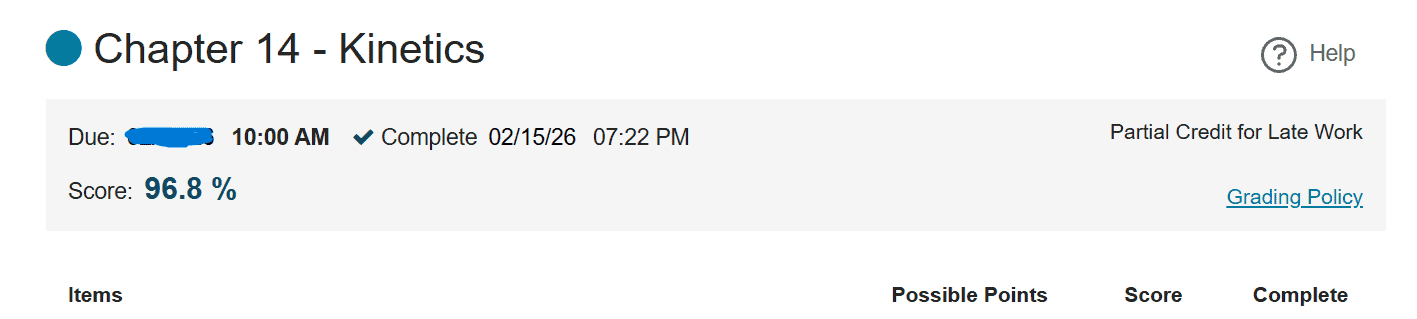
Real Mastering Chemistry Results from FMMC

What Is Mastering Chemistry
Mastering Chemistry is Pearson’s online homework and assessment platform for college-level chemistry courses. It is the chemistry component of the Pearson Mastering suite, which also includes Mastering Physics, Mastering Biology, and Mastering A&P. The platform is used at hundreds of colleges and universities across the U.S. and Canada, most commonly in General Chemistry, Organic Chemistry, and Introductory Chemistry for health science majors.
Mastering Chemistry assignments are embedded in the course LMS – most commonly Canvas, Blackboard, or Brightspace – but the actual problem content, grading, and submission occur within Pearson’s system. Students log in through their LMS, which authenticates them into Mastering, and grades sync back to the gradebook automatically. This LTI integration means the platform is technically separate from the LMS even though it appears to live inside it – a source of confusion when assignments do not load or grades do not sync correctly.
Assignment Types
Mastering Chemistry delivers several distinct assignment formats, each with different grading mechanics. Homework assignments consist of multi-part numerical, conceptual, and diagram-based problems aligned to the course textbook. Pre-lecture assignments are shorter reading checks. Chapter quizzes are timed and may not allow hints. Mastery modules (also called Dynamic Study Modules) are adaptive practice sets that keep assigning problems until a student demonstrates proficiency above a set threshold. Virtual lab assignments pair with platforms like Labster or use Pearson’s own interactive simulations and include pre-lab and post-lab written components.
Textbooks That Pair With Mastering Chemistry
The two most widely used textbooks are Chemistry: The Central Science (Brown, LeMay, Bursten) and Chemistry: A Molecular Approach by Nivaldo Tro. Other common pairings include General Chemistry by Petrucci and Organic Chemistry by McMurry, Wade, or Clayden. The specific problem bank a student encounters is tied to which textbook the instructor has paired with the course, which is why a generic answer key cannot work – problems are drawn from a specific bank and often have randomized numerical values.
Mastering Chemistry vs. ALEKS Chemistry
Mastering Chemistry is homework- and textbook-aligned – assignments are built around specific chapters and mirror the textbook’s problem sets. ALEKS Chemistry is a fully adaptive platform that builds a knowledge map of what a student knows and does not know, assigning problems accordingly without following a textbook chapter structure. Some courses use both – Mastering for graded homework and ALEKS for placement or adaptive practice. Check the syllabus or LMS login link if you are unsure which platform your course uses – FMMC covers both.
Why Mastering Chemistry Is Hard
Students who struggle with Mastering Chemistry usually are not struggling with chemistry. They are struggling with the platform itself – its input requirements, scoring mechanics, and adaptive systems. The fixes for each are completely different.
The precision requirement is stricter than a human grader. A human grader marking a paper exam will typically give credit for a correct numerical answer even with the wrong number of significant figures. Mastering Chemistry does not – it evaluates significant figures as a separate graded criterion from the numerical value. An answer of 4.5 when 4.50 is expected receives zero credit even though both values are numerically equivalent. The same applies to unit formats, subscript notation in chemical formulas, and capitalization in some fields.
Randomized values prevent answer sharing. Most homework problems use parametric randomization – the scenario is identical for every student, but the numerical values change per student per attempt. A generic answer key, even a recently posted one, gives the wrong numerical answer for any specific student’s version of the problem.
Mastery modules do not end when you run out of patience. Dynamic Study Modules use an adaptive algorithm that keeps assigning questions until proficiency crosses an instructor-set threshold. A student who has attempted many problems correctly may still not have “finished” because the algorithm has not registered enough consecutive correct answers. Students near a deadline discover there is no fixed end point.
The hint system has hidden costs. Each hint used deducts a percentage from that problem’s point value, set by the instructor and often not displayed prominently. A student who leans on hints expecting a small deduction can end up with only a fraction of the available credit even with a correct final answer.
The Four Scoring Traps
These four platform mechanics cost students points on work that is chemically correct. Each is predictable and avoidable once you know what the platform is checking – but most students only learn about them after failing an assignment.
| Trap | What Happens |
|---|---|
| Significant Figures | Entering 4.5 instead of 4.50 loses full credit, even though the values are numerically equivalent. |
| Unit and Notation Format | Wrong capitalization or an equivalent-but-different unit choice is rejected as incorrect. |
| Hint Penalties | Each hint deducts a percentage from the question score, set by the instructor and rarely shown up front. |
| Mastery Module Thresholds | The module keeps assigning problems until a proficiency threshold is reached, regardless of how many attempts have already been made. |
A student who understands stoichiometry correctly but does not know the platform requires three significant figures by default will consistently lose points on numerically correct answers. A student who uses hints freely, not realizing each one carries a real deduction, can end a homework set with a grade well below what their chemistry understanding would suggest. A student who starts a mastery module the night before it is due, not realizing it will not close until threshold is reached, can run out of time on an assignment they are technically passing. These are platform-literacy problems, distinct from chemistry-knowledge problems.
Chemistry Courses That Use Mastering
General Chemistry I and II
The most common context for Mastering Chemistry. Gen Chem I covers atomic structure, bonding, stoichiometry, gas laws, and thermodynamics. Gen Chem II covers equilibrium, kinetics, electrochemistry, and nuclear chemistry. Both are typically required for chemistry, biology, pre-med, pre-pharmacy, and engineering majors – fast-paced, high-credit, and high-stakes. See our guide on why General Chemistry is hard for more on what makes this course sequence so demanding.
Introductory and Allied Health Chemistry
Many nursing and allied health programs require an introductory chemistry sequence with the same platform mechanics as General Chemistry but less mathematical depth. Students in these programs often struggle more with the platform than with the underlying chemistry content.
Organic Chemistry I and II
Organic Chemistry on Mastering focuses more on mechanism drawing, reaction prediction, and conceptual questions than numerical calculation. The platform handles mechanism questions through drag-and-drop tools with their own formatting requirements – arrow placement, charge notation, and stereochemistry indicators all need exact input. See our Organic Chemistry help page for more detail.
Biochemistry
Introductory Biochemistry sometimes uses Mastering Chemistry for general chemistry prerequisite content, or pairs it with Mastering Biology for molecular biology components. FMMC covers introductory biochemistry at the undergraduate level.
Assignment Formats We Cover on Mastering Chemistry
Mastering Chemistry grades several distinct assignment formats differently, each with its own mechanics to navigate. For the full breakdown of chemistry topics we cover across General, Organic, and Biochemistry, see our Chemistry Homework Help page – here’s what’s specific to how Mastering structures and grades the work itself:
Homework Assignments
Multi-part numerical, conceptual, and diagram-based problems tied directly to your textbook’s chapter structure.
Pre-Lecture Assignments
Shorter reading checks due before class, graded on completion and comprehension rather than depth.
Chapter Quizzes
Timed assessments that frequently disable hints, raising the stakes on formatting and sig-fig accuracy.
Dynamic Study Modules
Adaptive mastery modules with no fixed endpoint, completed efficiently to reach the proficiency threshold before deadline.
Virtual Labs and Lab Reports
Pre-lab and post-lab write-ups, data analysis, percent error, and simulations including Labster integrations.
Health Sciences and Nursing Chemistry
Metric conversions, dimensional analysis, solution concentration, acid-base pH, and drug dosage calculations.
Nursing and allied health students encounter the same platform mechanics as Gen Chem students with less math background – FMMC bridges both gaps.
How FMMC Helps
FMMC provides Mastering Chemistry support at whatever scope is needed – a single homework set, a mastery module due before a deadline, or complete course management from the first assignment to the final exam.
| What Students Say | How FMMC Handles It |
|---|---|
| “The interface is confusing and unintuitive.” | We know the platform’s input tools, diagram editors, and navigation – assignments are completed accurately without fighting the interface. |
| “Small mistakes on sig figs and formatting get zero credit.” | We handle every precision requirement – significant figures, unit format, subscript notation, capitalization – so you do not lose points to platform mechanics. |
| “Questions are randomized – I cannot find answers online.” | We work inside your account and solve your specific version of each problem. Generic answer keys from other students will not match your values – ours will. |
| “Mastery modules keep going and I am running out of time.” | We navigate mastery modules efficiently and reach the proficiency threshold before the deadline. |
| “I am stuck on lab reports and conceptual questions.” | FMMC covers lab reports, post-lab analysis, and written conceptual questions – not just numerical calculation problems. |
All Mastering Chemistry work is completed by human chemistry experts working inside your account – never AI. See why we use human experts instead of AI, check our A/B grade guarantee for full terms, or view pricing. Get a free quote and hear back within hours.
Related services: general Chemistry homework help, ALEKS Chemistry, Organic Chemistry help, and Mastering Physics help.
Frequently Asked Questions
What is Pearson Mastering Chemistry?
Mastering Chemistry is Pearson’s online homework and assessment platform for college chemistry courses. It delivers homework sets, mastery modules, quizzes, pre-lecture assignments, and virtual lab components, embedded in course LMS systems via LTI integration.
Why does Mastering Chemistry mark my answer wrong when I think it is correct?
The most common reasons are significant figure count, unit format, and notation style. Mastering Chemistry enforces significant figures as a separate graded requirement – 4.5 and 4.50 are not equivalent on this platform. Unit capitalization and notation also trigger incorrect-answer responses.
Where can I find reliable Mastering Chemistry answers online?
Most problems use parametric randomization – the scenario is the same for all students but numerical values change per student. Any answer key online reflects a specific student’s version with specific values, not yours. FMMC works inside your account and solves your specific version of each problem.
What are Dynamic Study Modules and why do they take so long?
Dynamic Study Modules are adaptive assignments that keep assigning problems until the student’s proficiency crosses an instructor-set threshold. There is no fixed endpoint – the module continues until threshold is reached, regardless of how many problems have been attempted.
Do hints on Mastering Chemistry cost points?
Yes. Each hint deducts a percentage from that question’s point value, set by the instructor. Using multiple hints on a single question can reduce the score substantially even when the final answer is correct.
Can FMMC help with Mastering Chemistry lab assignments?
Yes. FMMC covers pre-lab questions, post-lab write-ups, data analysis, virtual lab simulations including Labster integrations, and observation-based conceptual questions.
Do you guarantee the grade on Mastering Chemistry work?
Yes. All Mastering Chemistry work is backed by the FMMC A/B grade guarantee. If we do not deliver the agreed grade and you followed our instructions, you receive a refund.
Which textbooks does Mastering Chemistry work with?
The most common pairings are Chemistry: The Central Science (Brown, LeMay, Bursten) and Chemistry: A Molecular Approach by Nivaldo Tro for General Chemistry. Organic Chemistry courses most commonly pair with McMurry, Wade, or Clayden.
Related Pages
There are many reasons why students need help with their coursework. In any case, it is never too late to ask for help. So, what are you waiting for? Let’s connect!