
Simplifying Algebraic Expressions
You walk into a store with 3 shirts, 2 pairs of jeans, and then grab 2 more shirts and a pair of jeans. You do not describe what you bought as “3 shirts + 2 jeans + 2 shirts + 1 jeans” — you say “5 shirts and 3 jeans.” That is simplifying. In algebra, simplifying an expression means combining what can be combined and writing the result in its most compact form. It is the first skill every algebra course builds on, and every later topic — solving equations, factoring, graphing — depends on doing it correctly.
The Core Rules
Like terms only: You can only combine terms with the same variable and the same exponent. 3x and 5x combine. 3x and 5x² do not.
Coefficients only: When combining like terms, add or subtract the coefficients. The variable part stays the same. 3x + 5x = 8x, not 8x².
Distribute before combining: If there are parentheses, distribute first. Then collect like terms. Never combine across undistributed parentheses.
Simplifying is not solving: There is no equals sign. You are rewriting the expression, not finding a value for x.
Table of Contents
1) What “Simplifying” Means in Algebra
An algebraic expression is a combination of variables, coefficients, and constants connected by operations. 4x² + 3x − 2x² + 7 − x + 5 is an expression. Simplifying it means rewriting it in its shortest equivalent form by combining everything that can be combined.
The key word is equivalent. A simplified expression has exactly the same value as the original for every possible value of x. You are not changing what the expression means — you are just writing it more efficiently.
There are two main tools for simplifying:
Combining Like Terms
Adding or subtracting terms that have the same variable and exponent. 3x + 5x = 8x. Only the coefficients change.
The Distributive Property
Multiplying a term outside parentheses by every term inside. 3(x + 4) = 3x + 12. Required before combining terms when parentheses are present.
Most simplification problems require both tools in sequence: distribute first, then combine. The sections below cover each step in detail.
Simplifying vs. solving: what is the difference?
This trips students up constantly. Simplifying rewrites an expression — there is no equals sign, and x stays in the answer. Solving an equation finds the value of x — there is an equals sign, and the answer is a number. Same expression, completely different tasks:
Simplify: 3x + 5 − x + 1
No equals sign → just combine.
x stays in the answer. Done.
Solve: 3x + 5 − x + 1 = 0
Has equals sign → find x.
Answer is a number. Done.
2) Combining Like Terms
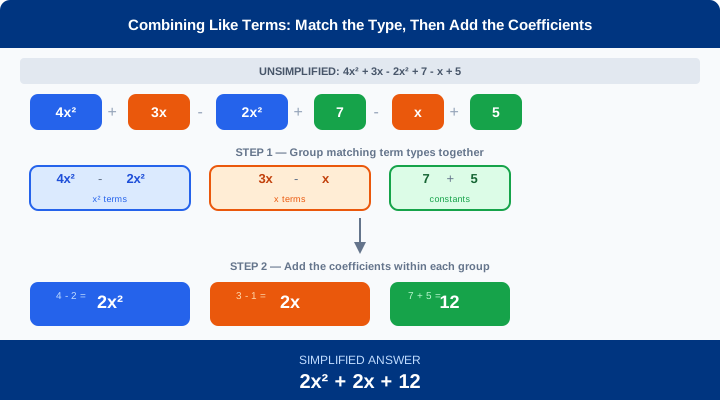
Like terms are terms that have the same variable raised to the same power. 4x² and −2x² are like terms. 3x and −x are like terms. 7 and 5 are like terms (both constants). But 3x and 3x² are not like terms — the exponents are different.
The process step by step
Identify all the like term groups. Collect each group. Add or subtract the coefficients within each group. Write the result with terms in standard order (highest exponent first, then descending).
x terms: 7x − 4x = 3x
constants: 3 + 9 = 12
Answer: 3x + 12
x² terms: 5x² + 2x² = 7x²
x terms: −3x + 8x = 5x
constants: −1
Answer: 7x² + 5x − 1
Coefficients of 1 and −1
When a variable has no written coefficient, the coefficient is 1. When a variable has a minus sign in front with no number, the coefficient is −1. Students often forget this when combining.
x + x = 1x + 1x = 2x
−x + 3x = −1x + 3x = 2x
3) The Distributive Property
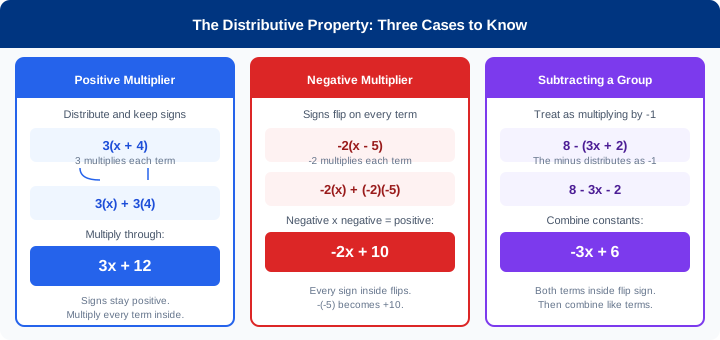
The distributive property says that a(b + c) = ab + ac. The term outside the parentheses multiplies every term inside. This must happen before you combine any like terms.
Positive multiplier
= 5(2x) + 5(3)
= 10x + 15
Negative multiplier
When the multiplier is negative, every sign inside flips. A positive term becomes negative and a negative term becomes positive.
= −4(3x) + (−4)(−2)
= −12x + 8
Subtracting a group
A minus sign directly in front of parentheses means multiplying by −1. Every term inside changes sign. Students most commonly miss this on the second or third term.
= 10 − 1(4x + 3)
= 10 − 4x − 3
= −4x + 7
Fractional and decimal multipliers
= (1/2)(4x) + (1/2)(6)
= 2x + 3
0.5(4x + 6) = 2x + 3 (same result)
4) Combining Like Terms After Distributing
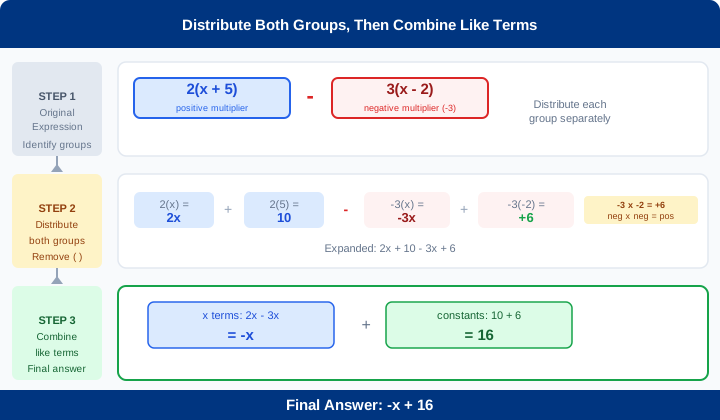
Most simplification problems combine both skills: distribute first to remove parentheses, then collect like terms. The order matters — combining before distributing produces wrong answers.
Standard example
Step 1 — Distribute:
6x + 12 + 5x − 6
Step 2 — Combine like terms:
x terms: 6x + 5x = 11x
constants: 12 − 6 = 6
Answer: 11x + 6
Two sets of parentheses
Distribute both groups:
2x + 10 − 3x + 6
Combine like terms:
x terms: 2x − 3x = −x
constants: 10 + 6 = 16
Answer: −x + 16
Leading negative on the second group
The −3 distributes into both terms inside the second parentheses. The −3(−2) becomes +6, not −6. This is the most common error in two-group problems.
Distribute (second group: −1 multiplier):
4x − 4 − 2x − 3
Combine:
x terms: 4x − 2x = 2x
constants: −4 − 3 = −7
Answer: 2x − 7
5) Simplifying with Multiple Variables
When an expression contains more than one variable, the same rules apply — like terms must have the same variable and the same exponent. An x term and a y term are never like terms, even if their coefficients match.
x terms: 3x + 5x = 8x
y terms: 2y − y = y
Answer: 8x + y
xy terms: 4xy − 2xy = 2xy
x terms: 3x + x = 4x
Answer: 2xy + 4x
xy is its own term type
4xy and 3x are not like terms. 4xy has two variables multiplied together — it is a different type from a plain x term. They must stay separate in the simplified answer.
Distributing with multiple variables
Distribute:
6x + 2y + 4x − 8y
Combine:
x terms: 6x + 4x = 10x
y terms: 2y − 8y = −6y
Answer: 10x − 6y
6) Common Mistakes
Combining unlike terms
✓ Correct: 3x + 2x² cannot be combined. They are unlike terms. The answer is just 2x² + 3x.
Forgetting to distribute to every term
✓ Correct: 3(x + 4) = 3x + 12 — the 3 multiplies both x and 4.
Dropping the negative when distributing
✓ Correct: −2(x − 5) = −2x + 10 — negative times negative is positive.
Adding exponents when combining like terms
✓ Correct: 3x + 5x = 8x — add the coefficients, not the exponents. Exponents are added when multiplying, not when adding.
Treating simplifying as solving
Simplifying an expression does not produce a numerical answer for x. There is no equals sign, so x stays in the answer. Students sometimes write the simplified expression and then set it equal to zero or try to “solve” for x. That is a different type of problem. See our guide on solving linear equations for when you do have an equals sign.
Standard form on platforms like MyMathLab and ALEKS
Most platforms expect simplified expressions in standard form — terms ordered from highest exponent to lowest, with constants last. 3 + 2x² + x may be marked wrong on MyMathLab even though it is mathematically equivalent to 2x² + x + 3. Always write your answer in descending exponent order. See our MyMathLab help page for format details specific to that platform.
How to type simplified expressions on MyMathLab and ALEKS
Exponents
Use ^ for exponents on both platforms.
Negative leading coefficient
Do not type -1x. Just -x. Most platforms reject the explicit 1.
Spaces
Spaces around operators are usually fine but check your platform — ALEKS is stricter than MyMathLab.
Multiplication
Write 2x or 2*x. Do not leave parentheses in your final answer.
7) How FMMC Can Help
Simplifying expressions appears in every algebra module — it is a prerequisite skill for solving equations and factoring. If you are behind on assignments or need help across a full algebra course, FMMC’s experts handle every module with an A/B guarantee.
Algebra Homework
Every simplifying, combining, and distributing module handled accurately on MyMathLab, ALEKS, WebAssign, and Hawkes. See our algebra homework help page.
Proctored Exams
Algebra exams on Honorlock and Respondus supported. See our proctored exam page.
A/B Guarantee
A or B grade or your money back — see our guarantee.
Behind on algebra or exam coming up? Tell us your course, platform, and next due date.
FAQ: Simplifying Algebraic Expressions
Why does my answer keep getting marked wrong even though it looks right?
The most common reason is standard form. Platforms like MyMathLab and ALEKS expect terms written in descending exponent order: x² first, then x, then constants. An answer like 6 + 2x is mathematically correct but may be rejected if the platform expects 2x + 6. The second most common reason is leaving a coefficient of 1 written out — writing 1x instead of x, or -1x instead of -x, can trigger an incorrect flag on some platforms.
What are like terms?
Like terms have the same variable raised to the same exponent. 3x and 7x are like terms. 5x² and −2x² are like terms. But 3x and 3x² are not like terms because the exponents differ, and 4x and 4y are not like terms because the variables differ.
What is the coefficient of a term like x or -x?
When a variable has no written number in front of it, the coefficient is 1. When a variable has just a minus sign in front, the coefficient is −1. So x means 1x, and −x means −1x. This matters when combining: 4x − x is 4x − 1x = 3x, not 4x − 0 = 4x, which is a common mistake.
What is the distributive property?
The distributive property states that a(b + c) = ab + ac. The term outside the parentheses multiplies every term inside. For example, 4(2x + 3) = 8x + 12. When the outside term is negative, every sign inside the parentheses flips.
Do you distribute before or after combining like terms?
Always distribute first, then combine like terms. Distributing removes the parentheses and reveals all the terms in the expression. Only after all parentheses are cleared can you safely identify and combine like terms.
Can you combine x and x² terms?
No. 3x and 5x² are unlike terms and cannot be combined. The exponents are different, which means they represent different mathematical objects. They must stay as separate terms in the simplified expression.
What order should terms be in after simplifying?
Standard form lists terms in descending order of exponents: x² terms first, then x terms, then constants. For example, 2x² + 5x − 3. Most homework platforms including MyMathLab and ALEKS expect this order and may mark an equivalent but non-standard answer wrong.
Can FMMC help with simplifying expressions homework?
Yes. FMMC handles algebra homework across MyMathLab, ALEKS, WebAssign, and Hawkes Learning. See our algebra homework help page or get a free quote.
Algebra Homework Piling Up?
Tell us your course, platform, and next due date. FMMC’s algebra experts handle every assignment — A/B guaranteed or your money back.
Or email: info@finishmymathclass.com • A/B Guarantee • Algebra Help