
WebAssign Answers: FMMC Completes Your Homework, Quizzes, and Exams
Done with fighting WebAssign’s formatting rules?
Finish My Math Class provides WebAssign answers for homework sets, quizzes, timed exams, and full courses across math, statistics, physics, and chemistry. Every problem completed by a real subject-matter expert who knows WebAssign’s syntax requirements, grading behavior, and LMS integrations — not a bot, not a recycled answer key. A/B grade guaranteed or your money back.
Contents
1. What FMMC Handles on WebAssign
WebAssign’s randomized problems, strict symbolic notation, limited submission attempts, and auto-grading system create a workload that compounds subject difficulty with platform difficulty. FMMC handles all of it. Our experts log into your account and complete the work — accurately, on time, and formatted correctly for WebAssign’s grading engine.
Homework sets
All homework completed accurately before deadlines. We handle multi-part problems, graphing questions, table-fill responses, and symbolic expression entry — formatted to match WebAssign’s parser exactly.
Quizzes and timed exams
Single-attempt and timed assessments completed in real time. We account for attempt limits and time constraints before submitting, and we do not panic-guess your attempts away.
Proctored exams
We handle WebAssign exams paired with LockDown Browser, Proctorio, and Honorlock. See our proctored exam service for full details on how we approach monitored assessments.
Interactive problems
Graphing tools, point plotting, vector diagrams, free body diagrams, circuit diagrams, molecular structure drawing — all handled directly inside the WebAssign interface. No text-based workaround.
Full course takeover
Every assignment, quiz, and exam from start to finish. Available for 5-week, 8-week, and 16-week courses. We track deadlines so nothing falls through.
All LMS integrations
Canvas, Blackboard, D2L, and Moodle integrations handled. If your WebAssign only opens through your school’s LMS, we access and complete it through that system.
Recent WebAssign results from FMMC clients:
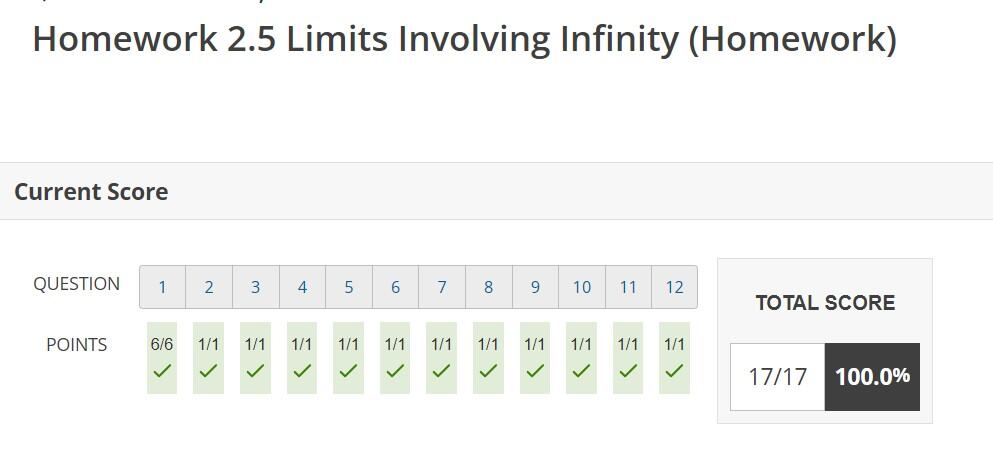

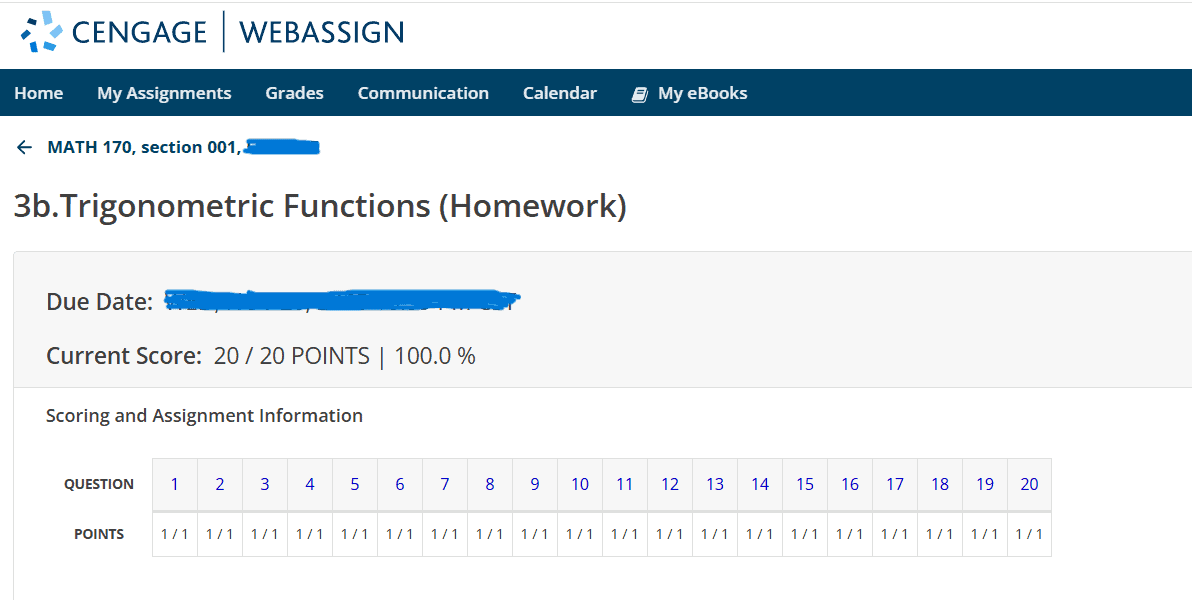
How it works: Send us your assignment details via the contact form. We review the course, provide a quote (usually within a few hours), and once you confirm, our expert starts on your next WebAssign assignment. For same-day deadlines, say so up front — we prioritize urgent work.
2. How WebAssign Works
WebAssign is a browser-based homework and assessment platform used across math, science, and engineering courses at colleges nationwide. Instructors build assignments from a textbook-linked problem library — most commonly Cengage titles, though WebAssign also supports OpenStax and others — and students complete them on a deadline. Most responses are graded automatically the moment you submit.
The settings instructors control matter a great deal to students. Two students in the same course can have very different assignment experiences depending on how their section is configured.
Randomized values
Each student receives different numerical values for the same problem. This is why Chegg solutions and answer keys don’t work — the answer listed is for someone else’s version.
Attempt limits
Homework sets typically allow 3–10 attempts per question. Quizzes and exams usually allow only 1. Each failed attempt on limited-attempt problems permanently reduces your max score.
Strict auto-grading
Numerical answers must fall within a narrow tolerance band. Expression answers must match WebAssign’s parser syntax exactly. A rounding error or missing parenthesis gets zero credit.
Locked progression
Some courses require a passing score on earlier modules before later ones unlock. One missed or incomplete assignment can block access to the rest of the coursework.
LMS integration
WebAssign is typically embedded inside Canvas, Blackboard, D2L, or Moodle. Assignments may only appear through the LMS link, and deadlines may display in one system while submissions happen in another.
Multi-part dependencies
Wrong answer in part A often makes part B impossible to get right, since later parts use earlier results. A single careless error can contaminate an entire multi-part problem.
3. The Symbolic Entry System
WebAssign’s symbolic math entry system is the platform’s most notorious feature — and the single biggest reason students with correct answers still lose points. The system requires mathematical expressions in exact notation. The parser does not interpret mathematical intent; it compares your text against expected formats character by character.
Core syntax rules
Multiplication
Must use asterisk explicitly. 2*x not 2x. Before parentheses too: 2*x*(3*x+5) not 2x(3x+5).
Exponents
Use caret with parentheses for compound exponents. x^(2/3) not x^2/3 (parsed as x²÷3). x^(-1) not x^-1.
Fractions
Parentheses required on both sides. (2*x+3)/(5*x-1) not 2x+3/5x-1 (parser reads that as 2x + 3/5x − 1).
Function names
Exact abbreviations only. sin(x) not sine(x). abs(x) not |x|. sin^(-1)(x) not arcsin(x).
Interval notation
Type the word, not the symbol. (-infinity, 5] not (-∞, 5] or (-inf, 5]. Brackets and parentheses must be correct for included vs. excluded endpoints.
Scientific notation
Format varies by problem — some accept 6.02E23, others require 6.02*10^23. Sig figs must match exactly; 6.020E23 is wrong if 3 sig figs were specified.
Subject-specific notation
Beyond the core syntax, each subject has its own notation layer:
Calculus
Indefinite integrals require + C; definite integrals forbid it. One-sided limits must indicate direction. dy/dx vs f’(x) vs D[f(x)] are not always interchangeable.
Chemistry
Subscripts use underscore: H_2O not H2O. Equilibrium constants need exact subscript format. Sig figs are enforced strictly — chemistry loses more points to precision errors than any other subject.
Physics
Units may be required or forbidden depending on the problem — and the problem text does not always make this clear. m/sec is not accepted where m/s is expected. Sign conventions for vectors must match the problem’s coordinate system.
Statistics
P(A|B), P(A∩B), and P(A∪B) are distinct inputs. Hypothesis notation must match exact format. Confidence interval bounds require the correct bracket type.
Quick reference for the most common WebAssign answer entry issues:
WebAssign answer entry reference — formatting and precision rules that determine whether a correct answer is accepted
4. Top 5 Mistakes That Cost Students Points
These five errors account for more WebAssign point loss than conceptual misunderstanding. Students who have the right answer still lose credit because of how WebAssign’s parser works.
1. Parentheses errors in fraction entry
On paper, a fraction bar provides visual grouping. In WebAssign’s text entry, the slash / is a binary operator that only applies to the adjacent terms. Typing 2x+3/5x-1 is parsed as 2x + (3/5x) − 1, not (2x+3)/(5x−1).
Correct entry: (2*x+3)/(5*x-1) — parentheses around the entire numerator and entire denominator, asterisks for all multiplication.
2. Missing explicit multiplication operators
Standard math notation treats juxtaposition as multiplication — 2x means 2 times x. WebAssign’s parser cannot make this assumption. Every multiplication must be written explicitly with an asterisk, including before parentheses.
Wrong: 2x(3x+5) Correct: 2*x*(3*x+5)
3. Scientific notation format errors
WebAssign’s scientific notation format varies by problem. Some accept 6.02E23, others require 6.02*10^23. Using the wrong format gets marked wrong even when the value is correct. Additionally, significant figures must match exactly — 6.020E23 is wrong if 3 sig figs were specified.
Prevention: Read the problem statement and check the format WebAssign provides in its worked examples for that assignment. When a unit or format selector dropdown appears, use it — it inserts the correct string automatically.
4. Rounding at intermediate steps
WebAssign compares your final answer against the result of its own internal calculation carried to full precision. If you round an intermediate value mid-problem, your final answer may differ from the system’s by enough to fall outside the tolerance band — and gets marked wrong.
Rule: Carry full precision through every intermediate step. Round only the final submitted answer, to exactly the number of decimal places or significant figures the problem specifies.
5. Panic-guessing through limited attempts
When a first submission comes back wrong, students sometimes rapidly try variations — different rounding, units added or removed, different format — burning through all remaining attempts in minutes. The problem locks with zero credit even though the underlying math was correct.
Better approach: After a wrong attempt, step back. Verify the calculation method completely. Check notation syntax against the rules above. Review the sig fig requirement. Use remaining attempts strategically, one at a time.
5. Why AI Tools Fail on WebAssign
Students increasingly try AI tools for WebAssign. The problem is that WebAssign requires a combination of things AI cannot provide: seeing your actual interface, formatting answers to match a specific parser, interacting with graphing and drawing tools, and adjusting based on platform feedback after a wrong submission.
| Capability | ChatGPT / AI tools | FMMC experts |
|---|---|---|
| WebAssign syntax knowledge | No understanding of required notation | Expert mastery of symbolic entry format |
| Parentheses grouping | Frequently wrong for fractions | Matches WebAssign parser exactly |
| Significant figure compliance | Cannot determine problem-specific requirements | Reads specifications and applies correctly |
| Unit inclusion decisions | Guesses whether units are needed | Knows when to include or exclude |
| Interactive problems | Cannot interact with graphing or drawing tools | Works directly inside WebAssign interface |
| Error recovery | Cannot see platform feedback to adjust | Adapts based on WebAssign’s response |
| Randomized values | Solves a generic version, not yours | Logged into your account, solves your version |
| Grade guarantee | None — wrong answers with full confidence | A/B guarantee or refund |
Even when AI produces a mathematically correct solution, the notation translation problem remains: you still have to convert that answer into WebAssign’s exact symbolic format yourself. If you knew how to do that reliably, the problem would not have been difficult in the first place.
6. Subjects and Platforms Covered
| Subject | Common WebAssign topics | Key formatting notes |
|---|---|---|
| College Algebra | Functions, systems, factoring, rational expressions, inequalities | Interval notation, parentheses in expressions |
| Precalculus | Exponential, logarithmic, trig functions, conics, sequences | Exact values preferred; log notation exact |
| Calculus I, II, III | Limits, derivatives, integrals, series, multivariable calculus | + C required for indefinite; carry full precision |
| Trigonometry | Unit circle, identities, inverse trig, law of sines and cosines | Exact values (sqrt(3)/2 not 0.866) preferred |
| Statistics | Probability, distributions, confidence intervals, hypothesis testing | Decimal places per problem; p-values carried exact |
| General Chemistry | Stoichiometry, gas laws, equilibrium, electrochemistry, thermodynamics | Sig figs strictly enforced; scientific notation required |
| Organic Chemistry | IUPAC naming, mechanisms, stereochemistry, structure drawing | Interactive bond-drawing tools; R/S, E/Z exact format |
| Physics I & II | Mechanics, energy, circuits, optics, electromagnetism | Units exact; sign conventions must match coordinate system |
We also handle engineering courses (statics, dynamics, mechanics of materials), business math, differential equations, and linear algebra on WebAssign. We work through Canvas, Blackboard, D2L, and Moodle integrations. If your WebAssign is only accessible through your school’s LMS, we access and complete it from there.
We also handle other major platforms — see our MyLab Math page and ALEKS page. If you are running multiple math courses simultaneously, our full services page covers everything we do.
Ready to hand off your WebAssign course?
Real experts, no bots. Every problem solved correctly and entered in the exact format WebAssign’s grading engine expects. A/B grade guaranteed or your money back. Check what students say or see pricing before reaching out.