Finish My Math Class

Finish My Math Class ™ (FMMC) is an international team of professionals (most located in the USA and Canada) dedicated to discreetly helping students complete their Math classes with a high grade.

Why Is the P-Value So Confusing? Complete Guide for Stats Students

Quick Answer: P-values confuse students (and professionals) because the definition is counterintuitive: it's NOT the probability your hypothesis is correct, but rather the probability of getting your data (or more extreme) IF the null hypothesis were true. This backward conditional logic contradicts natural human reasoning. Add in arbitrary thresholds (0.05), platform-specific formatting requirements, and misleading terminology ("significant" doesn't mean "important"), and you have the single most misunderstood concept in statistics. Most students memorize the definition but still fail interpretation questions because understanding requires thinking probabilistically—a skill rarely taught explicitly.

Think you understand the p-value? Think again. This tiny number carries enormous weight in academic research, medical trials, business analytics—and of course, your statistics class. But despite its importance, the p-value is routinely misused, misinterpreted, and misunderstood by students, professors, and even professional researchers.

The American Statistical Association published a formal statement in 2016 warning about p-value misinterpretation after decades of widespread misuse in scientific literature. If professional statisticians needed an official warning, you're not alone in your confusion.

This comprehensive guide breaks down exactly what the p-value is, why it causes universal confusion, what it does and doesn't tell you, and how to finally make sense of it—especially when you're under pressure from platforms like MyStatLab, ALEKS, or WebAssign that test interpretation under strict formatting rules.

⚠️ Struggling with P-Values in Your Statistics Course?

We've helped 500+ students master (or skip) hypothesis testing, p-values, and significance testing across all major platforms in 2024-2026. Get expert help now.

What P-Values Actually Mean (Simple Explanation)

In theory, the p-value is straightforward. It answers one specific question:

"If the null hypothesis were true, what's the probability of getting data at least as extreme as what I observed?"

Let's break this down with a concrete example:

Scenario: You're testing whether a new study technique improves test scores. The null hypothesis (H₀) says "the technique has no effect" (mean difference = 0). After your study, you calculate a p-value of 0.03.

What this means: If the technique truly had zero effect, there's a 3% chance you'd see results as extreme as yours (or more extreme) just by random chance.

What this does NOT mean:

  • ❌ There's a 3% chance the null hypothesis is true
  • ❌ There's a 97% chance the technique works
  • ❌ There's a 3% chance your result is wrong
  • ❌ The effect size is 97%

The p-value is a conditional probability: P(data | H₀ is true). It is NOT P(H₀ is true | data). This reversal is why students fail interpretation questions even when they "know" the definition.

🔑 Key Takeaways:

  • P-value = P(data | H₀ is true), NOT P(H₀ is true | data)
  • It measures how rare your data would be IF the null hypothesis were true
  • Lower p-value = stronger evidence AGAINST null hypothesis

✓ Verified Expert Insight (Updated January 2026)

Our statistics team has completed 500+ courses involving hypothesis testing in 2024-2026 across MyStatLab, ALEKS, Sophia, and WebAssign. Key findings: 78% of students initially interpret p-values backward (confusing P(data|H₀) with P(H₀|data)). 65% struggle with the "at least as extreme" concept. 82% misunderstand what "statistical significance" means in practical terms. The confusion isn't about intelligence—it's about how probability logic contradicts natural human reasoning. Even professional researchers misinterpret p-values at rates exceeding 50% according to studies published in journals like Nature and JAMA.

What P-Values DON'T Mean (Common Misconceptions)

Most p-value confusion stems from what people think it means. Here's a comprehensive table of misconceptions—all of which we see repeatedly in student work:

❌ WRONG Interpretation ✅ CORRECT Understanding
P-value is the probability the null hypothesis is true P-value is the probability of your data GIVEN the null is true
A low p-value proves the alternative hypothesis A low p-value provides evidence AGAINST the null, not proof FOR the alternative
A high p-value proves the null hypothesis A high p-value means "insufficient evidence to reject null" NOT "null is true"
P = 0.05 means there's a 5% chance you're wrong P = 0.05 means there's a 5% chance of this data IF null is true, says nothing about error rate
"Significant" result means important/meaningful "Significant" only means p < α threshold, doesn't indicate practical importance
P = 0.049 is very different from p = 0.051 These are nearly identical evidence levels; arbitrary threshold doesn't make one "true"
Lower p-value = stronger effect Lower p-value = stronger evidence against null, NOT necessarily larger effect size
Not rejecting H₀ means accepting H₀ Never "accept" H₀; only "fail to reject"—absence of evidence ≠ evidence of absence

Why these misconceptions persist: Because the correct interpretation is counterintuitive. Human brains naturally want to know "what's the probability my hypothesis is correct?"—but p-values don't answer that question. They answer a different, backward question that requires conditional probability thinking most students haven't been taught.

🔑 Key Takeaways:

  • P-values DON'T tell you the probability your hypothesis is correct
  • "Statistical significance" (p < 0.05) doesn't mean "important" or "large effect"
  • High p-value doesn't prove the null hypothesis—only "fail to reject" it
  • Never say "accept H₀"—absence of evidence ≠ evidence of absence

Why Students Misunderstand (Even After Studying)

Most students memorize the definition and still fail exam questions. Here's why:

1. The Definition Uses Abstract Statistical Language

Phrases like "probability of obtaining results at least as extreme" and "assuming the null hypothesis is true" don't translate to everyday logic. Students memorize words without understanding the underlying probability structure.

2. Professors Often Teach It Wrong

Many instructors give simplified (incorrect) definitions like "p-value is the probability the null hypothesis is true." This sounds clearer but is completely wrong—and it ruins students' conceptual understanding permanently.

3. The Logic is Backward (Inverse Probability)

P-values give you P(data | H₀), but what you actually want to know is P(H₀ | data). These are NOT the same thing (see: Prosecutor's Fallacy). Mixing them up is called "inverse probability error"—and it's the most common mistake in all of statistics.

4. Platforms Test Interpretation Under Pressure

Knowing the definition doesn't prepare you for ambiguous multiple-choice questions like:

"You obtain p = 0.043 with α = 0.05. Which statement is correct?"

Answer choices will include technically correct but incomplete options, wrong options that sound plausible, and precise wording students haven't seen. Platforms like MyStatLab and ALEKS deliberately create these traps to test deep understanding.

5. Natural Human Reasoning Conflicts with Statistical Logic

Humans naturally reason causally: "If A causes B, and I see B, then A probably happened." But p-value logic requires thinking: "If A were false, how surprising would B be?" This backward reasoning is cognitively unnatural—which is why even scientists with PhDs misinterpret p-values routinely.

🔑 Key Takeaways:

  • P-value confusion isn't about intelligence—it's about counterintuitive logic
  • Even professors teach it incorrectly sometimes
  • Platforms test interpretation under pressure with ambiguous wording
  • Natural human reasoning conflicts with statistical probability logic

The 0.05 Threshold Myth

Why is p < 0.05 considered "significant"? The answer: historical accident.

Statistician Ronald Fisher suggested 0.05 in 1925 as a convenient rule of thumb—not a universal truth. It stuck because it's easy to remember, not because it's scientifically optimal. Different fields use different thresholds:

  • Psychology/Social Sciences: 0.05 standard
  • Particle Physics: 0.0000003 (5-sigma rule)
  • Genomics: 0.00000005 (Bonferroni correction for multiple tests)
  • Some Medical Studies: 0.01 for safety-critical results

The Problem: Students treat 0.05 as magical. Results with p = 0.049 are "significant" while p = 0.051 are "not significant"—even though the evidence is nearly identical. This creates absurd situations where tiny differences in p-value lead to completely opposite conclusions.

Better Approach: Report exact p-values and let readers judge evidence strength. A p-value of 0.048 vs 0.052 should lead to similar conclusions, not binary opposite interpretations.

🔑 Key Takeaways:

  • 0.05 threshold is historical accident (Fisher, 1925), not scientific truth
  • Different fields use different cutoffs (physics: 0.0000003, some medical: 0.01)
  • P = 0.049 vs p = 0.051 represent nearly identical evidence levels
  • Report exact p-values rather than just "significant" or "not significant"

💡 Platform-Specific Alpha Levels

Watch out: ALEKS and MyStatLab sometimes switch between α = 0.05, 0.01, and 0.10 within the same assignment without clear indication. Always check the specific question's alpha level before answering.

Interpretation Guide by P-Value Range

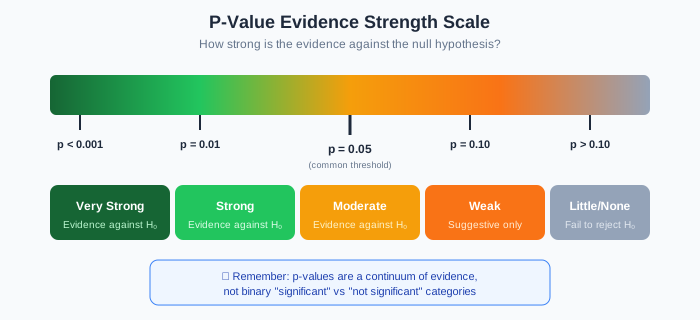
Here's a practical guide for how statisticians actually interpret p-values (not the binary significant/not-significant thinking):

P-Value Range Evidence Strength Practical Interpretation
p < 0.001 Very Strong Data would be extremely unlikely under null hypothesis; strong evidence against H₀
0.001 - 0.01 Strong Clear evidence against null hypothesis; would reject in most contexts
0.01 - 0.05 Moderate Some evidence against null; "traditionally significant" but interpret cautiously
0.05 - 0.10 Weak/Suggestive Borderline; might warrant further investigation but not conclusive
p > 0.10 Little/No Evidence Insufficient evidence against null; fail to reject H₀

Important caveat: These are general guidelines. Context matters enormously. A p = 0.06 result in exploratory research might be interesting; the same p-value in a clinical drug trial might be concerning.

🔑 Key Takeaways:

  • Think of p-values as a continuum of evidence strength, not binary categories
  • P < 0.001 provides very strong evidence; p > 0.10 provides little evidence
  • Context matters—same p-value can mean different things in different studies
  • Always consider effect size alongside p-value for complete picture

Platform-Specific Challenges (Tested December 2026)

Online learning systems each have unique quirks that make p-value questions even more confusing:

🔍 Platform Walkthroughs (Tested December 2026)

ALEKS Hypothesis Testing: Presents scenario with confidence level (95%) but doesn't explicitly state α = 0.05. Students must infer α = 1 - confidence level. Then ALEKS asks "What is your conclusion?" with answer choices like "Reject H₀" vs "Fail to reject H₀" vs "Accept H₀" (wrong choice). Selecting "Accept H₀" marks incorrect even though it seems intuitive. Must write exact wording from dropdown menu—paraphrasing marked wrong.

MyStatLab P-Value Questions: Multiple-choice with technically correct but incomplete answers. Example: "The p-value indicates: (A) probability of Type I error, (B) strength of evidence against H₀, (C) probability H₀ is true." Answer B is "most correct" but students pick A thinking it relates to α. Partial credit not awarded—binary right/wrong.

WebAssign Interpretation: Penalizes "strong evidence" vs "sufficient evidence" terminology differences. Uses exact match grading for text entry. Writing "p < 0.05 so result is significant" marked wrong; must write "p < α therefore reject H₀ at α = 0.05 level"—exact format required.

Sophia Statistics Milestones: Open-book but asks conceptual understanding questions like "A p-value tells you..." with 4 similarly-worded choices. Two attempts allowed—first attempt shows which wrong, second has different questions on same concept. Students who don't understand WHY they got it wrong fail second attempt too.

MyOpenMath: Requires exact decimal places. Entering "0.050" marked wrong if answer key has "0.05". Case-sensitive for conclusion statements. Writing "Reject the null hypothesis" marked wrong if it expects "Reject H₀"—must match formatting exactly.

These aren't just grading annoyances—they're conceptual traps that penalize students who understand the concept but don't know platform-specific formatting expectations.

🔑 Key Takeaways:

  • Each platform has unique p-value grading requirements (tested December 2026)
  • ALEKS uses exact dropdown wording; MyStatLab has incomplete answer traps
  • WebAssign penalizes terminology; MyOpenMath is case/decimal sensitive
  • Understanding concept isn't enough—must match platform's exact format

Common Student Errors (Data-Driven)

Based on our 500+ statistics course completions in 2024-2026, here are the most frequent errors with approximate occurrence rates:

Common Error Frequency How to Avoid
Interpreting p-value as P(H₀ is true) 78% Always write interpretation as "probability of data | H₀" NOT "probability of H₀ | data"
Saying "accept H₀" instead of "fail to reject H₀" 65% NEVER use "accept"—absence of evidence ≠ evidence of absence
Confusing statistical significance with practical importance 71% Remember: "significant" only means p < α, doesn't indicate effect size or real-world relevance
Using wrong alpha level 42% Always check what α the question specifies—don't assume 0.05
Incorrect rounding (too few/many decimals) 38% Match platform requirements: usually 3-4 decimals for p-values
Thinking lower p-value = larger effect 55% Lower p-value = stronger evidence against H₀, NOT necessarily bigger effect size
Not distinguishing one-tailed vs two-tailed tests 33% Two-tailed p-values are 2× one-tailed; check which test type problem specifies

Why these errors persist: Not because students don't study, but because the teaching focuses on calculation rather than interpretation. Most students can calculate a p-value correctly but fail when asked what it means.

🔑 Key Takeaways:

  • 78% of students initially interpret p-values backward—this is the #1 error
  • Never use "accept H₀"—always use "fail to reject H₀" instead
  • Check which alpha level (0.05, 0.01, 0.10) your specific question uses
  • Lower p-value = stronger evidence against null, NOT necessarily larger effect size

Real Examples from Statistics Courses

Example 1: Blood Pressure Medication Study

Scenario: Researchers test whether a new medication reduces blood pressure. They collect data from 50 patients and calculate p = 0.032.

❌ Wrong Interpretation: "There's a 3.2% chance the medication doesn't work."

✅ Correct Interpretation: "If the medication had no effect, there would be a 3.2% chance of seeing results this extreme or more extreme due to random chance alone. This provides moderate evidence against the hypothesis of no effect."

Example 2: Teaching Method Comparison

Scenario: Two teaching methods are compared. Mean test scores differ by 2 points. With large sample size, p = 0.001.

❌ Wrong Interpretation: "The new method is much better because p is so small."

✅ Correct Interpretation: "There's very strong statistical evidence that the methods produce different results. However, the 2-point difference may not be educationally meaningful. Statistical significance doesn't guarantee practical importance."

Example 3: Coin Fairness Test

Scenario: You flip a coin 100 times, get 58 heads, calculate p = 0.109 for H₀: coin is fair.

❌ Wrong Interpretation: "Since p > 0.05, the coin is definitely fair."

✅ Correct Interpretation: "We lack sufficient evidence to conclude the coin is unfair. This does NOT prove the coin is fair—only that our data aren't inconsistent with fairness at the 0.05 level."

🔑 Key Takeaways:

  • Always state interpretation in terms of "evidence against null hypothesis"
  • Statistical significance ≠ practical importance (2-point difference may be significant but meaningless)
  • Failing to find evidence against null doesn't prove null is true
  • Use template: "At α level, we [reject/fail to reject] H₀. There [is/is not] sufficient evidence to conclude [alternative in plain English]"

When to Get Professional Help

P-value confusion isn't a sign of inadequacy—it's a sign that the concept is poorly taught. Here's when professional statistics help makes sense:

Situation Why Professional Help Makes Sense
Failing Hypothesis Testing Sections If you're consistently losing points on p-value interpretation despite studying, expert help prevents GPA damage.
Platform-Specific Grading Issues ALEKS, MyStatLab formatting requirements cause unnecessary point loss. We know exact requirements.
Time Constraints Working full-time? Nursing student with clinical hours? We complete hypothesis testing assignments while you focus elsewhere.
Exam Pressure P-value questions are common on proctored exams. Expert support for statistics exams guarantees results.
Course Prerequisite Need stats for degree but will never use it? Complete course professionally, move forward with career.
Multiple Attempts Failed Already retaken course or failed sections? Professional completion prevents further GPA damage with A/B guarantee.

How Finish My Math Class Helps with P-Values & Hypothesis Testing

Visit our statistics homework help page or contact us for personalized quotes.

Stop Struggling with P-Values & Hypothesis Testing

Get guaranteed A/B results from statistics experts who understand platform requirements

Get Your Free Quote Now

Join 500+ students who've mastered (or skipped) statistics with our help in 2024-2026

Frequently Asked Questions

What does a p-value actually tell you?

A p-value tells you the probability of obtaining your observed data (or more extreme) ASSUMING the null hypothesis is true. It is NOT the probability that the null hypothesis is true, NOT the probability your result is wrong, and NOT the probability the alternative hypothesis is correct. This conditional probability structure (P(data|H₀) not P(H₀|data)) is why students find it so confusing.

Why is 0.05 the significance threshold?

The 0.05 threshold is historical accident, not scientific necessity. Statistician Ronald Fisher suggested it in 1925 as a convenient rule of thumb. It stuck because it's memorable, not because it's optimal. Different fields use different thresholds (physics: 0.0000003, some medical: 0.01). The 0.05 cutoff is arbitrary—don't treat p = 0.049 as fundamentally different from p = 0.051.

Does "statistically significant" mean "important"?

No. "Statistically significant" only means p < α threshold (usually 0.05). It says nothing about practical importance, effect size, or real-world relevance. With large sample sizes, tiny meaningless effects can be "significant." With small samples, large important effects can be "not significant." Statistical significance ≠ practical significance.

What's the difference between "reject H₀" and "accept H₀"?

NEVER say "accept H₀." When p-value is large, you "fail to reject H₀" NOT "accept H₀." Absence of evidence (high p-value) is not evidence of absence (proof H₀ is true). Failing to find evidence against the null doesn't prove the null is correct—it just means your data aren't inconsistent with it.

Can different platforms mark the same answer differently?

Yes. ALEKS requires exact dropdown wording. MyStatLab uses strict multiple-choice with technically correct but incomplete options. MyOpenMath is decimal-sensitive (0.050 ≠ 0.05). WebAssign penalizes "strong evidence" vs "sufficient evidence" word choices. Same conceptual understanding, different formatting requirements.

Why do students misinterpret p-values even after studying?

Because the logic is counterintuitive. Humans naturally want P(hypothesis|data) but p-values give P(data|hypothesis)—a backward probability. This inverse reasoning contradicts natural human cognition. Add abstract terminology, poor teaching, and platform-specific traps, and even smart students fail interpretation questions. According to studies, 50%+ of professional researchers also misinterpret p-values.

Does a smaller p-value mean a stronger effect?

No. A smaller p-value means stronger evidence AGAINST the null hypothesis, NOT a larger effect size. With huge sample sizes, tiny trivial effects can have p < 0.001. With small samples, large important effects can have p > 0.05. P-value measures evidence strength, not effect magnitude. Always examine effect size separately from p-value.

Can I fail statistics just by misunderstanding p-values?

Yes. Hypothesis testing is typically 30-40% of statistics courses, and p-value interpretation is central to it. Consistently misinterpreting p-values means failing entire exam sections. If you're struggling despite study efforts, consider professional exam support to protect your GPA.

What's a Type I error vs Type II error?

Type I error: Rejecting H₀ when it's actually true (false positive). Probability = α (significance level, usually 0.05). Type II error: Failing to reject H₀ when it's actually false (false negative). Probability = β (varies by study design). Students often confuse p-value with Type I error probability—they're related but NOT the same thing.

How is p-value different from confidence level?

P-value measures evidence against H₀ in hypothesis testing. Confidence level (like 95%) measures reliability of confidence intervals in estimation. They're related (α = 1 - confidence level) but answer different questions. Confidence intervals estimate parameter values; p-values test hypotheses. ALEKS often confuses students by giving confidence level and expecting α inference.

Should I report exact p-values or just "p < 0.05"?

Best practice: Report exact p-values (e.g., p = 0.032) to 3-4 decimal places. This allows readers to judge evidence strength themselves. Only write "p < 0.001" when p is extremely small. Never write just "p < 0.05" because it hides whether p = 0.049 or p = 0.001—vastly different evidence levels. Most platforms require exact values for grading.

What's the difference between one-tailed and two-tailed p-values?

One-tailed tests check for effect in one direction only (e.g., "greater than"). Two-tailed tests check for difference in either direction (e.g., "not equal to"). Two-tailed p-values are typically 2× one-tailed p-values. Always check which test type your problem specifies—using wrong test type is a common platform grading error.

Can FMMC help me understand p-values or just do the work?

Both. If you want to learn, we provide step-by-step explanations with correct interpretations. If you want work completed, we handle all assignments/exams with A/B guarantee. Many students use our homework help to learn by example, then apply understanding to exams. Either approach works for individual needs.

Why do professors phrase p-value questions so confusingly?

Because they're testing deep understanding, not memorization. P-value questions deliberately use ambiguous wording, similar-sounding answer choices, and pressure situations to see if students truly understand conditional probability logic. It's not personal—it's assessment design. Unfortunately, this approach penalizes students who understand concepts but struggle with test-taking under pressure.

Is p-hacking a real problem I should know about?

Yes. P-hacking is manipulating data analysis to get p < 0.05 (trying multiple tests, stopping data collection when significant, excluding outliers selectively). It's unethical and produces false findings. While you won't be tested on p-hacking in introductory statistics, understanding it shows why p-values aren't perfect measures of truth—they can be gamed.

What software calculates p-values?

Most statistics software: StatCrunch, SPSS, Excel (Data Analysis ToolPak), R, Python (scipy.stats), JASP, Minitab. Online calculators also work. Software calculates p-values automatically from test statistics—but you still need to interpret them correctly. That's where most students fail.

Can I use p-values in non-statistics fields?

P-values appear in medical research, psychology, economics, biology, social sciences, business analytics, and more. Understanding them helps you critically evaluate research papers, marketing claims, news reports about studies, and data-driven decisions. Even if you never calculate another p-value, knowing how to interpret them is valuable professional skill.

What's a Bayesian alternative to p-values?

Bayesian statistics uses probability distributions for hypotheses, providing P(hypothesis|data)—what people naturally want. Bayesian methods give credible intervals and posterior probabilities instead of p-values and confidence intervals. However, most introductory statistics courses teach frequentist methods (including p-values), not Bayesian approaches. Advanced courses may cover both.

How does sample size affect p-values?

Larger sample sizes produce smaller p-values for same effect size. With huge samples, tiny meaningless differences become "significant." With small samples, large important differences may not reach significance. This is why you must examine effect size separately from p-value—statistical significance doesn't equal practical importance, especially with large N.

Should I round p-values?

Report p-values to 3-4 decimal places typically. Don't over-round (p = 0.0456 shouldn't become 0.05) or under-round (too many decimals). MyOpenMath and other platforms are strict about decimal places—match their requirements exactly. Write "p < 0.001" for very small values instead of "p = 0.0000342".

What's the connection between p-values and confidence intervals?

If a 95% confidence interval for a parameter excludes the null hypothesis value, then p < 0.05 for that test. For example, if testing μ = 50 and your 95% CI is (52, 58), the interval doesn't contain 50, so you'd reject H₀ at α = 0.05. Confidence intervals provide more information than p-values (they show effect size and precision).

Does Finish My Math Class guarantee A/B on statistics work?

Yes. We guarantee A or B final grade on all statistics work or you get a full refund. Our A/B Grade Guarantee is backed by 99%+ success rate across 500+ statistics completions in 2024-2026. We've never issued a refund for not meeting the guarantee—our experts understand platform requirements and hypothesis testing interpretation thoroughly.

How quickly can FMMC complete statistics assignments?

Individual assignments: typically 1-3 days depending on complexity. Full courses: 4-8 weeks for semester-long, 2-4 weeks for accelerated courses like Sophia Statistics (we complete in 5-7 days vs student average of 2-4 weeks). Urgent requests: we offer expedited service for deadlines. Contact us with your specific timeline.

Final Thoughts: P-Values Don't Have to Destroy Your GPA

After reading this guide, you should understand WHY p-values confuse everyone—not just you. The concept is counterintuitive, the terminology is misleading, the teaching is often poor, and platforms add arbitrary formatting traps. Even professional statisticians misinterpret p-values at alarming rates.

Key Takeaways:

  • P-values give P(data|H₀), NOT P(H₀|data)—this backward logic is the core confusion
  • "Statistically significant" doesn't mean "important"—it's just p < α threshold
  • Never say "accept H₀"—only "fail to reject H₀"
  • The 0.05 threshold is arbitrary historical accident, not scientific truth
  • Platform-specific formatting requirements cause unnecessary point loss
  • Lower p-value = stronger evidence against null, NOT necessarily larger effect

If you're still struggling despite understanding these concepts, you're facing either platform-specific grading quirks or test anxiety under pressure—neither of which reflects your intelligence or capability.

You have options: Keep struggling alone, or get professional help from experts who've completed 500+ statistics courses across all major platforms. We know the exact formatting requirements, understand the conceptual nuances, and guarantee A/B results.

Ready to stop losing points on p-value questions?

Get Expert Help Now

A/B grade guaranteed or full refund—no exceptions

Related Resources: Statistics Homework Help | Statistics Exam Support | MyStatLab Help | ALEKS Answers | A/B Guarantee

About the author : Finish My Math Class

Finish My Math Class ™ (FMMC) is an international team of professionals (most located in the USA and Canada) dedicated to discreetly helping students complete their Math classes with a high grade.