

Is Biochemistry Harder than Organic Chemistry? Complete Comparison
Quick Answer
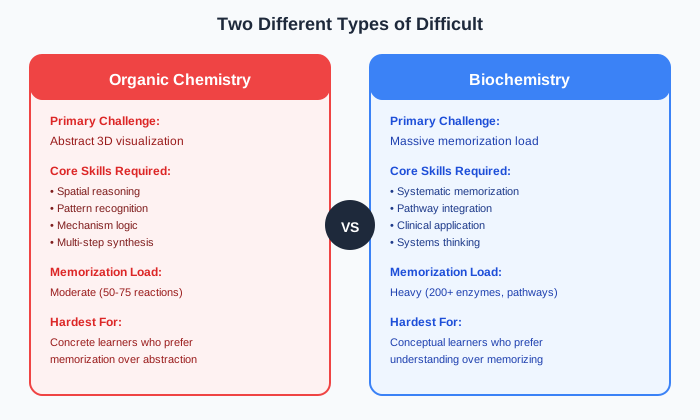
Neither is objectively “harder” — they’re difficult in different ways. Organic Chemistry requires abstract 3D visualization, pattern recognition, and multi-step synthesis (favors conceptual thinkers). Biochemistry demands massive memorization of pathways, enzymes, and biological processes (favors concrete learners). Most students find whichever course conflicts with their natural learning style to be harder.
Ask any college student what the toughest science courses are, and you’ll almost always hear the same two names: Organic Chemistry and Biochemistry. Both have earned reputations for wrecking GPAs, stressing out pre-med and nursing majors, and serving as the infamous “weed-out” courses that separate future healthcare professionals from everyone else.
But which one is actually harder? The truth is more nuanced than most students realize. The answer depends on your learning style, your career path, and the platform you’re using (ALEKS, MasteringChemistry, etc.). This comprehensive guide breaks down the unique challenges of both courses, compares them across multiple dimensions, and provides honest insights into what students actually experience.
📑 Table of Contents
Understanding Both Courses
Before comparing difficulty, it’s essential to understand what each course actually covers:
Organic Chemistry: The Study of Carbon Compounds
Organic Chemistry focuses on the structure, properties, and reactions of carbon-containing compounds. It’s the foundation for understanding pharmaceuticals, polymers, and biological molecules. The course typically covers molecular structure and bonding, reaction mechanisms (how and why molecules react), functional groups and their characteristic reactions, multi-step synthesis pathways, and spectroscopy for structure determination (NMR, IR, Mass Spec).
Core skill required: 3D spatial reasoning, pattern recognition, logical deduction
Biochemistry: The Chemistry of Life
Biochemistry applies chemical principles to biological systems, studying the molecular basis of life processes. The course typically covers biomolecules (proteins, carbohydrates, lipids, nucleic acids), metabolic pathways (glycolysis, TCA cycle, electron transport), enzyme kinetics and regulation, DNA/RNA processes (replication, transcription, translation), and cellular signaling and membrane transport.
Core skill required: Memorization, systems thinking, application to biological contexts
What Makes Organic Chemistry Difficult
Organic Chemistry has earned its reputation as the “pre-med killer course” for good reasons:
| Challenge | Why It’s Difficult | Impact |
|---|---|---|
| 3D Visualization | Must mentally rotate molecules and understand stereochemistry (R/S, E/Z) | ~70% struggle with stereochemistry |
| Abstract Mechanisms | Must understand electron movement and why reactions occur | Conceptually challenging |
| Synthesis Problems | Multi-step pathways with no single “right” answer | ~65% find synthesis overwhelming |
| Lab Technique Demands | Reflux, distillation, chromatography require hands-on mastery | Adds 5-8 hours weekly |
The “Weed-Out” Factor
Organic Chemistry is deliberately used by medical schools and pre-med programs to identify students who can handle abstract, complex material under pressure. According to the Association of American Medical Colleges, Organic Chemistry grades are among the strongest predictors of MCAT performance — not because doctors use organic chemistry daily, but because it tests pattern recognition, logical reasoning, and handling ambiguity.
What Makes Biochemistry Difficult
Biochemistry presents an entirely different set of challenges — less about conceptual understanding, more about managing massive amounts of interconnected information:
| Challenge | Why It’s Difficult | Impact |
|---|---|---|
| Memorization Overload | Hundreds of enzymes, pathways, cofactors to memorize | Exhausting memory burden |
| Pathway Interconnections | Glycolysis feeds TCA cycle feeds electron transport — one error cascades | ~68% struggle with integration |
| Clinical Applications | Exams ask about disease states and drug mechanisms | Can’t just memorize answers |
| Volume of Content | 2-3 chapters per week with no time to fully master | Always playing catch-up |
The Memorization Trap
Students often underestimate Biochemistry because it “looks” less abstract than Organic Chemistry. The pathways make sense, enzymes have logical names, and everything connects to biology you already know. But this accessibility is deceptive — Biochemistry demands sustained, systematic memorization over an entire semester. You can’t cram the night before; you need consistent daily review.
Direct Comparison: 8 Key Dimensions
| Dimension | Organic Chemistry | Biochemistry |
|---|---|---|
| Primary Focus | Mechanisms and reactions of carbon compounds | Biological pathways and molecular basis of life |
| Thinking Style | Abstract, conceptual, puzzle-solving | Concrete, systematic, memorization-based |
| Memorization Load | Moderate (50-75 key reactions) | Heavy (200+ enzymes, multiple pathways) |
| Conceptual Difficulty | High (3D thinking, electron pushing) | Moderate (pathways are logical) |
| Weekly Time Required | 15-20 hours | 12-18 hours |
| Lab Component | Synthesis, purification (hands-on technique) | Enzyme assays, protein work (protocol-following) |
| Average D/F Rate | 25-30% | 15-20% |
| Favors Students Who | Think spatially, enjoy puzzles | Memorize well, like biology |
Key Insight: Organic Chemistry has a slightly higher failure rate, but both courses see substantial numbers of students earning C or below — grades that can derail pre-med, nursing, and pharmacy applications.
Which Course Fits Your Learning Style
Your natural learning style is the single biggest predictor of which course you’ll find harder:

Organic Chemistry = Easier If You:
- Enjoy puzzles and logic problems
- Think abstractly and conceptually
- Can visualize objects rotating in 3D
- Prefer understanding “why” over memorizing “what”
- Performed well in physics or calculus
Biochemistry = Easier If You:
- Have strong memorization skills
- Think systematically and sequentially
- Prefer concrete concepts over abstractions
- Excel at connecting information into stories
- Performed well in biology and anatomy
The Order Matters: Whichever course you take first tends to feel harder because you’re still adjusting to college-level chemistry rigor. Students who take Organic Chemistry first often find Biochemistry more manageable because they already understand molecular structures and bonding.
Career Path Considerations
Your intended career significantly impacts which course matters more:

GPA Impact for Healthcare Careers
For pre-med, pharmacy, and dental students, both courses heavily influence acceptances. According to the AAMC, the average accepted medical school applicant has an Organic Chemistry GPA of 3.5-3.7 and Biochemistry GPA of 3.6-3.8. A C in either course significantly damages applications.
Common Student Struggles
Here are the honest, recurring patterns we’ve observed:
“Stereochemistry Broke Me”
R/S configuration and chirality feel incomprehensible. The 3D visualization required doesn’t click for everyone. ~70% of struggling students cite stereochemistry as their breaking point.
“I Can’t Keep the Pathways Straight”
Glycolysis has 10 steps, TCA has 8, electron transport has 4 complexes — and you need every enzyme and cofactor. Students feel like they’re “drowning in details.”
“Synthesis Feels Impossible”
Multi-step synthesis requires creativity. There’s often no single “right” answer, and partial credit is inconsistent. ~65% report synthesis as their weakest area.
“I Study Every Day and Still Fail”
Biochemistry demands daily review, not cramming. Students report 2-3 hours daily yet still failing — because memorization without understanding doesn’t work for application questions.
These Struggles Are Universal: If you’re experiencing these patterns, you’re not uniquely bad at chemistry — these courses are genuinely difficult and designed to be selective. Recognizing these patterns helps you prepare — or recognize when expert help makes more sense than continued struggle.
Platform-Specific Challenges
Online learning platforms add another layer of difficulty:
Knowledge Checks test all previous material. Structure drawing requires precise input — one wrong bond angle fails the question. Zero partial credit.
MasteringChemistry
Multi-part questions cascade — get Part A wrong and Parts B-D become impossible. Limited attempts. Exact format requirements (sig figs, units).
Proctored Exams
Respondus, Honorlock, ProctorU add technical stress. Camera requirements create pressure. Can’t reference notes or normal study tools.
When to Get Professional Help
Many students wait until they’re failing before seeking help. Clear signs it’s time:
| Situation | Why Professional Help Makes Sense |
|---|---|
| Pre-Med/Pharmacy Track | One bad grade can derail applications. Protect your GPA and future career. |
| Already Failing | Below C after first exam? Catching up alone is statistically unlikely. |
| Multiple Difficult Courses | Taking Organic + Physics? Get help with one so you can focus on the other. |
| Working Full-Time | 15-20 hours weekly isn’t realistic with 40+ hour work weeks. |
How Finish My Math Class Helps
We provide comprehensive support for both Organic Chemistry and Biochemistry:
- Complete Course Management: All homework, labs, exams
- Platform Expertise: ALEKS, MasteringChemistry, WebAssign, Connect
- Exam Support: Including proctored exams
- Human Experts: Real chemists with MS/PhD degrees — not AI
- A/B Guarantee: We guarantee A or B final grade or refund your money. See our guarantee details
Struggling with Chemistry?
Organic, Biochemistry, or both — we guarantee A/B results.
Frequently Asked Questions
Is Biochemistry harder than Organic Chemistry?
Neither is objectively harder — they’re difficult in different ways. Organic Chemistry requires abstract 3D thinking and pattern recognition (favors conceptual learners). Biochemistry demands massive memorization of pathways and enzymes (favors concrete learners). Most students find whichever course conflicts with their natural learning style to be harder.
Which should I take first?
Most programs require Organic Chemistry before Biochemistry because Biochem assumes you understand molecular structure, bonding, and reaction mechanisms. Taking Organic first provides the foundation for understanding biomolecular chemistry. However, some programs allow either order — check your specific degree requirements.
Do I need both courses for medical school?
Yes. Virtually all medical schools require both Organic Chemistry (usually 2 semesters) and Biochemistry (1 semester minimum). Both are heavily tested on the MCAT. Dental, pharmacy, and veterinary programs similarly require both. Nursing and PA programs often require only Biochemistry.
Which course is more important for the MCAT?
Both are critical. The MCAT Chemical and Physical Foundations section tests Organic Chemistry heavily (15-20% of questions). The Biological and Biochemical Foundations section tests Biochemistry extensively (25-30% of questions). You cannot score competitively without strong performance in both courses.
What if I’m better at memorization than abstract thinking?
You’ll likely find Biochemistry more manageable than Organic Chemistry. Biochemistry rewards strong memorization and systematic study, while Organic Chemistry demands 3D spatial reasoning and abstract problem-solving. Both require significant work — your strength just makes one feel less overwhelming.
How much time do these courses require weekly?
Organic Chemistry: 15-20 hours weekly (lecture, lab, homework, study). Biochemistry: 12-18 hours weekly (more memorization at home, less hands-on lab time). Students working full-time or taking multiple hard courses simultaneously often find this workload unsustainable — which is when professional help makes sense.
Will a C in Organic Chemistry ruin medical school chances?
One C won’t automatically disqualify you, but it significantly hurts your application — especially if your overall science GPA drops below 3.5. Medical schools view Organic Chemistry as a predictor of MCAT performance and ability to handle rigorous coursework. Multiple C’s or a D/F essentially requires a post-bacc or retake.
Can I take both courses in the same semester?
Not recommended unless you have light course load otherwise, no job, and exceptionally strong chemistry background. Combined they require 30-35 hours weekly. Most students who attempt both simultaneously earn lower grades in both. Better strategy: take one, excel at it, then take the other — or get professional help with one so you can focus on the other.
Final Verdict: Which Is Actually Harder?
So, is Biochemistry harder than Organic Chemistry? Here’s the honest answer:
- For conceptual thinkers who enjoy puzzles: Biochemistry feels harder due to overwhelming memorization demands.
- For concrete learners who excel at memorization: Organic Chemistry feels harder due to abstract 3D visualization requirements.
- For pre-med students: Organic Chemistry is typically the bigger GPA threat because it’s specifically designed as a weed-out course.
- For nursing/PA students: Biochemistry often feels harder because most programs don’t require Organic, so Biochem becomes the toughest science course.
The universal truth: Both courses are genuinely difficult, demand 15-20 hours weekly, and pose serious GPA risks. The “harder” course is whichever one conflicts with your natural learning style.
The good news? You don’t have to choose between struggling alone and risking your future career. Whether you’re facing Organic Chemistry’s stereochemistry nightmares or Biochemistry’s pathway overload — Finish My Math Class provides expert completion with guaranteed A/B results.
📚 Related Resources