

Confidence Intervals Explained: What “95% Confident” Really Means
Quick Answer
A confidence interval is a range of values that likely contains the true population parameter. “95% confident” does NOT mean there’s a 95% probability the true value is in your interval. It means: if you repeated sampling and calculated CIs many times, about 95% of those intervals would capture the true value. The confidence describes the method’s reliability, not the probability for your specific interval.
Confidence intervals are one of the most misunderstood concepts in statistics. Students memorize formulas, calculate intervals correctly, and still fundamentally misinterpret what their results mean. The phrase “95% confident” sounds intuitive but leads to a critical misconception that can derail exam answers and real-world statistical reasoning.
This guide explains what confidence intervals actually measure, how to calculate them, the tradeoff between confidence level and precision, and the common mistakes that cost students points on exams.
📑 Table of Contents
What a Confidence Interval Actually Means
A confidence interval provides a range of plausible values for an unknown population parameter (like the true mean or true proportion). Instead of claiming the population mean is exactly 72, you say: “We’re 95% confident the population mean is between 68 and 76.”
But what does “95% confident” actually mean? This is where most students go wrong.

The confidence level (95%) describes the method, not your specific interval. If you repeated the entire sampling process 100 times — taking a new random sample each time and calculating a new confidence interval — about 95 of those 100 intervals would contain the true population parameter. Five would miss it entirely.
Your specific interval either contains the true value or it doesn’t — you just don’t know which. The 95% tells you how reliable the method is across many repetitions, not the probability for your particular result.
The 95% Misconception
The most common mistake is interpreting “95% confident” as “95% probability the true value is in this interval.” This sounds right but is technically wrong — and the distinction matters on exams.
| ❌ Wrong Interpretation | ✓ Correct Interpretation |
|---|---|
| “There’s a 95% chance the true mean is between 68 and 76” | “We are 95% confident that the interval 68 to 76 captures the true mean” |
| “The probability that μ falls in this range is 0.95” | “If we repeated this process many times, 95% of intervals would capture μ” |
| “95% of the data falls within this interval” | “This interval is our estimate of where the population parameter lies” |
Why does this matter? The true population parameter (μ) is a fixed, unknown value — it’s not random. Either your interval captured it or it didn’t. Probability statements apply to random events, and the fixed parameter isn’t random. The randomness comes from the sampling process, which is why the confidence describes the method’s reliability.
Anatomy of a Confidence Interval
Every confidence interval has the same basic structure:
CI = Point Estimate ± Margin of Error

| Component | What It Is | Example |
|---|---|---|
| Point Estimate | Your best single guess (sample mean x̄ or sample proportion p̂) | x̄ = 72 |
| Margin of Error | How far the interval extends in each direction (z* × SE) | ± 4 |
| Critical Value (z* or t*) | Multiplier based on confidence level | z* = 1.96 for 95% |
| Standard Error (SE) | Measures sampling variability (σ/√n or s/√n) | SE = 2.04 |
How to Calculate Confidence Intervals
For a Population Mean (σ known)
CI = x̄ ± z* × (σ/√n)
Example: Sample mean x̄ = 72, population σ = 10, sample size n = 25, find 95% CI.
1. Standard Error: SE = 10/√25 = 10/5 = 2
2. Critical value for 95%: z* = 1.96
3. Margin of Error: ME = 1.96 × 2 = 3.92
4. CI: 72 ± 3.92 = (68.08, 75.92)
For a Population Mean (σ unknown)
CI = x̄ ± t* × (s/√n)
Use t* from t-distribution with df = n – 1. For small samples, t* is larger than z*, giving wider intervals.
For a Population Proportion
CI = p̂ ± z* × √[p̂(1-p̂)/n]
Common Critical Values
| Confidence Level | z* Value | α (significance) |
|---|---|---|
| 90% | 1.645 | 0.10 |
| 95% | 1.96 | 0.05 |
| 99% | 2.576 | 0.01 |
Confidence Level vs. Width Tradeoff
Higher confidence levels produce wider intervals. This is the fundamental tradeoff in confidence intervals: more confidence = less precision.
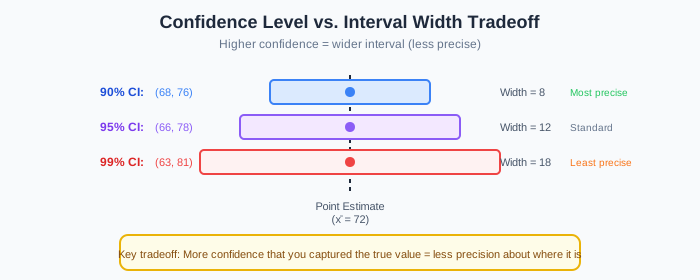
Why does this happen? To be more confident you’ve captured the true value, you need to cast a wider net. A 99% CI uses z* = 2.576 instead of 1.96, making the margin of error about 31% larger than a 95% CI.
The practical implication: A 99% CI of “between 50 and 90” is less useful than a 95% CI of “between 60 and 80” — even though the first is more confident. Always consider whether the precision is sufficient for your purpose.
When to Use z* vs t*
| Use z* | Use t* |
|---|---|
| Population σ is known | Using sample s to estimate σ |
| Large sample (n ≥ 30) | Small sample (n < 30) |
| Proportion problems (always) | Mean problems with unknown σ |
Key insight: As sample size increases, t* approaches z*. With n = 30+, the difference becomes negligible. When in doubt on exams, read carefully whether σ or s is given.
How Sample Size Affects Width
Larger samples produce narrower (more precise) confidence intervals. The relationship is through the standard error:
SE = σ/√n
As n increases, √n increases, so SE decreases, so the margin of error shrinks.
The Square Root Rule: To cut interval width in half, you must quadruple your sample size. Going from n=100 to n=200 only reduces width by about 29%, not 50%. This has major implications for study design and sample size planning.
Interpreting Confidence Intervals
Proper interpretation requires careful language:
✓ Correct Template
“We are [confidence level]% confident that the true [parameter] is between [lower bound] and [upper bound].”
Example: “We are 95% confident that the true mean test score for all students is between 68 and 76 points.”
Does the Interval Include Zero?
For intervals estimating differences (treatment effects, mean comparisons), whether zero falls inside the interval matters:
- CI includes zero: Cannot conclude a significant difference exists
- CI excludes zero: Difference is statistically significant at that confidence level
Common Mistakes
| Mistake | Correction |
|---|---|
| Saying “95% probability μ is in interval” | Say “95% confident” — confidence describes the method |
| Confusing σ with s | σ (population) → use z; s (sample) → use t |
| Using z* = 1.96 for all intervals | Check confidence level: 90% uses 1.645, 99% uses 2.576 |
| Forgetting to use √n in SE formula | SE = σ/√n, not σ/n — always divide by square root |
Platform-Specific Tips
Requires exact interpretation language. Will mark wrong for “95% probability” vs “95% confident.” Round to 2-4 decimals as specified. Knowledge checks may reset progress if CI concepts are missed.
Watch for z vs t distinction — MyStatLab often specifies which to use. Interpretation questions are strict about wording. Use their built-in calculator for consistency.
May require showing work steps. Pay attention to whether question asks for interval (lower, upper) format or x̄ ± ME format. Rounding requirements vary by problem.
Frequently Asked Questions
What does 95% confidence actually mean?
It means that if you repeated the sampling process many times and calculated a confidence interval each time, about 95% of those intervals would contain the true population parameter. It does NOT mean there’s a 95% probability that the true value lies within your specific interval.
Why do higher confidence levels give wider intervals?
To be more confident you’ve captured the true value, you need to cast a wider net. A 99% CI is wider than a 95% CI because you need more buffer room to be 99% sure rather than 95% sure. The tradeoff is precision — wider intervals are less useful for making specific claims.
What is margin of error?
Margin of error is the plus-or-minus part of a confidence interval. It equals the critical value (z* or t*) multiplied by the standard error. A 95% CI of 50 ± 5 has a margin of error of 5, meaning the interval extends 5 units in each direction from the point estimate.
When do I use z* versus t*?
Use z* when you know the population standard deviation (σ) or have a large sample (n ≥ 30). Use t* when you’re estimating with the sample standard deviation (s) and have a smaller sample. For proportions, always use z*.
How does sample size affect confidence interval width?
Larger samples give narrower (more precise) intervals. This is because standard error = σ/√n — as n increases, the denominator grows, making SE smaller. To cut your interval width in half, you need to quadruple your sample size.
Can a confidence interval include zero?
Yes, and this is often important. For difference-of-means or treatment effect intervals, if the CI includes zero, you cannot conclude a statistically significant difference exists. If the CI excludes zero, the effect is statistically significant at that confidence level.
What’s the relationship between confidence intervals and hypothesis tests?
They’re two sides of the same coin. A 95% CI that excludes a hypothesized value corresponds to rejecting that hypothesis at α = 0.05. If your 95% CI for a mean doesn’t include 50, you’d reject H₀: μ = 50 at the 0.05 significance level. See our p-value guide for more on hypothesis testing.
What is standard error?
Standard error (SE) measures how much your sample statistic (like the mean) would vary from sample to sample. For means, SE = σ/√n or s/√n. For proportions, SE = √[p̂(1-p̂)/n]. Smaller SE means more precise estimates. See our standard deviation guide for the relationship between σ and SE.
Struggling with Statistics?
Confidence intervals, hypothesis tests, and more — we guarantee results.