

Quick Answer
ALEKS frustrates even capable students because the platform is built around algorithmic mastery requirements that punish inconsistency, erase progress without warning, and assume ALEKS is your only obligation. If you have searched “I hate ALEKS,” you are not struggling because of weak math skills. You are dealing with a system that is genuinely difficult to work with. Our experts handle ALEKS courses with A/B grades guaranteed.
A/B Guarantee | Real Experts | Same-Day Available
On This Page
- • What Is ALEKS
- • Problem 1: Knowledge Checks Erase Progress
- • Problem 2: Explanations Do Not Help
- • Problem 3: Overwhelming Time Requirements
- • Problem 4: The Two-Hour Lockout
- • Problem 5: Stress and Mental Health Impact
- • Problem 6: Surface Learning Without Retention
- • Why Schools Still Use ALEKS
- • How Expert Help Works
- • Results
- • Frequently Asked Questions
If you have landed on this page, you are probably feeling what thousands of students feel every semester: complete frustration with ALEKS. Whether you have spent hours on topics only to have a Knowledge Check erase your progress, struggled with explanations that do not match the problems, or hit the “Take a break” lockout with a deadline in four hours, you are dealing with predictable consequences of how ALEKS is built. This is not about being bad at math. ALEKS creates structural problems that affect mathematically capable students who would do fine on any other platform.
This page explains the six most common ALEKS complaints and the specific platform mechanics behind each one. Understanding why the system works this way does not make it less frustrating, but it does make the situation clearer.
What Is ALEKS?
ALEKS (Assessment and LEarning in Knowledge Spaces) is an AI-powered adaptive learning platform used for mathematics, chemistry, statistics, and accounting from middle school through college. Unlike traditional homework systems, it uses artificial intelligence to create personalized learning paths based on continuous assessment of what you know and do not know.
The system operates through several key mechanics:
Pie Chart Progress
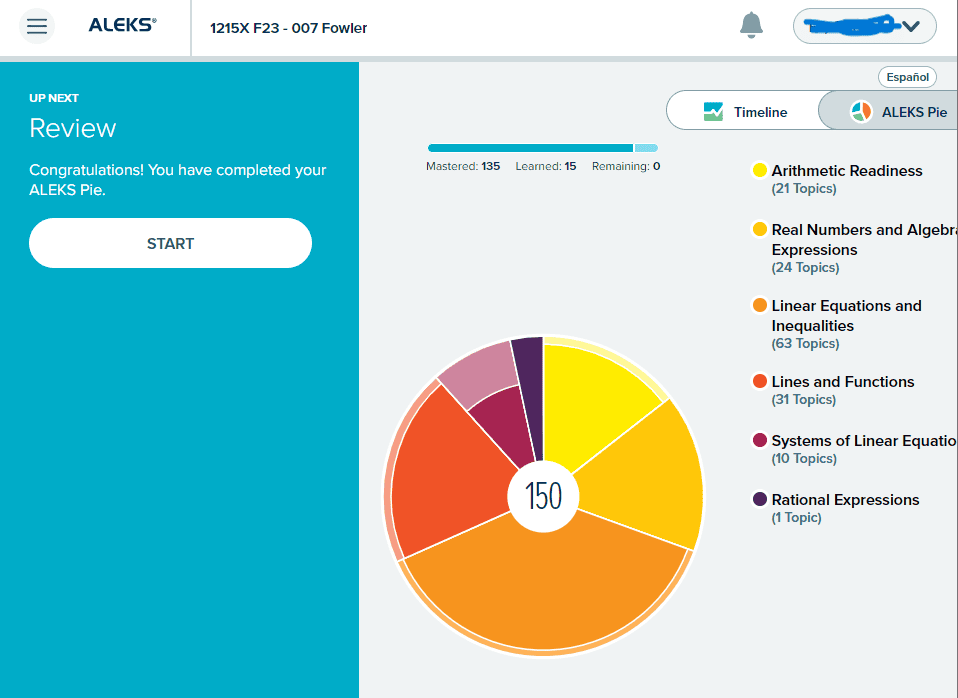
Your course divides into topic slices. You must master topics to advance through the pie.
Knowledge Checks
Periodic assessments that test retention. Missed questions can reset topics you already completed back to “remaining.”
Mastery Bar System
Each topic requires filling a 5-bar meter. Wrong answers decrease the bar, requiring additional correct answers to recover.
Lockout Mechanism
Three consecutive wrong answers lock you out of a topic for two hours, regardless of why you got them wrong.
For the full technical breakdown of how ALEKS’s algorithm and pie chart system work, see our main ALEKS platform guide. This page focuses on the student experience side of those mechanics.
Problem 1: Knowledge Checks Erase Hours of Work
The single most common ALEKS complaint: Knowledge Checks that reset topics students already completed. Students across every platform that reviews ALEKS describe the same experience: sitting down to finish the last stretch of their deadline, getting interrupted by a Knowledge Check, and watching completed topics return to the queue.
The Mastered vs. Learned Gap
Completing a topic in learning mode marks it “learned,” not “mastered.” Knowledge Checks test whether you retained it over time. One missed question signals the algorithm that long-term mastery was not achieved, and the topic resets.
The Cascade Problem
When you miss a question on Topic X, the algorithm assumes related topics Y and Z sharing the same mathematical foundation may also have been forgotten. One wrong answer can trigger resets across a dozen topics at once.
The Timing Trap
Knowledge Checks trigger when the algorithm determines enough time has passed for potential forgetting. Students completing many topics quickly trigger them sooner, interrupting completion momentum exactly when a deadline is close.
The practical result is that students cannot accurately predict how long ALEKS will take. A planned two-hour session becomes five or more hours once a Knowledge Check resets 15 to 20 completed topics. Students with jobs, children, or multiple courses cannot absorb that kind of unpredictable workload expansion.
Problem 2: Explanations Do Not Match the Problems
Students consistently report that ALEKS’s built-in help does not actually help. The platform provides a worked example when you start a topic, but students find the example covers a simpler version of the problem they are actually asked to solve. A standard example might show solving 2x + 3 = 7, while the actual problem requires distributing and combining like terms across multiple steps the example never demonstrated.
The Explain Button Penalty
Clicking “Explain” shows the worked solution but breaks your mastery bar streak. Students report the explanations skip steps that a textbook would show, assuming fluency they do not yet have.
The YouTube Dependency Loop
When the in-platform help fails, students leave ALEKS to find explanations on YouTube or Khan Academy, spending 20 to 30 minutes per confusing topic on external resources before returning to attempt the problem. ALEKS becomes a testing platform rather than a teaching one.
Video Explanation Gaps
ALEKS video tutorials are generic overviews rather than problem-specific walkthroughs, paced too quickly for students encountering the concept for the first time, and missing the bridging steps between simple examples and complex variations.
Problem 3: ALEKS Consumes Your Entire Life
Time investment is the second most common complaint after progress resets. Students report spending entire weekends on ALEKS while still not finishing assigned topic goals. The platform’s design philosophy treats mastery as the only priority, regardless of time cost, and instructors who assign “complete 20 topics this week” often have no idea how long that actually takes a struggling student.
Instructor estimate
20 topics at roughly 18 minutes each = 6 hours
Student reality
Add external research, lockout waits, and Knowledge Check resets = 15 to 20 hours
The mastery bar system punishes inconsistency more than incompetence. A student who gets four right, then one wrong, then two more right, then one wrong cycles through the same topic indefinitely without completing it. Combined with Knowledge Checks that can reset 15 to 20 completed topics at once, students who are “almost done” can find themselves back at the beginning of a section with the same deadline approaching.
Problem 4: The Two-Hour Lockout Punishment
Few ALEKS mechanics generate more immediate rage than the “Take a break” lockout. Three consecutive wrong answers lock you out of a topic for two hours. The educational theory behind it suggests that students who are repeatedly failing a concept need time to consolidate learning before continuing. The practical problem is that the system cannot distinguish three reasons to get something wrong:
Conceptual confusion
The student genuinely does not understand the topic yet. A break makes sense here.
Careless arithmetic error
The student understands the concept but typed 24 instead of 42. A two-hour lockout is useless here.
Format mismatch
The student’s answer is mathematically correct but entered as “1/2” when ALEKS requires “0.5.” Also punished identically.
For students with homework due at midnight, an 8pm lockout on a sequentially gated topic is not educational — it is a failed assignment. Many ALEKS courses gate topics so you cannot access Topic 15 until completing Topic 14. A lockout on Topic 14 does not just pause that topic; it stops all subsequent work.
Problem 5: Stress and Mental Health Impact
The combination of unpredictable progress resets, two-hour lockouts, and time demands that expand without warning creates a specific kind of psychological difficulty. Students report anxiety before starting ALEKS sessions, avoidance behavior because engaging feels dangerous, and a damage to their sense of mathematical competence that persists beyond the course.
Learned Helplessness
When effort does not reliably predict outcomes — when you can complete 40 topics and lose 20 of them to a single Knowledge Check — motivation collapses. Psychology research calls this learned helplessness: the system teaches students that trying harder does not work.
Competence Undermining
Students who understand math conceptually but struggle with ALEKS-specific mechanics (formatting requirements, timing pressure, interface quirks) internalize the difficulty as personal failure. The platform design is the problem, but the student absorbs it as “I am bad at math.”
Cascading Course Impact
ALEKS’s time demands pull focus from other courses. Students sacrifice sleep and other assignments to meet weekly topic goals. When the workload expands unpredictably, everything else suffers alongside ALEKS.
If academic stress has moved into something more serious: Your school’s counseling services and the 988 Suicide and Crisis Lifeline are available around the clock. No course grade is worth your wellbeing. ALEKS is genuinely difficult by design, not because of anything lacking in you.
Problem 6: Surface Learning Without Retention
Even students who successfully complete ALEKS courses report that they did not actually learn the material. The platform’s structure incentivizes pattern recognition over conceptual understanding: students figure out what each problem type looks like and replicate the steps without understanding why they work. This passes topics in the short term but fails Knowledge Check retention tests and transfers nothing to subsequent courses.
What ALEKS Teaches Well
Procedural fluency within narrow problem types, once students understand what format the platform expects.
What Is Missing
Conceptual development explaining why procedures work, connections between topics showing mathematical relationships, and metacognitive guidance helping students understand their own errors.
When platform mechanics dominate student attention, cognitive resources go toward gaming the system rather than learning mathematics. Students optimize for passing ALEKS, which is a different skill set than understanding the subject.
Why Schools Still Use ALEKS Despite Student Complaints
Given how consistently students report these problems, why do institutions keep adopting ALEKS? The short answer is that the metrics institutions track look different from the experience students have.
| What Institutions Measure | What Students Experience |
|---|---|
| Pass rates (often acceptable) | Mental health deterioration |
| Cost savings vs. additional faculty | Unsustainable weekly time investment |
| Scalability to large sections | Feeling abandoned by instructors |
| Completion statistics | Surface learning without retention |
| Adaptive learning branding | Platform anxiety and avoidance |
McGraw-Hill, which owns ALEKS, maintains strong relationships with institutions through bundled textbook deals and implementation support. Student suffering is not visible in the aggregate statistics administrators review. That disconnect is not a conspiracy — it is a structural feature of how institutions evaluate platforms vs. how students experience them.
How Expert ALEKS Help Works
At Finish My Math Class, we have completed thousands of ALEKS courses across Math, Statistics, Chemistry, and Accounting. Our experts understand the platform’s mechanics at a level most students never reach, because they work inside it daily.
Send Your Details
Share your ALEKS course info, remaining topics, and deadline. Screenshots of your current pie chart help us quote accurately.
Get Your Quote
We respond within hours with transparent pricing. No hidden fees. Rush service is available for urgent deadlines.
We Deliver Results
Our experts complete your ALEKS work with guaranteed A/B grades. Full courses, targeted topics, or Knowledge Check recovery all covered.
Subject coverage: Math (Algebra through Calculus), Statistics, Chemistry (including labs), and Accounting. We handle complete course takeovers, mid-course catch-up, Knowledge Check recovery, and final exam preparation.
Results
Recent ALEKS courses completed by our team:

Frequently Asked Questions
Why does ALEKS reset my progress after Knowledge Checks?
ALEKS distinguishes between “learned” (demonstrated once) and “mastered” (retained over time). When a Knowledge Check question is missed, the algorithm infers that related topics sharing the same mathematical foundation may also have been forgotten, triggering cascading resets across multiple topics at once.
Why does ALEKS lock me out for two hours?
Three consecutive wrong answers trigger a two-hour lockout based on educational theory about productive struggle and cognitive consolidation. The system cannot distinguish conceptual confusion from a careless arithmetic error or a formatting mismatch, so all three receive the same two-hour penalty regardless of the cause.
Can you complete my entire ALEKS course?
Yes. We handle complete ALEKS courses from start to finish, including all topics, Knowledge Checks, and exams. Our experts work through your pie chart systematically and complete everything within your deadlines. A/B grades are guaranteed, or you get a full refund. See our grade guarantee policy for details.
How long does it take to complete an ALEKS course?
Typical full courses of 100 to 150 topics complete in one to two weeks when we work actively. Rush completion within 24 to 72 hours is available for urgent deadlines at expedited pricing. We provide specific timeline estimates during the initial quote based on your remaining topics and course structure.
What if I am already halfway through ALEKS and falling behind?
We can take over mid-course. Many students contact us after Knowledge Checks reset substantial progress or after falling too far behind to recover independently. Mid-course intervention often salvages grades by completing remaining topics with high accuracy. The earlier you contact us, the better the outcome, but we have helped students recover with only days before final deadlines.
Do you handle ALEKS Chemistry in addition to math?
Yes. We support ALEKS Chemistry including general chemistry, organic chemistry, and chemistry labs. See our ALEKS Chemistry page for subject-specific details.
Why can’t I just use ChatGPT or Photomath for ALEKS?
AI tools fail on ALEKS for specific reasons: they cannot see the platform interface, produce answers in formats ALEKS rejects, and make arithmetic errors on multi-step problems. They also cannot navigate Knowledge Checks or topic sequencing. Wrong answers from AI tools burn your limited attempts with no recovery. Human experts who know the platform’s exact formatting requirements are the only reliable solution.
How much does ALEKS help cost?
Pricing depends on remaining topics, subject complexity, and deadline urgency. See our pricing page for general ranges, or contact us for a personalized quote based on your specific course situation.
Done with ALEKS Frustration?
No more progress resets. No more two-hour lockouts. Our experts handle ALEKS with A/B grades guaranteed.
See also: ALEKS Answers Hub | ALEKS Chemistry | ALEKS Math Guide | Grade Guarantee Policy