
Home ›
Chemistry Help ›
NH₃ Molecular Geometry
NH₃ Molecular Geometry: Trigonal Pyramidal Shape, Bond Angle & Polarity
Quick Answer
The molecular geometry of NH₃ (ammonia) is trigonal pyramidal with sp³ hybridization. Nitrogen has four electron domains (three bonding pairs and one lone pair), giving tetrahedral electron geometry but trigonal pyramidal molecular geometry. Bond angles are approximately 107°, and the molecule is polar.
Ammonia is one of the most important molecules in chemistry—and one of the most frequently confused. Students often wonder why NH₃ is pyramidal when BF₃ (also with 3 bonds) is flat. The answer is the lone pair, and this question appears constantly on ALEKS Chemistry, MasteringChemistry, and Cengage MindTap assignments.
This guide covers everything: Lewis structure, geometry, hybridization, polarity, and the common mistakes that cost students points.
Why Ammonia Matters (Beyond Your Exam)
Ammonia isn’t just an exam question—it’s one of the most industrially important molecules on Earth. About 150 million tons are produced annually, mostly through the Haber process. Understanding its geometry explains its real-world behavior:
- Fertilizers: ~80% of ammonia becomes fertilizer. Its polarity lets it dissolve in soil water and deliver nitrogen to plants.
- Household cleaners: That sharp smell? Ammonia’s pyramidal shape makes it polar and volatile—it evaporates easily and cuts through grease.
- Hydrogen bonding: The lone pair on nitrogen acts as a hydrogen bond acceptor. This is why ammonia dissolves readily in water and has a higher boiling point than you’d expect for its size.
- Refrigerants: Ammonia’s polarity and boiling point make it effective for industrial cooling systems.
In This Guide
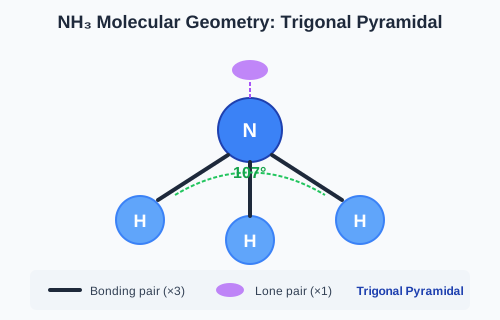
Ammonia’s pyramidal shape is caused by one lone pair pushing the hydrogen atoms down
Drawing the Lewis Structure of NH₃
The Lewis structure is your starting point for determining molecular geometry. Here’s the step-by-step process:
Count Total Valence Electrons
Nitrogen (5) + Hydrogen × 3 (3) = 8 valence electrons
Identify the Central Atom
Nitrogen is the central atom with three hydrogens around it. (Hydrogen can never be central—it only forms one bond.)
Draw Single Bonds
Connect N to each H with single bonds. This uses 6 electrons (2 per bond), leaving 2 remaining.
Place Remaining Electrons on Central Atom
The final 2 electrons form one lone pair on nitrogen. This lone pair is what makes NH₃ pyramidal instead of flat.
💡 Key Insight
Nitrogen has 5 valence electrons. Three go into bonds with hydrogen, leaving 2 electrons as a lone pair. This one lone pair is the key difference between NH₃ (pyramidal) and BF₃ (flat).
VSEPR Theory & Geometry
VSEPR theory predicts geometry based on electron domain repulsion. For NH₃, there’s a critical distinction:
Electron Geometry
Tetrahedral
Considers ALL electron domains
(3 bonding + 1 lone pair = 4)
Molecular Geometry
Trigonal Pyramidal
Considers ONLY bonded atoms
(3 hydrogens visible, lone pair “hidden”)
The four electron domains point toward the corners of a tetrahedron. But since we only “see” the three hydrogen atoms (not the lone pair), the visible shape is a three-sided pyramid with nitrogen at the apex.
Why NH₃ Is Pyramidal, Not Flat
This is the most common point of confusion. BF₃ has 3 bonds and is flat. NH₃ has 3 bonds and is pyramidal. Why?
| BF₃ (Flat) | NH₃ (Pyramidal) | |
|---|---|---|
| Bonds | 3 | 3 |
| Lone pairs on central atom | 0 | 1 |
| Total electron domains | 3 | 4 |
| Electron geometry | Trigonal Planar | Tetrahedral |
| Molecular geometry | Trigonal Planar | Trigonal Pyramidal |
| Bond angle | 120° | 107° |
The bottom line: Don’t count bonds—count electron domains (including lone pairs). BF₃ has 3 domains (flat). NH₃ has 4 domains (tetrahedral electron geometry, pyramidal molecular geometry).
Why 107° and Not 109.5°?
The ideal tetrahedral angle is 109.5°. But lone pairs repel more strongly than bonding pairs (they’re only attracted to one nucleus, not two). The lone pair on nitrogen pushes the N-H bonds closer together, compressing the angle from 109.5° to about 107°.
Hybridization of NH₃
Hybridization is determined by the number of electron domains:
| Electron Domains | Hybridization | Example |
|---|---|---|
| 2 | sp | CO₂, BeCl₂ |
| 3 | sp² | BF₃, SO₃ |
| 4 ← NH₃ | sp³ | CH₄, NH₃, H₂O |
| 5 | sp³d | PCl₅ |
For NH₃: Four electron domains (3 bonds + 1 lone pair) require sp³ hybridization. Nitrogen’s one 2s orbital and three 2p orbitals mix to form four equivalent sp³ hybrid orbitals—three form sigma bonds with hydrogen atoms, and one holds the lone pair.
Polarity Analysis
Ammonia is a classic example of a polar molecule.
Bond Polarity
Each N-H bond is polar because nitrogen (electronegativity 3.04) is more electronegative than hydrogen (2.20). Electrons are pulled toward nitrogen, creating partial charges: δ- on nitrogen, δ+ on each hydrogen.
Molecular Polarity
NH₃ is polar overall because:
- The trigonal pyramidal shape is asymmetric
- All three N-H bond dipoles point generally toward the nitrogen
- The dipoles do not cancel—they add together
- The lone pair contributes additional electron density on the nitrogen side
- Result: a significant net dipole moment pointing from the hydrogens toward the nitrogen
💡 Why Polarity Matters
Ammonia’s polarity allows it to form hydrogen bonds and dissolve in water. This is why ammonia is a gas at room temperature but dissolves readily in water to form ammonium hydroxide (household ammonia).
The Lone Pair Compression Series: CH₄ → NH₃ → H₂O
This is one of the most important patterns in VSEPR theory. All three molecules have tetrahedral electron geometry (4 electron domains), but different numbers of lone pairs create different molecular shapes:
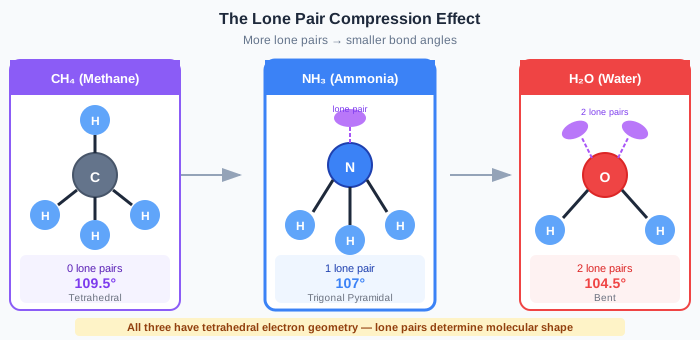
Each additional lone pair compresses the bond angle by about 2.5°
| Molecule | Lone Pairs | Bond Angle | Molecular Geometry |
|---|---|---|---|
| CH₄ | 0 | 109.5° | Tetrahedral |
| NH₃ | 1 | 107° | Trigonal Pyramidal |
| H₂O | 2 | 104.5° | Bent |
💡 The Pattern to Remember
Start with the ideal tetrahedral angle (109.5°). Each lone pair compresses the bond angle by about 2-3°. This is because lone pairs repel more strongly than bonding pairs—they’re attracted to only one nucleus instead of two, so they spread out more and take up more space.
Understanding this series is crucial. If you know NH₃ fits between CH₄ and H₂O, you can predict its geometry and bond angle without memorizing—just count lone pairs.
Common Student Mistakes
❌ Mistake #1: Saying NH₃ is trigonal planar
This ignores the lone pair on nitrogen. Trigonal planar requires 3 electron domains (like BF₃). NH₃ has 4 electron domains, making it trigonal pyramidal.
❌ Mistake #2: Using 120° for the bond angle
That’s the angle for trigonal planar geometry. NH₃ has ~107° bond angles (compressed from 109.5° by the lone pair).
❌ Mistake #3: Saying NH₃ is nonpolar
Trigonal pyramidal geometry is asymmetric, so the bond dipoles don’t cancel. NH₃ is definitely polar.
❌ Mistake #4: Using sp² hybridization
sp² requires 3 electron domains. NH₃ has 4 electron domains (3 bonds + 1 lone pair), so it’s sp³.
❌ Mistake #5: Forgetting the lone pair in the Lewis structure
After drawing 3 N-H bonds (6 electrons), you have 2 electrons left. These form the lone pair on nitrogen—don’t leave it out!
Assignment Due Soon?
We handle ALEKS, MasteringChemistry, and MindTap with guaranteed A/B grades.
Platform-Specific Tips
ALEKS Chemistry
- When drawing the Lewis structure, make sure the lone pair is visible on nitrogen
- For bond angle, enter 107 (ALEKS may also accept 107.5)
- Scroll carefully through geometry options—”trigonal planar” and “trigonal pyramidal” look similar
Pearson MasteringChemistry
- Pay attention to “electron geometry” (tetrahedral) vs “molecular geometry” (trigonal pyramidal)—different answers
- Hybridization is sp³, not sp²
- For polarity, answer “polar” or “yes”
Cengage MindTap
- Spelling matters: “trigonal pyramidal” (not “triangular pyramid”)
- 3D model questions: rotate to see the pyramid shape from the side
- Some questions ask about the dipole moment direction—it points from H atoms toward N
Need help with these platforms? Our experts work with ALEKS Chemistry, MasteringChemistry, and Cengage MindTap daily.
Quick Reference Summary
📐 Geometry
- Electron geometry: Tetrahedral
- Molecular geometry: Trigonal Pyramidal
- Bond angle: 107°
🔬 Structure
- Valence electrons: 8
- Bonding pairs: 3
- Lone pairs: 1
⚗️ Properties
Hybridization: sp³ | Polarity: Polar | Shape: Pyramidal
Test Your Understanding
📝 ALEKS-Style Practice Problem
For the ammonia molecule (NH₃), determine:
- Total number of valence electrons
- Number of bonding pairs and lone pairs on the central atom
- Electron geometry
- Molecular geometry
- Hybridization of the central atom
- Whether the molecule is polar or nonpolar
Click to reveal answer
- Valence electrons: 8 (5 from N + 1 + 1 + 1 from 3 H)
- Bonding pairs: 3 | Lone pairs: 1
- Electron geometry: Tetrahedral (4 electron domains)
- Molecular geometry: Trigonal Pyramidal (3 bonds visible, 1 lone pair hidden)
- Hybridization: sp³ (4 electron domains = 4 hybrid orbitals)
- Polarity: Polar (asymmetric shape, dipoles don’t cancel)
Still confused? Molecular geometry trips up a lot of students. Get help with your chemistry assignment →
📝 Practice Problem #2: Ranking Bond Angles
Rank these molecules in order from largest to smallest bond angle:
H₂O CH₄ NH₃ PH₃
Click to reveal answer
Answer: CH₄ > NH₃ > PH₃ > H₂O
- CH₄: 109.5° (0 lone pairs, ideal tetrahedral)
- NH₃: 107° (1 lone pair compresses angle)
- PH₃: 93° (1 lone pair, but P is larger so bonds are farther apart and lone pair has less effect—actually results in MORE compression due to poor orbital overlap)
- H₂O: 104.5° (2 lone pairs compress further)
Wait—why is PH₃ smaller than H₂O? This is an advanced concept: phosphorus is larger and has poorer s-p orbital mixing, so the bonds have more p-character and compress closer to 90°.
Frequently Asked Questions
What is the molecular geometry of NH₃?
The molecular geometry of NH₃ (ammonia) is trigonal pyramidal. Nitrogen has four electron domains (three bonding pairs and one lone pair), giving tetrahedral electron geometry, but the molecular geometry considering only bonded atoms is trigonal pyramidal with a 107° bond angle.
Why is NH₃ pyramidal but BF₃ is flat?
The difference is lone pairs. BF₃ has zero lone pairs on boron (3 electron domains → trigonal planar). NH₃ has one lone pair on nitrogen (4 electron domains → tetrahedral electron geometry → trigonal pyramidal molecular geometry). The lone pair takes up space and pushes the bonds into a pyramid shape.
What is the bond angle in NH₃?
The H-N-H bond angle in ammonia is approximately 107°. This is less than the ideal tetrahedral angle of 109.5° because the lone pair on nitrogen repels more strongly than bonding pairs, compressing the bond angles.
What is the hybridization of NH₃?
The nitrogen atom in NH₃ uses sp³ hybridization. Four electron domains (3 bonding pairs + 1 lone pair) require four sp³ hybrid orbitals. Three orbitals form N-H bonds, and one holds the lone pair.
Is NH₃ polar or nonpolar?
NH₃ is polar. The trigonal pyramidal shape is asymmetric, and nitrogen is more electronegative than hydrogen, so the bond dipoles don’t cancel. The molecule has a significant dipole moment pointing from the hydrogen atoms toward the nitrogen.
How many lone pairs does NH₃ have?
NH₃ has one lone pair on the central nitrogen atom. After forming three N-H bonds (using 6 of 8 valence electrons), the remaining 2 electrons form one lone pair on nitrogen.
How does NH₃ compare to H₂O?
Both have tetrahedral electron geometry (4 electron domains). NH₃ has 3 bonds + 1 lone pair → trigonal pyramidal (107°). H₂O has 2 bonds + 2 lone pairs → bent (104.5°). More lone pairs = more compression of the bond angle.
Can you help with my NH₃ assignment?
Yes! Finish My Math Class handles chemistry assignments on ALEKS, MasteringChemistry, and Cengage MindTap with guaranteed high grades. We cover Lewis structures, VSEPR theory, molecular geometry, and all General Chemistry topics.
Related Resources
The Lone Pair Series
- H₂O Molecular Geometry — The next step: 2 lone pairs create bent shape (104.5°)
- CO₂ Molecular Geometry — Linear with no lone pairs (180°)
- SO₃²⁻ Molecular Geometry
Chemistry Help
Struggling with Chemistry?
We complete ALEKS, MasteringChemistry, and MindTap assignments with guaranteed high grades.