
The Sigma Symbol: Σ and σ Explained
Sigma is the eighteenth letter of the Greek alphabet and one of the most frequently misread symbols in undergraduate math and science. Uppercase Σ means summation — it tells you to add up a series of terms according to a rule. Lowercase σ means standard deviation — it measures how spread out a set of values is around a mean. These two uses are unrelated, and confusing them is one of the most common mistakes students make when moving between algebra, calculus, and statistics. This guide covers both forms, where each appears, and how to use them correctly.
Quick Answer
Σ (uppercase): Summation. Σxᵢ from i=1 to n means add up x₁ + x₂ + … + xₙ. Used in algebra, calculus (Riemann sums), and statistics (formulas for mean and variance).
σ (lowercase): Population standard deviation. Measures how far values in a dataset spread from the mean. σ² is the population variance. In physics and engineering, σ also means stress or electrical conductivity depending on context.
s vs σ: When you have sample data, you use s (not σ) for standard deviation. σ is reserved for the entire population.
On This Page
1) What Is the Sigma Symbol?
Sigma (Σ, σ) is a Greek letter that carries two distinct and unrelated meanings in mathematics. Uppercase Σ is a compact instruction to perform repeated addition. Lowercase σ is a measure of variability. A student who encounters both symbols in the same statistics course — which is common — needs to know immediately from context which meaning applies.
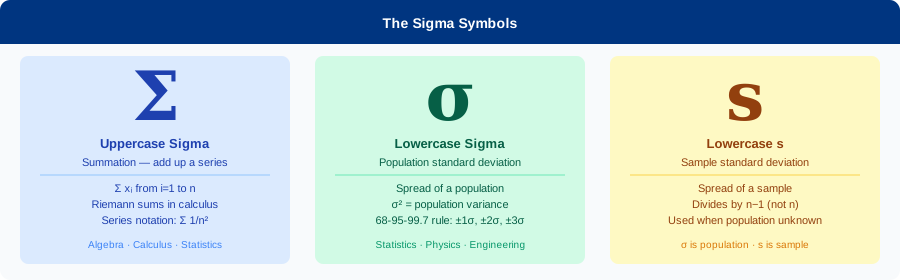
A third form, the terminal sigma (ς), is used in Greek text when sigma appears at the end of a word. It has no mathematical meaning and you will not encounter it in coursework. The two forms that matter for math and science are Σ and σ.
2) A Brief History of Sigma
Sigma derives from the Phoenician letter shin and was adopted into the Greek alphabet as the eighteenth letter. Its shape evolved over centuries — the uppercase form Σ (also called lunate sigma in some historical texts) retained its angular appearance, while the lowercase σ developed into its curved modern form.
The use of Σ for summation was introduced by Leonhard Euler in the 18th century as part of his systematic notation for infinite series. Euler recognized that mathematicians needed a compact symbol for “add up a sequence of terms,” and the capital sigma — the Greek equivalent of S for “sum” — was the natural choice. The notation spread rapidly through European mathematics and has remained standard ever since.
The use of σ for standard deviation was introduced by Karl Pearson in 1894 as part of his foundational work in statistics. Pearson chose lowercase sigma to denote the spread of a frequency distribution, and the notation was quickly adopted across the emerging field of mathematical statistics. Today σ and its sample counterpart s are among the most recognized symbols in any introductory statistics course.
3) Uppercase Sigma (Σ): Summation Notation
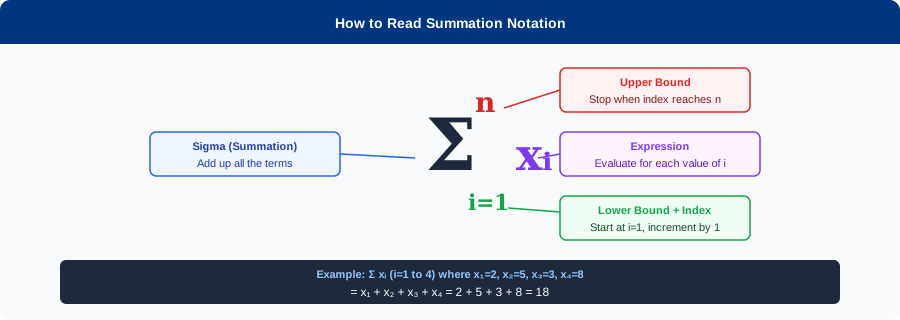
Summation notation is a compact way to write a sum with many terms. Instead of writing x₁ + x₂ + x₃ + x₄ + x₅, you write Σxᵢ with bounds specifying where to start and stop. The notation has four components, and misreading any one of them leads to the wrong answer.
Reading the notation step by step
The index variable (i, j, k, or any letter) appears below the Σ next to its starting value (e.g., i=1). The upper bound appears above the Σ (e.g., n or a specific number). The expression to the right tells you what to evaluate at each step. You substitute i=1, compute the expression, then i=2, compute again, and continue until you reach and include the upper bound — then add all the results together.
Common summation rules
Several summation identities appear repeatedly in calculus and statistics courses. The sum of a constant c from i=1 to n equals cn. The sum of i from i=1 to n equals n(n+1)/2. The sum of i² from i=1 to n equals n(n+1)(2n+1)/6. These formulas come up directly in Riemann sum calculations and in deriving the formulas for mean and variance from first principles. For help with algebra coursework involving summation, see our algebra help page.
The lower bound is not always 1
Students habitually assume i starts at 1 because most textbook examples start there. But lower bounds can be 0, 2, any integer — and starting in the wrong place produces a completely wrong sum. Always read the lower bound explicitly before expanding.
4) Lowercase Sigma (σ): Standard Deviation
Lowercase σ is the population standard deviation. It quantifies how spread out the values in a population are around the population mean μ. A small σ means values cluster tightly around the mean. A large σ means they are widely dispersed. The formula is:
You subtract the mean from each value, square the result, average those squared differences, and take the square root. The squaring step ensures that values above and below the mean do not cancel each other out. The square root brings the units back to the same scale as the original data.
Population σ versus sample s
The formula above uses N (the total population size) in the denominator. When you have sample data rather than the full population, you use s instead of σ, and the denominator becomes n−1 rather than n. This adjustment — called Bessel’s correction — compensates for the fact that a sample tends to underestimate the true spread of the population. The distinction between σ and s is tested directly on most introductory statistics exams. If you see population data, use σ and N. If you see sample data, use s and n−1.
Variance
The population variance is σ² — the standard deviation squared. Variance is in squared units (e.g., dollars² if the original data is in dollars), which makes it harder to interpret directly. Standard deviation σ is preferred for communication because it is in the same units as the data. Variance is preferred for mathematical derivations because its algebraic properties are cleaner.
5) Sigma Notation in Calculus
Sigma notation is the foundation of integral calculus. The definite integral is defined as the limit of a Riemann sum — a sum of rectangle areas under a curve — as the number of rectangles approaches infinity and their width approaches zero.
A right Riemann sum with n rectangles over [a, b] is written as Σ f(xᵢ)·Δx from i=1 to n, where Δx = (b−a)/n and xᵢ = a + i·Δx. As n → ∞, this sum converges to the definite integral ∫f(x)dx from a to b. Understanding this connection — that integration is the limit of a sigma sum — is what ties algebra notation to calculus and makes the fundamental theorem of calculus intuitive rather than arbitrary.
Sigma also appears throughout series and sequences in Calculus II. A geometric series is written as Σ arⁿ from n=0 to ∞. A Taylor series is written as Σ f⁽ⁿ⁾(a)/n! · (x−a)ⁿ from n=0 to ∞. The convergence tests (ratio test, integral test, comparison test) all apply to series expressed in Σ notation. For help with calculus coursework, see our calculus help page.
Riemann sum setup is where most students lose points
The most common errors are using the wrong Δx, starting the index at the wrong end (left vs. right endpoints), and forgetting to multiply f(xᵢ) by Δx. Write out the first two terms explicitly before collapsing into sigma notation — it catches most mistakes immediately.
6) Sigma in Statistics
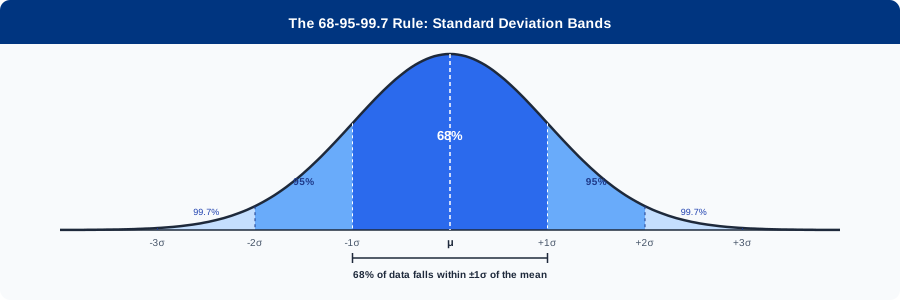
In statistics, σ is most visible through the normal distribution and the empirical rule. A normal distribution is fully described by two parameters: the mean μ (center) and the standard deviation σ (spread). Every statistical inference about a normally distributed population involves σ in some form.
The empirical rule (68-95-99.7)
For any normally distributed population, approximately 68% of values fall within one standard deviation of the mean (between μ−σ and μ+σ), approximately 95% fall within two standard deviations, and approximately 99.7% fall within three standard deviations. This rule is used to make quick probability estimates without consulting a table. If a test score distribution has μ=75 and σ=8, you can immediately say that about 68% of students scored between 67 and 83.
Z-scores
A z-score converts a raw data value to the number of standard deviations it sits away from the mean: z = (x − μ) / σ. A z-score of 0 means the value equals the mean. A z-score of 2 means the value is two standard deviations above the mean. Z-scores allow comparison across different distributions and are the basis for all standard normal probability calculations using z-tables or software.
Example: A student scores 82 on an exam where the class mean is μ = 75 and the standard deviation is σ = 8. Their z-score is z = (82 − 75) / 8 = 7/8 = 0.875. This means the student scored about 0.875 standard deviations above the mean — a solid performance, but not exceptional. A score of 91 would yield z = 2.0, placing the student in roughly the top 2.3% of the class.
Six Sigma
Six Sigma is a process improvement methodology used in business and manufacturing. The name comes directly from statistics: a process operating at six sigma quality produces fewer than 3.4 defects per million opportunities, meaning virtually all output falls within six standard deviations of the target mean. The methodology uses σ as its benchmark for process consistency — the higher the sigma level, the tighter and more reliable the process. Students who encounter “Six Sigma” in a business or operations course are seeing the same σ from statistics applied as a quality standard.
Sigma in formulas
Uppercase Σ appears directly inside the formulas for σ itself: σ = √[Σ(xᵢ − μ)²/N]. It also appears in the formula for sample mean: x̄ = Σxᵢ/n. In regression, the sum of squared residuals is written as Σ(yᵢ − ŷᵢ)². Virtually every descriptive and inferential statistics formula contains Σ somewhere in its derivation, making summation notation fluency a prerequisite for upper-division statistics. For help with statistics coursework across all platforms, see our statistics help page. If your course runs on ALEKS, see our ALEKS answers page; if it runs on MyMathLab or MyStatLab, see our MyMathLab answers page.
7) Sigma in Physics and Engineering
In physics and engineering, lowercase σ takes on additional meanings that are entirely separate from standard deviation. The correct interpretation depends entirely on the subject area.
| Field | Symbol | Meaning | Example |
|---|---|---|---|
| Mechanics | σ | Normal stress (force per unit area) | σ = F/A (Pa or psi) |
| Electromagnetism | σ | Electrical conductivity | J = σE (S/m) |
| Thermodynamics | σ | Stefan-Boltzmann constant | P = σT⁴ (blackbody radiation) |
| Nuclear Physics | σ | Cross section (interaction probability) | Measured in barns (10⁻²⁴ cm²) |
In all of these physics uses, σ is a specific physical quantity with units — not a statistical measure of spread. The Stefan-Boltzmann constant is a fixed value (5.67×10⁻⁸ W/m²K⁴). Electrical conductivity is a material property measured in siemens per meter. Stress is force divided by area. Context and units are the clearest way to identify which σ is in play. For help with physics coursework, see our physics help page.
8) Unicode and Encoding Reference
Need to type a sigma symbol in a document, equation editor, or code file? Here is every format you are likely to need.
| Symbol | Name | Unicode | HTML Entity | LaTeX |
|---|---|---|---|---|
| Σ | Capital Sigma | U+03A3 | Σ | \Sigma |
| σ | Lowercase Sigma | U+03C3 | σ | \sigma |
| ς | Terminal Sigma | U+03C2 | ς | \varsigma |
Keyboard shortcuts
Windows: In Microsoft Word, type 03A3 then press Alt + X to get Σ, or 03C3 + Alt + X for σ. Alternatively, Insert > Symbol > Greek alphabet.
Mac: Control + Command + Space opens the character viewer — search “sigma” to find all forms. The Greek keyboard layout also works.
LaTeX: Use \Sigma for Σ and \sigma for σ inside math mode. For the summation operator with bounds, use \sum_{i=1}^{n}.
9) How FMMC Can Help
Whether sigma is showing up as a summation operator in College Algebra, a Riemann sum in Calculus, standard deviation in Statistics, or stress in a Physics course, FMMC’s experts cover every subject and every platform. We handle full courses and individual assignments, backed by an A/B grade guarantee.
Algebra
Summation notation, series, sequences. Algebra help →
Calculus
Riemann sums, series convergence, integrals. Calculus help →
Statistics
Standard deviation, z-scores, inference. Statistics help →
Physics
Stress, conductivity, thermodynamics. Physics help →
Stuck on a sigma problem right now? Tell us your course, platform, and what you are working on.
Also on FMMC
If you found this page while researching Greek letters in math more broadly, see our delta symbol guide for coverage of Δ, δ, and ∇.
FAQ
What does Σ mean in math?
Σ (uppercase sigma) means summation — it is an instruction to add up a series of terms. The expression below Σ gives the index variable and its starting value, the expression above gives the stopping value, and the expression to the right gives what to compute at each step. For example, Σxᵢ from i=1 to n means add up x₁ + x₂ + … + xₙ.
What does σ mean in statistics?
In statistics, σ (lowercase sigma) is the population standard deviation. It measures how spread out the values in a population are around the population mean μ. The formula is σ = √[Σ(xᵢ − μ)²/N]. A small σ means values cluster tightly around the mean; a large σ means they are widely dispersed.
What is the difference between σ and s?
σ is the population standard deviation and uses N (the full population size) in its denominator. s is the sample standard deviation and uses n−1 in its denominator. This n−1 adjustment (Bessel’s correction) prevents the sample statistic from systematically underestimating the true population spread. Use σ when you have data for the entire population; use s when you have a sample.
What is the 68-95-99.7 rule?
The empirical rule states that for a normally distributed population, approximately 68% of values fall within one standard deviation of the mean (μ ± σ), approximately 95% fall within two standard deviations (μ ± 2σ), and approximately 99.7% fall within three standard deviations (μ ± 3σ). It allows quick probability estimates without consulting a z-table.
How do you read summation notation?
Start with the lower bound below Σ to find the index variable and its starting value. Read the upper bound above Σ for the stopping value. Read the expression to the right of Σ for what to compute. Substitute each integer value of the index from start to stop, compute the expression each time, and add all results together. Always check the lower bound — it is not always 1.
What is a Riemann sum and how does Σ relate to integration?
A Riemann sum approximates the area under a curve by dividing the interval into n rectangles, computing the area of each (height × width = f(xᵢ) × Δx), and adding them with Σ. As n approaches infinity and the rectangle width Δx approaches zero, the Riemann sum converges to the definite integral. This is the formal definition of integration, and it shows that Σ (finite sum) and ∫ (integral) are the same concept at different scales.
What does σ mean in physics?
In physics, σ has several meanings depending on the field: normal stress (force per unit area, σ = F/A) in mechanics, electrical conductivity in electromagnetism, the Stefan-Boltzmann constant in thermodynamics (P = σT⁴), and nuclear cross section in particle physics. None of these are related to the statistical meaning of σ as standard deviation.
How do I type the sigma symbol?
In Microsoft Word, type 03A3 then press Alt + X for Σ, or 03C3 + Alt + X for σ. On Mac, use Control + Command + Space and search “sigma.” In LaTeX, use \Sigma for Σ and \sigma for σ inside math mode; for the summation operator with bounds use \sum_{i=1}^{n}. Unicode code points are U+03A3 for Σ and U+03C3 for σ.
Stuck on a Course That Uses Sigma?
Whether it’s summation notation in Algebra, Riemann sums in Calculus, or standard deviation in Statistics — FMMC’s experts handle it. A/B guaranteed or your money back.
Or email: info@finishmymathclass.com • A/B Guarantee • Delta Symbol Guide