

The Ultimate Guide to the Delta Symbol: Δ, δ, ∇ in Math, Science, and Tech
Quick Answer
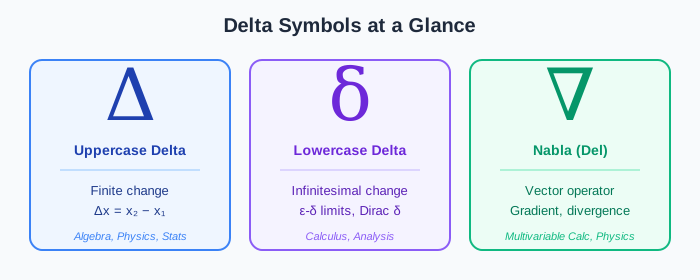
The delta symbol (Δ) means "change" or "difference" in math and science. Uppercase Δ represents finite change (like Δx = x₂ − x₁). Lowercase δ represents infinitesimal change (used in calculus limits). Nabla (∇) is the vector differential operator for gradient and divergence — not technically delta, but often confused with it.
The delta symbol (Δ) might look simple, but it has a powerful presence across mathematics, science, engineering, computer science, and even philosophy. Whether it's representing change, denoting partial derivatives, or labeling a triangle in geometry, this little triangle packs a punch.
This guide breaks down everything you need to know about delta — in all its forms.
📑 Table of Contents
What Is the Delta Symbol?
At its core, the delta symbol (Δ or δ) represents change or difference. It's derived from the Greek alphabet, where Δ (uppercase) is the fourth letter. In mathematical contexts, it usually signals a difference between two values — such as Δx = x₂ − x₁.
But depending on the discipline, the meaning shifts dramatically. Here's the breakdown:
- Δ (uppercase delta): Finite change in variables, discriminants in algebra
- δ (lowercase delta): Small/infinitesimal changes in calculus, Kronecker delta, Dirac delta
- ∇ (nabla): Vector differential operators — gradient, divergence, curl
Struggling to keep these straight in your coursework? You're not alone. Get expert help with delta-related problems on any platform.
A Brief History of Delta
The delta symbol originates from the Greek alphabet, where it's the fourth letter — derived from the Phoenician letter "dalet." Its triangular shape made it a natural fit for geometry and measurement.
By the 17th–18th century, European mathematicians began using Δ systematically to express change, difference, and variation. The usage evolved further in physics, chemistry, and engineering, where delta became shorthand for shifts, transitions, and differentials.
Today, delta exists not only in textbooks but also in digital software, coding syntax, and even popular culture — as a general emblem of transformation.
Uppercase Delta (Δ) in Mathematics
Capital delta (Δ) typically represents a finite change in a variable:
This notation shows up in:
- Algebra: Change in x or y between two points on a graph
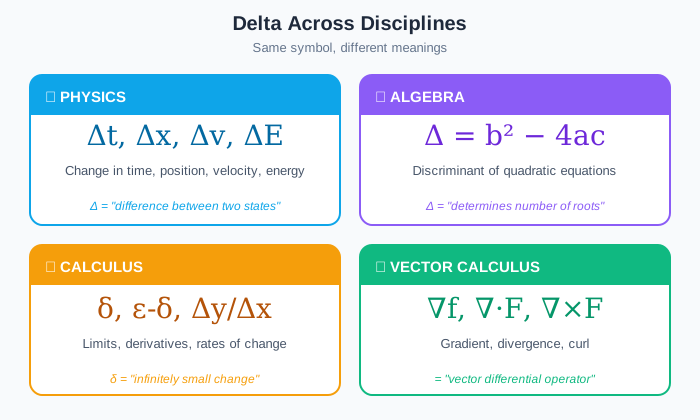
- Physics: Δt (time), Δv (velocity), ΔE (energy)
- Statistics: Δμ or Δσ for change in mean or standard deviation
Remember: uppercase delta (Δ) refers to finite, measurable differences — as opposed to infinitesimal ones (which use lowercase δ).
Lowercase Delta (δ) in Mathematics
The lowercase delta (δ) represents small changes — especially in calculus and analysis:
- Limits & Continuity: In epsilon-delta (ε-δ) definitions, δ defines the neighborhood around a point
- Dirac Delta Function: δ(x) models an impulse at a single point — used in physics and signal processing
- Kronecker Delta: δᵢⱼ equals 1 when i = j, 0 otherwise — used in linear algebra
Unlike Δ, which represents a clearly defined numerical change, δ is often used in abstract definitions to establish conditions for convergence, sensitivity, or exactness.
If ε-δ proofs are making your head spin, you're in good company. Get calculus help from experts who actually understand limits.
Nabla (∇): The Upside-Down Delta
The upside-down delta (∇), called nabla or del, is a different character entirely. In multivariable calculus, it denotes vector differential operators:
- Gradient: ∇f — the vector of partial derivatives of a scalar function
- Divergence: ∇·F — measures the magnitude of a source or sink in a vector field
- Curl: ∇×F — measures the rotation or swirling strength of a vector field
These operations are foundational in electromagnetism, fluid dynamics, and quantum mechanics. If you're seeing ∇ in your homework, you're likely in Calculus III or a physics course.
Need help with vector calculus? We've got you covered.
Delta in Algebra: The Discriminant
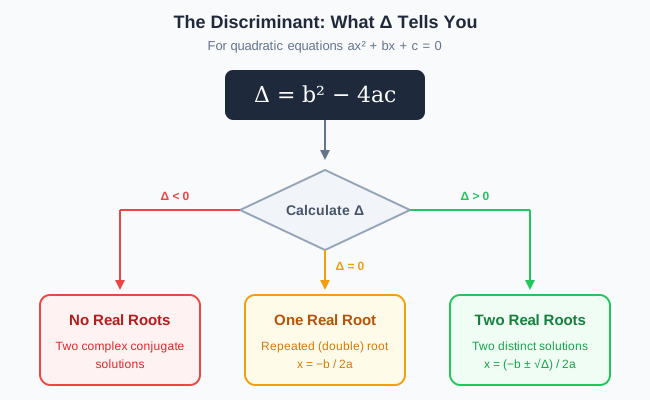
In algebra, Δ most commonly appears as the discriminant of a quadratic equation:
The discriminant tells you how many real solutions the equation ax² + bx + c = 0 has:
This is one of the most tested concepts in College Algebra and Precalculus. If quadratics are giving you trouble, our algebra experts can help.
Delta in Calculus
In calculus, delta plays a critical role in understanding rates of change:
| Symbol | Meaning | Usage |
|---|---|---|
| Δx | Finite change in x | Average rate of change |
| δx | Infinitesimally small change | ε-δ limit definitions |
| Δy / Δx | Slope of secant line | Average rate of change |
| dy/dx | Derivative | Instantaneous rate of change |
The transition from Δy/Δx to dy/dx is the conceptual leap that defines calculus. As Δx approaches zero, the average rate of change becomes the instantaneous rate — the derivative.
Derivatives, limits, and ε-δ proofs causing problems? Get calculus homework help with guaranteed grades.
Delta in Statistics
In statistics, Δ and δ represent changes or differences in parameters:
- Difference Between Means: Δμ = μ₁ − μ₂
- Effect Size: Cohen's d expresses the standardized difference between means
- Delta Method: A technique for approximating distributions of functions using Taylor expansions
Lowercase δ may also be used for threshold values in hypothesis testing or sensitivity coefficients in experimental design.
Statistics homework piling up? Our stats experts can handle MyStatLab, ALEKS, and more.
Delta in Physics and Engineering
In physics and engineering, delta (Δ) is everywhere. It signals change over time or difference in measurement:
| Symbol | Meaning | Example |
|---|---|---|
| Δt | Change in time | Δt = t₂ − t₁ |
| Δx | Displacement | Δx = x_final − x_initial |
| Δv | Change in velocity | a = Δv / Δt |
| ΔE | Change in energy | Work-energy theorem |
| ΔT | Change in temperature | Q = mcΔT (heat transfer) |
Engineering also uses Δ in structural analysis (deflection), circuit theory (voltage drop), and thermodynamics (entropy change).
Physics equations tripping you up? Get physics homework help from real experts.
Unicode & Encoding Table
Need to type delta symbols? Here's everything you need:
| Symbol | Name | Unicode | HTML | LaTeX |
|---|---|---|---|---|
| Δ | Capital Delta | U+0394 | Δ | \Delta |
| δ | Lowercase Delta | U+03B4 | δ | \delta |
| ∇ | Nabla | U+2207 | ∇ | \nabla |
Keyboard shortcuts:
- Windows: Alt + 916 (Δ) or Alt + 235 (δ)
- Mac: Control + Command + Space → search "delta"
- Word: Type 0394, then press Alt + X for Δ
Frequently Asked Questions
What does Δ mean in math?
In math, Δ (uppercase delta) generally means "change" or "difference." For example, Δx = x₂ − x₁ represents the change in x between two values. In algebra, Δ also represents the discriminant of a quadratic equation (Δ = b² − 4ac).
What is the difference between Δ and δ?
Δ (uppercase) represents a finite, measurable change — like the difference between two points. δ (lowercase) represents an infinitesimally small change, used in calculus for limits and epsilon-delta proofs. Both come from the Greek alphabet but serve different mathematical roles.
What is ∇ and how is it different from Δ?
∇ (nabla) is a vector differential operator used in multivariable calculus for gradient (∇f), divergence (∇·F), and curl (∇×F). While it looks like an upside-down delta, it serves a completely different purpose — performing differentiation rather than indicating change.
What is the discriminant Δ = b² − 4ac?
The discriminant tells you how many real solutions a quadratic equation has. If Δ > 0, there are two real roots. If Δ = 0, there is one repeated root. If Δ < 0, there are no real roots (two complex conjugate solutions).
How is delta used in physics?
In physics, Δ indicates change in physical quantities: Δt (change in time), Δx (displacement), Δv (change in velocity), ΔE (change in energy), and ΔT (change in temperature). It's fundamental to kinematics, thermodynamics, and mechanics.
What is the epsilon-delta definition of a limit?
In calculus, the ε-δ definition formally defines what it means for a function to approach a limit. ε (epsilon) represents how close f(x) must be to L, and δ (delta) represents how close x must be to c. It's a rigorous way to prove limits exist.
How do I type the delta symbol?
On Windows, use Alt + 916 for Δ or Alt + 235 for δ. On Mac, use Control + Command + Space and search "delta." In LaTeX, use \Delta for uppercase and \delta for lowercase. Unicode values are U+0394 (Δ) and U+03B4 (δ).
Where can I get help with delta-related math problems?
If you're struggling with problems involving Δ, δ, or ∇ — whether in algebra, calculus, statistics, or physics — Finish My Math Class offers expert homework help with A/B grades guaranteed on all major platforms.
Need Help With Delta Problems?
Algebra, calculus, stats, physics — we cover it all.