

Trigonometry in Chemistry: Orbitals, Angles, and Crystals
How sine and cosine explain bond angles, orbital shapes, and X-ray diffraction
Quick Answer
Trigonometry isn’t just triangles — in chemistry, sine and cosine explain why tetrahedral angles are 109.5°, how orbital wavefunctions create nodal planes, and how X-rays reveal crystal structures through Bragg’s law (nλ = 2d sin θ). If you’re dealing with bond angles, VSEPR geometry, or diffraction problems, trig is the underlying math.
📑 Table of Contents
Why Trigonometry Shows Up in Chemistry
Chemistry is inherently three-dimensional. Molecules have shapes, bonds have angles, and crystals have repeating geometric patterns. Trigonometry provides the mathematical tools to describe and calculate these spatial relationships.
| Application | What Trig Does | Example |
|---|---|---|
| Bond Angles | Calculates 3D angles between bonds | Tetrahedral 109.5°, octahedral 90° |
| Orbitals | Describes angular parts of wavefunctions | p-orbital nodal planes |
| Crystals | Relates diffraction angles to atomic spacing | Bragg’s law (nλ = 2d sin θ) |
Need a geometry refresher first? Start with our Geometry in Chemistry guide for foundational concepts.
Bond Angles & VSEPR (Beyond Memorization)
VSEPR theory tells you what the shapes are. Trigonometry explains why the angles are what they are.
For a tetrahedron, the 109.5° bond angle isn’t arbitrary — it comes directly from vector geometry. If you place a central atom at the origin with four bonds pointing to the vertices of a regular tetrahedron, the angle between any two bonds can be calculated using the dot product.
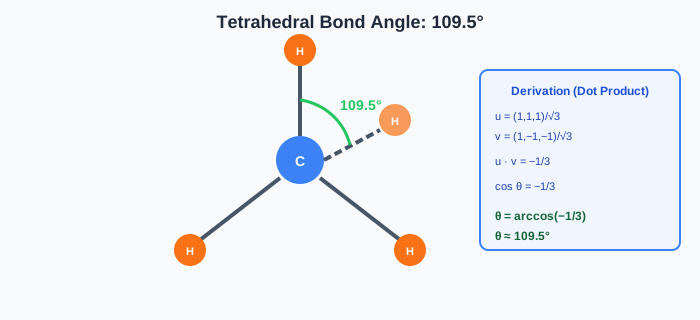
The Derivation
| Step | Calculation | Result |
|---|---|---|
| Pick unit vectors to two vertices | u = (1,1,1)/√3 and v = (1,−1,−1)/√3 | Bond directions |
| Apply dot product | u·v = (1×1 + 1×(−1) + 1×(−1))/3 = −1/3 | cos θ = −1/3 |
| Solve for angle | θ = arccos(−1/3) | θ ≈ 109.5° |
This approach works for any molecular geometry. The same dot product method gives you 120° for trigonal planar, 90° for octahedral equatorial angles, and so on.
Related: For a specific example, see our guide on the molecular geometry of SO₃²⁻.
Trig and Molecular Orbitals
Atomic orbital shapes depend on angular functions involving sine and cosine (the spherical harmonics). Without diving into full quantum mechanics, you can understand the key ideas:
| Concept | Trig Connection |
|---|---|
| Nodal Planes | Regions where wavefunction = 0. For p-orbitals, the nodal plane through the nucleus corresponds to where sin or cos terms equal zero. |
| Angular Dependence | Orbital “lobes” and “nodes” reflect the angular part of wavefunctions, which contain sin θ and cos θ terms. |
| Hybridization Geometry | sp, sp², sp³ orientations can be understood through vector angles and the same dot product approach used for bond angles. |
Bragg’s Law in X-ray Crystallography
When X-rays reflect off parallel planes of atoms in a crystal, constructive interference occurs at specific angles. This relationship is described by Bragg’s Law:
nλ = 2d sin θ

| Symbol | Meaning |
|---|---|
| n | Order of reflection (integer: 1, 2, 3…) |
| λ | X-ray wavelength |
| d | Interplanar spacing (distance between crystal planes) |
| θ | Bragg angle (between incident beam and crystal plane) |
Worked Example
Given: λ = 1.541 Å (Cu Kα radiation), first order (n = 1), θ = 20.0°. Find d.
d = nλ / (2 sin θ)
d = (1 × 1.541 Å) / (2 × sin 20.0°)
d = 1.541 / (2 × 0.342)
d = 2.25 Å (3 sig figs)
Practice Problems
- Tetrahedral angle: Show that the ideal bond angle is arccos(−1/3). Give the numerical value to 1 decimal place.
- Trigonal bipyramidal: What are the equatorial–equatorial and axial–equatorial angles?
- Bragg’s law: λ = 1.000 Å, θ = 30.0°, n = 1. Calculate d.
- Orbitals: A p-orbital has a nodal plane containing the nucleus. What trig concept explains why the probability density is zero there?
- Calculator check: If sin(30) returns 0.5, are you in degrees or radians mode? What would sin(30) return in the wrong mode?
Show Solutions
- Using dot product with symmetric direction vectors: cos θ = −1/3 → θ = arccos(−1/3) = 109.5°
- Equatorial–equatorial = 120°; axial–equatorial = 90°
- d = nλ/(2 sin θ) = 1.000 / (2 × 0.5) = 1.000 Å
- The angular part of orbital wavefunctions contains sine/cosine terms. Zeros of these functions define nodal planes where probability density is zero.
- Degrees mode. In radians, sin(30 rad) ≈ −0.988.
Common Mistakes
| Mistake | Fix |
|---|---|
| Degrees vs radians confusion | Check calculator mode before every calculation. Annotate angles with ° symbol. |
| Wrong θ in Bragg’s law | θ is the angle between beam and lattice plane (Bragg angle), not always the detector angle. |
| Memorizing instead of deriving | Use dot products to verify angles — don’t rely on memory alone. |
| Rounding too early | Carry extra digits through calculations; round only at the end. |
Platform Notes
Trig appears in orbital geometry and vector problems. Knowledge Checks can reset progress if angle concepts are missed.
Expect Bragg’s law calculations and 3D angle problems. Watch for significant figure requirements.
Bond-angle quizzes penalize degree/radian errors heavily. Verify calculator mode before submitting.
Frequently Asked Questions
Why is trigonometry needed in chemistry?
3D angles and distances govern molecular geometry, orbital shapes, and diffraction. Trig provides the mathematical language to compute bond angles, understand orbital nodal planes, and analyze crystal structures using X-ray diffraction.
How does Bragg’s law use sinθ?
Bragg’s law (nλ = 2d sinθ) describes constructive interference when the path length difference between X-rays reflecting off parallel crystal planes equals an integer number of wavelengths. The sinθ term relates the incident angle to the geometry of reflection.
Where does the 109.5° tetrahedral angle come from?
Using the dot product of two bond direction vectors pointing from the center to vertices of a regular tetrahedron gives cos θ = −1/3. Solving for θ: arccos(−1/3) ≈ 109.5°.
Do I need trig for ALEKS Chemistry?
Not heavily, but angles, vectors, and some orbital modules benefit from trig knowledge—especially for geometry justification. Understanding why angles are what they are helps with VSEPR questions.
What’s the most common trig mistake in chemistry?
Degrees vs radians mode confusion. If your calculator is in radians and you enter sin(30) expecting 0.5, you’ll get sin(30 rad) ≈ −0.988 instead. Always verify your calculator mode matches the problem requirements.